
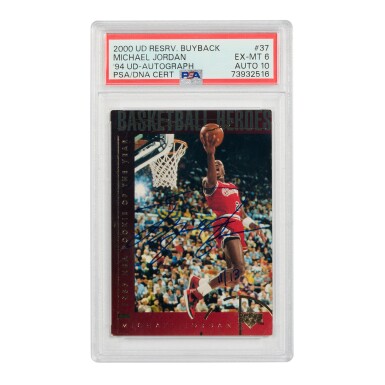
Michael Jordan 2000-01 Upper Deck Reserve Buyback “1994 Upper Deck Jordan Heroes” Autograph 11/13 #37 PSA 6 & PSA/DNA 10 | On-Card Autograph
Auction Closed
September 30, 11:40 PM GMT
Estimate
Upon Request
Lot Details
Description
Professional Sports Authenticator, PSA, 6 Excellent-Mint & PSA/DNA Autograph 10, sealed plastic holder, Cert number: 73932516
Cardboard and Plastic
The beginning of the aughts saw a trading card hobby that had undergone dramatic changes over the past decade. Exiting a period known affectionately by many hobbyists as the “junk wax era,” various trading card makers were now utilizing new technologies, pack-pulled autographs, cards that included game-worn pieces of memorabilia, and serialized cards to entice collectors old and new into a space that continued to offer standard trading card offerings while introducing the chance to bring collectors closer to their favorite sports and athletes than many could ever be.
For basketball card manufacturers, this period had the good fortune to coincide with a period of historically great NBA players who were also major pop culture icons. At the top of the list, as well as at the top of many fans’ greatest of all time lists, sat none other than Michael Jordan.
Michael Jordan’s ascendance as a global superstar coincided with this trading card renaissance, and manufacturers used this fortuitous fact to full effect. Jordan was at the heart of most major releases throughout the decade, even during his brief retirement from 1993-1995. From the first basketball refractor released in 1993-94 Finest and career retrospectives released when the NBA world thought Jordan had quit for good to Precious Metal Gems and 1-of-1s released in the heart of Jordan’s second three-peat that showed fans he very much was not, Jordan was central to many new releases.
As the decade progressed and Jordan neared his second retirement, another trading card phenomenon became more prevalent: buyback autographs. Often limited to a very small number, these cards allowed manufacturers to revisit and reinvigorate fan favorite designs with a new chase factor, namely the autograph of the featured player while keying in on the nostalgia for players and sets that has built up over time. Upper Deck produced some of its earliest buybacks in 1997-98 SP, and the tradition has carried on for decades since. Holding exclusive trading card autograph rights for Jordan and being a key industry innovator, Upper Deck has stood especially to gain from this configuration.
That is where this card shines. This buyback, offered in 2000-01, was a rare pull that in many ways encapsulated Jordan’s entire career to that point. The card depicts Jordan as an energetic and majestically athletic rookie competing in his first of three dunk contests, wearing the famous script Chicago Bulls jersey with gold chains and wearing red and black Air Jordans just weeks before they became available to the public and took the world by storm. The card itself was released in the midst of Jordan’s first retirement as part of a continuation of a series called “Basketball Heroes” from previous seasons, which included legends that had carried the game forward. The autograph was added in the heart of his second retirement, perhaps as the inkling of possibly making one more run in the NBA began entering his mind. To top it all off, the card is numbered to the exact number of seasons that he had played with his beloved Bulls: 13. This card is fortuitously serialized to perhaps the best of those seasons for Jordan and the Bulls, perhaps the best for any basketball team ever assembled: the Bulls’ record-setting 72-10 championship season. For many, trading cards serve as an encapsulation of time: a moment of pure ecstasy or deep connection with a team or player and those you are watching them with, the encapsulation of a broader cultural moment, and even the encapsulation of an entire career and how it shaped the sport and one’s own understanding of it. For an encapsulation of the greatest years played by perhaps the most consequential player to ever step foot on the hardwood, it is hard to imagine a more fitting example than this.
Buyback autographs are exceptionally rare in 2000-01 Upper Deck Reserve, falling only once in every 239 packs. With a checklist containing more than 40 entries, the chances of pulling this card are almost impossibly narrow. This card has been authenticated and deemed to be in Excellent-Mint condition, receiving a grade of 6 from Professional Sports Authenticator (PSA) and an autograph grade of Gem Mint 10 from PSA/DNA. A holographic Upper Deck Certificate of Authenticity is affixed to the back of the card, with UDA Serial #00005030. This example is among the finest available: at the time of cataloging, of the four examples graded by PSA with an autograph assessed by PSA/DNA, only one has received a higher card grade.
The PSA certificate number for this card is: 73932516.
Going Deeper - Michael Jordan: The Early Years
One of the most important sporting careers in history began when the freshly minted NBA Commissioner David Stern simply read: “The Chicago Bulls pick Michael Jordan out of the University of North Carolina.” Neither man knew it yet, but before Jordan hung up his sneakers for the last time, he would help complete the transformation of the NBA from a league struggling for live tv coverage to a global sports and pop culture superpower.
After winning gold in the 1984 Olympics, Jordan joined a team that had only made the playoffs three times in the last 10 seasons. They would not miss them again for 15 years and in that time, Jordan became a global superstar.
Just weeks after his NBA debut ushered in a paradigm shifting era in the NBA and sport of basketball as a whole, the third overall pick in the 1984 NBA Draft showed off to the world for the first time a pair of shoes that would redefine sneakers, fashion, and collecting as we know it and would ultimately help make their namesake a billionaire: the Air Jordan. Ahead of their April release, Jordan took to the dunk contest stage in a pair featuring the red and black colorway, still banned from NBA games, and a matching tracksuit. Combined with his gold chains, Jordan put on a show and brought demand for the shoes to a fever pitch.
On April 1, 1985, the Air Jordan I became available to the public, and a cultural phenomenon began that is still yet to dissipate. A shoe that Nike hoped would bring in $3 million ended up bringing in over $100 million by the end of 1985, and the iconic jumpman etched itself into the public consciousness.
Jordan’s playoff prowess was on near instant display with his 63-point outburst against the Celtics in the first round of the ‘86 playoffs, and Jordan would continue to deliver historic performances throughout the decade. Jordan appeared destined to reach the NBA summit in the near future, winning both MVP and Defensive Player of the Year honors in 1988 and welcoming the addition of future hall of fame teammate and longtime partner Scottie Pippen, however one foe stood in his way.
While Jordan was receiving the adulation of many of his NBA peers, the Detroit Pistons bestowed a different, more punishing form of praise on him: The Jordan Rules. A physical defensive scheme specifically designed to neutralize Jordan’s otherworldly talents, the Pistons managed to best the Bulls for three straight years in the NBA playoffs, posing the first significant roadblock in Jordan’s ascendence. However, after tireless effort, Jordan and the Bulls bested Jordan’s first true NBA foe in convincing fashion, securing a sweep in the 1991 Eastern Conference Finals. This set up a matchup between Jordan and one of the stars he had taken the NBA reins from, Magic Johnson and the Los Angeles Lakers. The Jordan onslaught was too much for the Lakers, and the Bulls took Jordan’s first championship in five games. Jordan led the fifth game in scoring with 30 and took home Finals MVP honors, becoming only the sixth basketball player to play on an NCAA Championship Team, Olympic Gold Medal Team, and NBA Championship Team before the Olympics allowed professionals to take part. Jordan would go on to win five more championships and become in the eyes of many the greatest to ever play the game.