
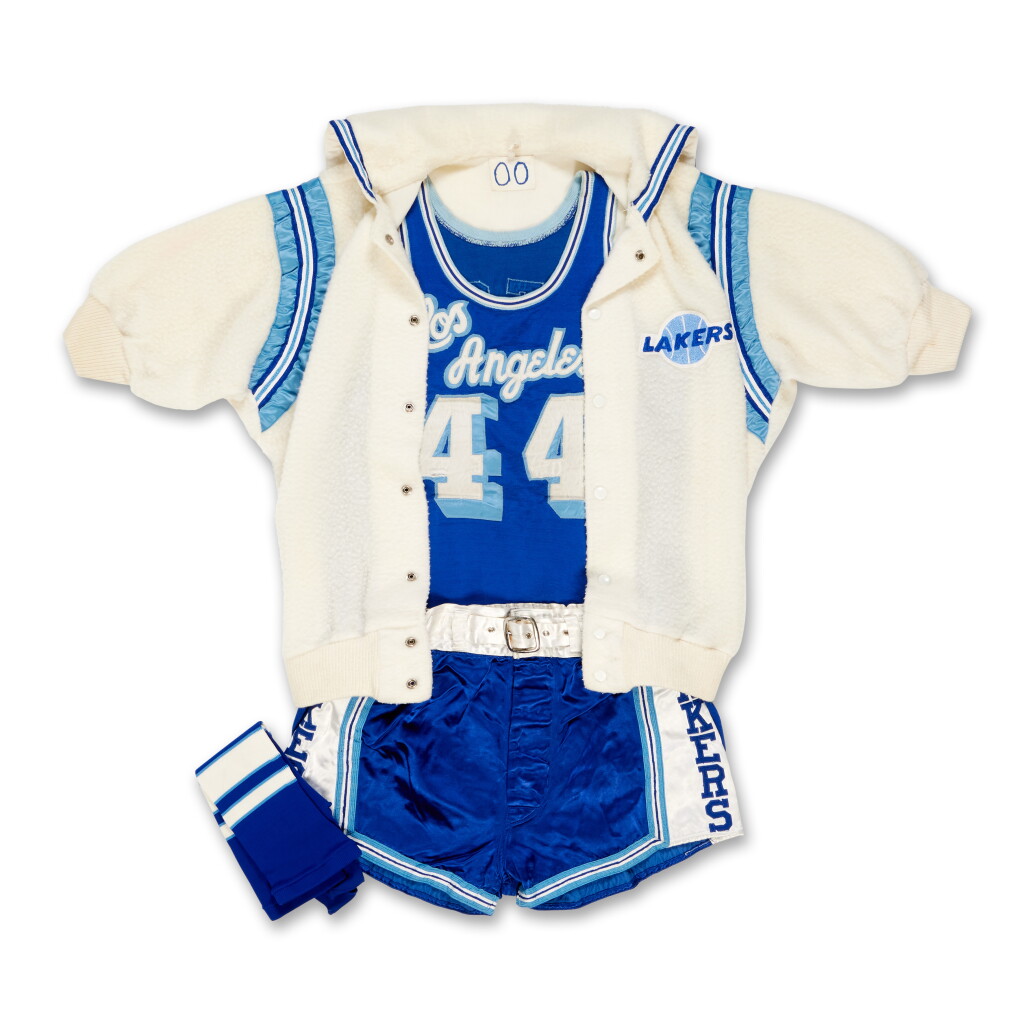
Jerry West Los Angeles Lakers 1964-67 Game Worn Jersey | Photomatched to 1965 Western Division Finals Game 6 | Likely Worn in the 1965 and 1966 NBA Finals | Matched to 4 Additional Undated Photos
Auction Closed
September 30, 11:40 PM GMT
Estimate
Upon Request
Lot Details
Description
Tiernan, Tiernan Basketball Jersey
Cotton
Circa mid-to-late 1960s
The uniform was received in 1967 from Frank O'Neill, former Lakers trainer, when the Lakers were purchased by Jack Cooke and moved to the Forum. The uniform has remained in a private collection since.
Presented is what is to date only the second photomatched game worn jersey and the earliest known photomatched jersey of Jerry West to appear at auction. Known as Mr. Clutch, West played a pivotal role in re-establishing the Los Angeles Lakers as consistent championship contenders in the 1960s while demonstrating dogged determination to compete at all costs and emerging as one of the league’s first true superstar players, especially at the guard position. An elite scorer and underrated defender, The Logo has left an indelible mark on the NBA to this day despite the challenges he faced during his career. The lot also includes a warmup jacket, shorts, and socks, which based on provenance, Sotheby's believes also to be game worn.
West burst onto the NBA scene in 1960 after co-captaining Team USA to gold at the 1960 Olympic Games. He had grown up loving the game, playing as a boy to the point where he ignored his mother’s calls to come home and developed a vitamin deficiency due to missing meals to play. He was the second pick, selected by the Lakers, who that summer left Minneapolis in favor of Los Angeles. West joined a Laker team that had recently returned to stable playoff appearances thanks in large part to star Elgin Baylor. While weak at center for much of the 1960s, West and Baylor wasted little time combining their talents to bring the Lakers to the championship round.
The 1961-62 season saw the Lakers take a major leap in the standings, far outpacing their expected win total. West too made significant progress, almost doubling his scoring output from 17.6 to 30.8 points per game while also increasing his rebounding and assist numbers. After tearing through the Pistons, delivering three double-doubles and two 40 point performances, the Lakers faced the Celtics for the first time in West’s career. Despite a scoring masterclass that saw West average 31.1 points per game over the series, the Lakers fell in seven games to the Celtics, who won their third straight championship.
That did not stop West and the Lakers. The following season, despite a leg injury that cost him 27 games, West still produced 27.1 points and seven rebounds per game and the Lakers still won 53 games. West and the Lakers dispatched the St. Louis Hawks in seven games and found themselves right back in the NBA Finals with the Celtics. Despite turning in his then-playoff career high, the Celtics denied West and the Lakers once again, this time in six games.
1963-64 saw West become the Lakers’ points per game leader for the first time in his career, a title he would not give up until the 1971-72 season. The following season and postseason however secured West’s role as the leader of the Lakers for years to come. After posting career best scoring figures in the regular season, West’s postseason was rocked by the loss of fellow Hall of Famer Elgin Baylor, who went down in the opening game of the Lakers’ postseason with a major knee injury. West’s performances after this were inspired. The following game, he scored the second most of any postseason game of his career with 52 points, and his scoring never dipped below 40. In the closeout game of the Western Division Finals, in this jersey, West put on an impressive display, scoring 42 points and adding eight rebounds and eight assists to lead the Lakers to a 117-115 victory against the Baltimore Bullets. West put on a show in the Finals against the Boston Celtics, averaging 33.8 points per game including a 26 point performance in Game One in this jersey, however the Lakers once again came up short against their familiar foe.
1965-66 saw Jerry West carry the Lakers almost single-handedly. While Baylor returned and played 65 games, he was a shell of himself, averaging only 16.6 points per game. Meanwhile, West played with courage and had the best offensive season of his career. He averaged a career-high 31.3 points and a then-career high of 6.1 assists per game that included 10 40-point games, among those two 51 point masterpieces against his former Olympic co-captain, Oscar Robertson and the Cincinnati Royals. Despite being shorthanded, West managed to lead the Lakers to a first place finish in the Western Division and a winning record.
The 1966 Playoffs were grueling for West and saw both of the Lakers’ series extend to seven games. In game six of the Division Finals, in this jersey, West played every second and scored 38, however St. Louis forced a game seven. After defeating St. Louis in game seven West once again lined up against his now arch-rival, the Boston Celtics. West willed the Lakers to an overtime win in game one in this jersey, putting up 41 points, however the Lakers quickly fell into a 3-1 hole. Despite heroic efforts from the still recovering Baylor in game five and West leading all scorers in game six, the Lakers ultimately fell in seven games to Russell’s Celtics.
1966-67 saw West suffer a leg injury that cost him 15 games, however he still managed 28.7 points per game, good for fourth in the NBA. This jersey saw him take on the Cincinnati Royals during the season, against whom West played some of his best games of the year including seven of his 30-point games. The Lakers however fell to third in the Western Division and were swept by the San Francisco Warriors.
West and the Lakers had two more chances at Bill Russell’s Celtics in 1968 and 1969, however in both seasons Boston prevailed, even with the services of Hall of Fame center Wilt Chamberlain added to the roster from the 1968-69 season. West took the 1969 loss particularly hard as the Lakers had jumped out to a 2-0 lead and he played through an incredibly painful hamstring injury in game seven just to come up short again. His heroics made him the only losing player in NBA history to be awarded Finals MVP, however it was cold comfort. West contemplated quitting. In his words, the game was like “life and death” to him and he felt he could not face dying again; “it was too painful.”
West did not give up though and summoned the courage to keep fighting for that elusive championship. He brought the Lakers to the 1970 NBA Finals despite Wilt Chamberlain being injured for almost the entire season and cemented his reputation as Mr. Clutch with a desperation 60-footer to tie game three of the Finals against the Knicks at the buzzer. However, the Knicks ultimately prevailed. The next season, despite Elgin Baylor suffering another devastating injury, West led the Lakers to the Western Conference Finals, where they lost to the Milwaukee Bucks and Lew Alcindor, soon to be known as Kareem Abdul-Jabbar.
West would finally break through in 1971-72. West narrowly surrendered the team points per game crown to Gail Goodrich and instead led the NBA in assists while leading the Lakers to the best record in NBA history to date and the longest winning streak in North American sports. West got revenge on his new rival, the New York Knicks, and finally secured his lone NBA title.
West retired in 1974, however his presence has remained a basketball constant. West remained a central figure in basketball, going on to win eight NBA Championships in executive roles and earn two Executive of the Year awards. Perhaps his most famous moves came in the summer of 1996, when he landed both Shaq and Kobe for the Los Angeles Lakers. A Laker legend, West’s impact on the NBA is still felt to this day and is perhaps best encapsulated through his likeness on the NBA logo. To this day, when NBA players suit up, they don the unforgettable likeness of a player who embodied many of the most desirable qualities in an NBA player that his career and this jersey represent. West could score from anywhere and shoot in a way that was ahead of his time. West was mentally and physically resilient: when injuries or obstacles in the form of the most dominant team in NBA history presented themselves to West, he never gave in and competed with every ounce of strength and fortitude he could muster. This jersey is in many ways a perfect encapsulation of an extraordinary career. Worn over the course of three of his 14 NBA seasons, this piece of Jerry West’s equipment bore witness to his fight to hone his craft and achieve the pinnacle of success in his sport. This jersey is indelibly etched with the marks of the hard work it took for one of the sport’s greatest to finally achieve his ultimate goal. Do not miss this chance to own one of the most significant Jerry West pieces ever to surface and a major part of NBA history.
The jersey is accompanied by a letter from Sports Investors Authentication in regards to the photomatch. The Shorts and Warmup are presumed game-worn based on provenance.