
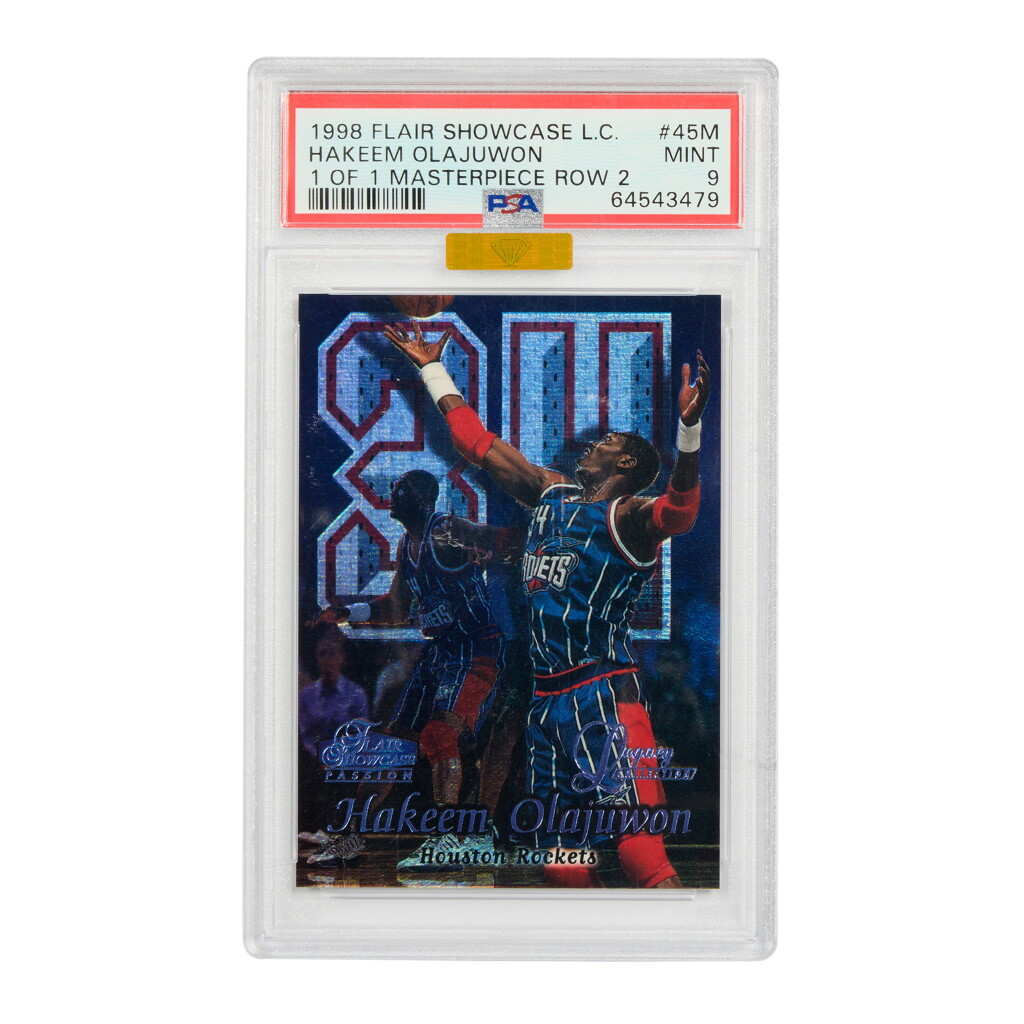
Hakeem Olajuwon 1998-99 Flair Showcase Legacy Collection 1 of 1 Masterpiece Row 2 #45M PSA 9 | 1 of 1 | MBA Gold Diamond
Auction Closed
September 30, 11:40 PM GMT
Estimate
Upon Request
Lot Details
Description
Professional Sports Authenticator, PSA, 9 Mint, sealed plastic holder, Cert number: 64543479
MBA Gold Diamond Sticker, Card
Cardboard and Plastic
For over 40 years, the NBA had never awarded a non-American player their MVP award. The league had fielded international talent since its inception, however none had been able to achieve the league’s highest individual honor as of 1993.
That all changed when Hakeem Olajuwon delivered his masterclass of a season in 1993-94. Already a perennial All-Star and two-time blocks leader, Olajuwon led the Rockets to the best record in franchise history with career-high marks in scoring and assists while adding 11.9 rebounds and 3.7 blocks per game. For this, Olajuwon became the first non-American ever to win the NBA MVP award, a full 12 seasons before the next, Steve Nash. Olajuwon also earned Defensive Player of the Year honors that season and after leading the postseason in scoring and Win Shares became the first player in NBA history to win both awards as well as Finals MVP.
Olajuwon’s historic season offered a glimpse at the revolutionary wave of international talent that was in the midst of hitting the NBA. Beginning with Steve Nash, 10 of the last 21 MVPs have been awarded to players born outside of the United States, including the last seven consecutively. As the game went truly global in the 1990s, the NBA had the good fortune to include one of the best international stars the NBA has ever seen.
It is fitting that the card offered is an example of a similarly revolutionary period in trading cards. The 1990s were a revolutionary time in trading cards after a period characterized by mass production, sometimes affectionately known as the “junk wax” era. During this period, some collectors began to shy away from buying new releases, and because of this card companies began to experiment with additional methods to expand the appeal of their offerings. Newcomer Upper Deck blazed the trail immediately and offered a security hologram to help combat counterfeiting with their iconic debut, their 1989 baseball set. In 1990, they introduced the first pack pulled autograph card ever offered in the hobby: the 1990 Reggie Jackson numbered to 2500. This new chase also helped to introduce another appealing innovation to the wider trading card community: manufactured rarity.
In the years that followed, more companies offered serialized and autographed cards in packs. Companies like Fleer, Pacific, and Topps among others gave collectors the chance not only to know how many of their cards had been made but also where theirs were in the print run. Trading card manufacturers also began to focus on expanding the variety of rare inserts available in trading card products, leading to legendary insert sets such as Beam Team as well as new technologies like the opti-chrome offerings of Finest and Topps Chrome. Collectors embraced these changes, and soon cards with extra features and limited print runs became a regular feature of trading card releases.
1996-97 saw the introduction of a set that would become a fan favorite, Flair Showcase. The 90 name base checklist was broken into three rows, yielding a base-set of 270 cards that saw odds for pulling a particular entry vary based on both the row and their place in the checklist. Combined with the Hot Shots insert and the Class of Ninety-Six insert commemorating that year’s legendary class, the product found itself a steady place in the hobby calendar thanks to its eye-catching foiling and glossy finishes.
1997-98 was a seminal year in trading cards, seeing the first 1 of 1 cards offered in sets like Flair Showcase and Fleer Ultra. For the first time, hobbyists could chase truly unique parallels of their favorite players.
1998-99 Flair Showcase continued the legacy, again featuring 1 of 1 Masterpiece parallels for each of the base cards in the set. The offered example is Hakeem Olajuwon’s Row 2 “Passion: Showpiece” entry based on his placement in the checklist between 31-60. Row 2 was 1998-99 Flair Showcase’s second rarest base set configuration, with cards in the “Passion: Showpiece” portion of the base version falling 1 in every 1.3 packs. Legacy Collection offered parallels limited to 99, and masterpieces were singular prints.
This card commemorates Hakeem’s last season as an upper echelon NBA star, featuring his legendary number 34 along with dazzling foil and wonderful photography. Despite turning 36 days before the start of the lockout shortened season, Olajuwon still managed 18.9 points per game along with 9.6 rebounds and 2.5 blocks, earning him his final All-NBA nod. As collectors chased this card, they could now reflect on one of the most revolutionary NBA careers there ever was. Olajuwon’s defensive abilities as well as his mobility and offensive talent and finesse played a major role in adjusting the expectations for what centers were capable of and he ushered in an era of elite international talent that we are in the midst of to this day. This card reminds us of the place that Olajuwon holds in the eyes of many basketball fans around the world, especially Rockets fans: singularly great.
The card has been awarded a PSA 9 for condition, placing it among the best conditioned examples in this set. In addition to its PSA 9 designation, the card offers another attestation to its impeccable quality: the Mike Baker Authenticated (MBA) Gold Diamond. Reserved for only the top 5% of quality within an assigned grade, the MBA Gold Diamond highlights cards that are worthy of technical grade increases of 0.5 or more in the opinion of MBA. This example earned a Mint+ 9.5 grade by MBA, thus earning a gold diamond certification at the time of cataloging. A purple foil stamp on the back of the card reads “The Only 1 of 1 Masterpiece,” confirming its singular print run.
The PSA certificate number for this card is: 64543479.
This card has also been assessed by Mike Baker Authenticated (MBA) and been awarded with an MBA Gold Diamond. The card is searchable on the MBA website under the PSA certificate number.
Going Deeper - Hakeem Olajuwon
The Number 1 Pick
When a team passes on the opportunity to draft a player the likes of Michael Jordan, history usually does not remember the occasion too fondly. Portland, who selected just before the Bulls, has long received flak from fans around the NBA for selecting Sam Bowie with the second overall pick.
However the Houston Rockets, who held the first overall that year, have avoided such a fate thanks to the world-class caliber of their selection: Hakeem Olajuwon.
Olajuwon came to basketball late, playing the sport for the first time at the age of 15 thanks to a fellow student, who encouraged him to join his high school basketball team for the basketball tournament at the All-Nigeria Teachers Sports Festival in Sokoto.
Olajuwon instantly fell in love. In his words, “Basketball is something that is so unique. That immediately I pick up the game and, you know, realize that this is the life for me. All the other sports just become obsolete.” Shortly thereafter he was invited to workout with the University of Houston coaching staff, where he later enrolled.
After redshirting his freshman year and coming off the bench in his first season of college basketball, Hakeem began training with Moses Malone, who had gone to the Finals with the Houston Rockets and would be traded to the 76ers later in 1982. Malone’s lessons helped Hakeem’s game progress tremendously, and his effortless dunks earned him the nickname “The Dream.”
With his improved play, the Cougars advanced to consecutive NCAA Tournament Finals, which saw the team lose on a last-second tip-in in 1983 and to Patrick Ewing and the powerhouse Georgetown Hoyas in 1984. Despite this, Olajuwon was named a Consensus All-American in 1984 and weighed declaring for the NBA Draft. When it became clear that the Houston Rockets were a contender for the first overall pick, Olajuwon threw his hat in the ring, betting that the Rockets would win the coin toss.
The Rockets did just that and selected Olajuwon first overall in a draft class that included fellow NBA greats Michael Jordan, Charles Barkley, and John Stockton. Olajuwon joined fellow seven-footer and future Hall of Famer Ralph Sampson, who was Houston’s Rookie of the Year first overall pick from the 1983 NBA Draft. The pair garnered the nickname “Twin Towers” thanks to their formidable height, and the Rockets saw almost immediate success.
Olajuwon earned his first of 12 All-Star nods and averaged a double-double in his rookie season, the first of 12 consecutive seasons where he did so. He also earned All-Defensive 2nd Team honors and came in second in Rookie of the Year voting while helping the Rockets end their playoff drought. The following season, with Sampson, he brought the Rockets to the 1986 NBA Finals against the Boston Celtics while earning All-NBA 2nd Team honors. Olajuwon led the Playoffs in points and rebounds and pushed the Celtics hard, however Larry Bird and company ultimately won the series in six games.
As the decade progressed and Sampson was traded away following Olajuwon’s third season, the Rockets became his team, and Olajuwon showed he was up to the challenge. By the end of the 1980s, Olajuwon led the league in rebounds for two consecutive seasons including an incredible 14 rebounds per game in 1989-90, and led the league in blocks for the first time that same year with 4.6 per game. However despite his individual success, the Rockets struggled to make it past the first round and missed the playoffs entirely for the first time in Olajuwon’s career in 1992. That summer, disgruntled both with his contract and with the team that had been built around him, Olajuwon requested a trade.
Had his request been granted, the story of the 1990s, especially the period in which Jordan retired for the first time, may have played out differently. Instead, the Rockets did not grant the request and instead the season began under coach Rudy Tomjanovich, who had been promoted midway through the 1991-92 season. Olajuwon responded with career highs in points and assists and his first Defensive Player of the Year Award, leading the Rockets to a franchise record 55 wins and a return to the playoffs, where the Rockets pushed MVP Charles Barkley’s Phoenix Suns to seven games before the Suns ultimately won Game 7 in overtime. The Rockets solved one of Olajuwon’s qualms with the franchise, offering him a new four-year contract.
That offseason, Michael Jordan shocked the world by announcing that he was retiring from the NBA. Suddenly, the NBA, which had watched him win the last three championships, was up for grabs. Olajuwon made sure to seize the moment. Olajuwon turned in yet another career-high year in points and assists while becoming the first non-U.S. born player to win the NBA MVP Award and repeated as Defensive Player of the Year. Olajuwon was a tour de force in the 1994 Playoffs, leading the postseason in scoring as the Rockets progressed to the Finals, where he faced off against longtime rival Patrick Ewing. Olajuwon outscored Ewing in every game of the series and saved the Rockets with a clutch block in Game 6, forcing a decisive Game 7. There, he recorded a double-double, leading the Rockets to their first NBA Championship and the first major Houston professional sports championship since 1961. Olajuwon was named Finals MVP, becoming the first player in NBA history to win MVP, Defensive Player of the Year, and Finals MVP in the same season.
Olajuwon and the Rockets followed this up with another strong season in 1994-95 and was joined by former college teammate Clyde Drexler in a midseason trade, however they entered the playoffs as the sixth seed, a position from which no team had ever won the NBA Championship before. Nevertheless, in the first round, the Rockets defeated the Utah Jazz in five games in a major upset. Olajuwon dominated the series, averaging 35 points, 8.6 rebounds, and 2.6 blocks per game.
Next the Rockets faced Charles Barkley and the Phoenix Suns. Despite falling into a 3-1 hole, the Rockets became only the fifth team in NBA history to comeback from such a deficit behind Olajuwon’s series-leading 29.6 points per game despite a 46-point effort from Kevin Johnson and 23-rebound effort from Charles Barkley in Game 7.
The Conference Finals pitted Olajuwon against another longtime rival that played in the same state, David Robinson and the San Antonio Spurs. Olajuwon utterly dominated the series, posting series-leading averages in points, rebounds, and blocks per game while leading his team in assists. The Rockets dispatched the Spurs in six games and stood poised to become the first championship team in NBA history to achieve it from such a low seed.
Standing in their way was Shaquille O’Neal and the Orlando Magic. The Magic had dispatched Michael Jordan and the Chicago Bulls on their way to the Finals and entered the Playoffs with the best record in the Eastern Conference.
The Magic proved no match for the Rockets. Olajuwon led every game of the four game-sweep in scoring and recorded a 35 point and 15 rebound double-double in the closeout game. Olajuwon repeated as Finals MVP and cemented his reputation as one of the game’s greatest of all-time with his historic playoff run.
Olajuwon would play six more seasons with the Rockets before a final season with the Toronto Raptors, and was named one of the 50 Greatest Players of All Time after winning a Gold Medal with Team USA in 1996. He retired as the NBA’s all-time leader in blocks and was elected to the 75th Anniversary Team. Olajuwon was inducted into the Basketball Hall of Fame in 2008 and has become the model for many young big men, with stars often sent to train with him and learn the moves that made him so special. There will however always be only one “Dream.”