Property from a Private Collection
Roy Lichtenstein
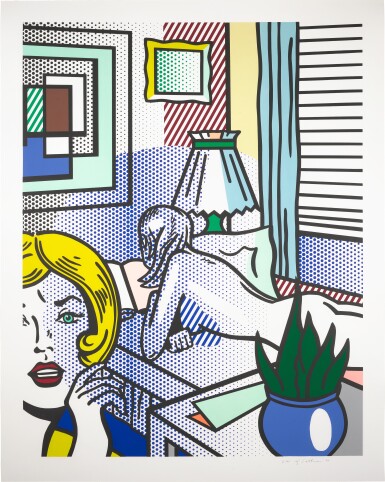
Roommates, from Nudes Series
Lot Closed
March 26, 05:37 PM GMT
Estimate
400,000 - 600,000 GBP
We may charge or debit your saved payment method subject to the terms set out in our Conditions of Business for Buyers.
Read more.Lot Details
Description
Roy Lichtenstein
1923 - 1997
Roommates, from Nudes Series
signed in pencil, dated and numbered 5/40
relief print in colours on Rives BFK mold-made paper
image: 1461 by 1145 mm. 57½ by 45 in.
sheet: 1631 by 1297 mm. 64¼ by 51⅛ in.
Executed in 1994; this impression is number 5 from the edition of 40 plus ten artist's proofs, with the blindstamp of the publisher, Tyler Graphics, Ltd., Mount Kisco.
----------------------------------------------
來自私人珍藏
羅伊・李奇登斯坦
《室友》,來自《裸體系列》
以鉛筆簽名,標註日期並編號為 5/40
在Rives BFK 模造紙上進行彩色浮雕版畫
圖像尺寸:1461 x 1145 毫米,57½ x 45 英寸
紙張尺寸:1631 x 1297 毫米,64¼ x 51⅛ 英寸
創作於1994年;此作品為40版加十版藝術家樣本中的第5版,並加蓋出版商 Tyler Graphics, Ltd., Mount Kisco 的浮雕印記。
Galerie Guy Heytens, Monaco
Acquired from the above by the present owners, 2002
----------------------------------------------
Galerie Guy Heytens, 摩納哥
現有者於2002年從上述畫廊購得
Corlett 254
Executed in 1994, Roommates is a brilliant impression from Roy Lichtenstein’s celebrated Nudes Series, the first major project the artist undertook following his acclaimed retrospective in 1993 at the Solomon R. Guggenheim Museum and, ultimately, the last major body of printed work before the artist’s death in 1997.
Comprising six images and three states, the Nudes Series features figures derived from 1960s comic book illustrations, with Lichtenstein removing the protagonists’ outfits and incorporating references to his earlier works, such as Mirrors, Waterlilies, Interiors, and Imperfects assimilating them as part of the interior. On the left wall of this print hangs Lichtenstein’s version of a painting by Theo van Doesburg, founder of De Stijl movement. While women had long been central to his painted work, this marked his first exploration of the female nude in print - immediately preceding a
series of paintings on the same subject. Unlike the earlier women in his paintings, often caught in romantic trysts or dramatic moments, Roommates does not present an explicit narrative; instead, the dynamic between the two figures remains suggestive and ambiguous.
Remarking upon the elusive allure of the nudes, Edward Said notes, “Lichtenstein’s Nudes signal the tension between what is represented and what isn’t represented, between the articulate and the silent.”[1] Moreover, in their unapologetic celebration of the female form, Lichtenstein’s Roommates capture a more contemporary and provocative characterization of femininity. Critic Avis Berman comments, "The 1990s Nudes take pleasure in their own company, without the slightest hint of needing or missing a man. They are not paralyzed by their emotions. In contrast to Lichtenstein's original romance-comic pictures, this world flourishes exuberantly without men or engagement rings or kisses."[2] Indeed, in the present work, Lichtenstein’s figures exude a quiet self-assurance, unconcerned by the viewer’s voyeuristic gaze, confident in the profound power of their allure.
In Roommates, Lichtenstein paid homage to the iconic subject matter of two of his greatest mentors: Pablo Picasso and Henri Matisse. For both artists, the nude operated as the original signifier of desire, codified and distilled into the sinuous
contours of the idealised female form. Recalling the profound influence these artists enacted upon Lichtenstein, Dorothy Lichtenstein notes, “He grew up studying [the Venus de Milo], but I think he felt more challenged by what we would call the early Modernists – Picasso, Cézanne, and Matisse. He felt that they had restructured painting and they were actually part of his time. He grew up in New York, and so these were really the first works he saw in the Museum of Modern Art.”[3] Throughout his career, these giants of Modernism remained touchstones for Lichtenstein, their investigation of the aesthetic quandaries of modern art—the relationship between subject and artist, the temporal nature of reality, and the formal functions of line, light, and colour—mirrored within his own oeuvre. Lichtenstein’s late Nude
Series trace a markedly similar trajectory to Picasso’s in the late 1920s and early 1930s; the so-called Marie-Thérèse era, inspired and enlivened by the beauty and vitality of his youthful mistress Marie-Thérèse Walter, Picasso embarked upon a series of formally inventive and powerful etchings, paintings and sculptures, of his beloved’s voluptuous form. While
Lichtenstein revisited Picasso’s oeuvre with increasing verve in the years following the latter’s death in 1973, the 1990s Nude Series, in turn, represent the culmination of his ongoing engagement with these Modernist giants.
Roommates contrasts geometric forms with the soft curves of the female figure, blending abstraction with figuration.
Lichtenstein’s precise use of Ben-Day dots and bold colours creates a dynamic tension between structure and sensuality, developing a unique Pop chiaroscuro adding both depth and solidity while simultaneously reinforcing the illusion of
three-dimensionality. Discussing his approach to shadow and form, Lichtenstein
explained, “It’s a little bit the way chiaroscuro isn’t just shadows but a way of combining the figure and the
background, or whatever’s near it in a dark area... You’re not confined to the object pattern, but the subject matter excuse for this is that it’s a shadow. And that’s interesting to me.”[4]Lichtenstein had often used variable-sized dots in his images. However, the dots in this work exhibit distinct characteristics, showcasing his technical virtuosity. They create an undulation of light and space by flowing across multiple objects at a time rather than being contained within the
boundaries of a single object or outline.
Roommates exemplifies Lichtenstein’s ability to reinterpret one of art history’s most enduring subjects - the nude - through
the bold, graphic lens of pop art. This work transcends mere representation, existing in the realm of imagination and visual play. The interplay between abstraction and figuration, between what is revealed and what is withheld, heightens the work’s intrigue. The carefully composed scene invites the viewer to question the narrative at hand - what is left unsaid.
[1] Edward W. Said, On Late Style: Music, and Literature against the Grain, 2006, p. xix.
[2] (Exh. Cat., Vienna, Kunsthaus Bregenz, Roy Lichtenstein: Classic of the New, 2005, p. 143).
[3] (Dorothy Lichtenstein in conversation with Jeff Koons in Exh. Cat, New York, Gagosian Gallery, Lichtenstein: Girls, 2008, p. 11).
[4] (David Sylvester, Some Kind of Reality: Roy Lichtenstein, p. 38).
You May Also Like