Property from a Private Collection, Germany
Simon Luttichuys
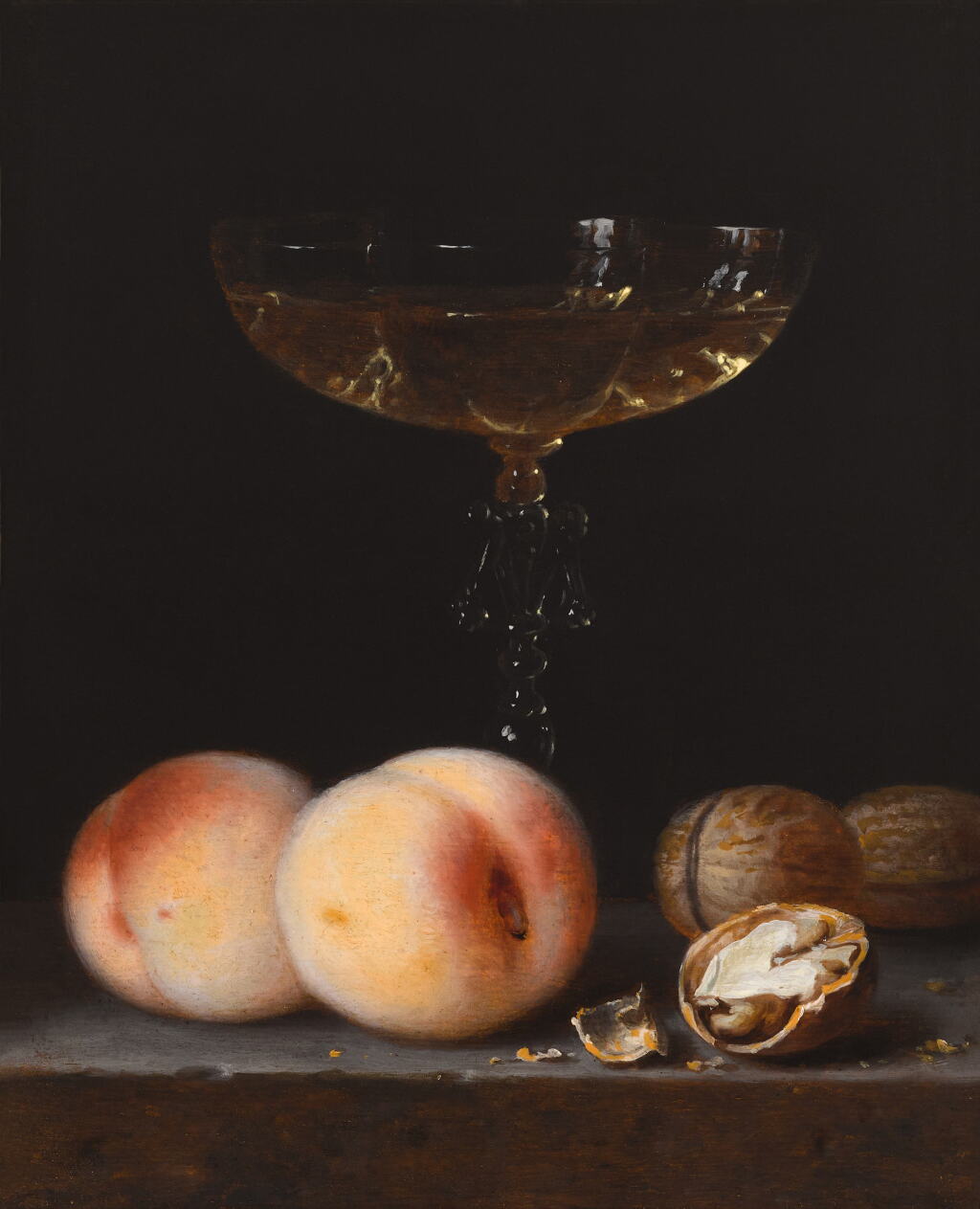
Still life with peaches, walnuts and a façon de Venise wine glass
Auction Closed
December 4, 01:51 PM GMT
Estimate
30,000 - 50,000 GBP
Lot Details
Description
Property from a Private Collection, Germany
Simon Luttichuys
London 1610–1661 Amsterdam
Still life with peaches, walnuts and a façon de Venise wine glass
oil on oak panel
unframed: 25.6 x 20.7 cm.; 10⅛ x 8⅛ in.
framed: 37.4 x 32.5 cm.; 14¾ x 12¾ in.
With Xaver Scheidwimmer, Munich;
From whom acquired by a private collection, Munich, in 1975;
Private collection, Berlin, 1984 (alongside its pendant);
With Norbert Pokutta, Munich (alongside its pendant);
From whom acquired by the family of the present owner in 1987 (alongside its pendant).
Berlin, Gemäldegalerie, Hollandische Malerei aus Berliner privatbesitz, 1984, no. 36 (alongside its pendant).
J. Kelch, Hollandische Malerei aus Berliner privatbesitz, exh. cat., Berlin 1984, pp. 76–77, no. 36, reproduced in colour (alongside its pendant);
R. Müller-Mehlis, 'Kunsthandel in Bayern', in Weltkunst, 57, July 1987, p. 1802, reproduced in colour (alongside its pendant);
B. Ebert, Simon und Isaack Luttichuys, Berlin and Munich 2009, pp. 361–62, no. Sim. A9, reproduced in colour.
This well-preserved, elegant painting belongs to a small, homogenous group of fewer than ten works dating to circa 1640 that Bernd Ebert grouped together based on their upright format, intimate scale, pyramidal arrangement of objects, and execution on panel rather than canvas.1 In each example, a limited range of carefully arranged objects – typically one or more pieces of fruit set before a façon de Venise glass – rests on a ledge against a dark, neutral background. This pared-back approach allows subtle shifts of light, texture and tone, to take center stage, demonstrating the artist's remarkable precision and sensitivity as a still-life painter.
Simon Luttichuys was a Dutch Golden Age painter known for his refined and carefully-arranged lifes. Born in England to a family of Flemish descent, Luttichuys later settled in Amsterdam, where he became part of the city’s flourishing artistic milieu. Though influenced by contemporaries such as Willem Claesz. Heda and Pieter Claesz, Luttichuys developed a distinctive style marked by compositional clarity and an understated sense of luxury.
A variant of this composition, featuring a glass flute rather than a coupe, was last recorded on the Berlin art market in 1918. The pendant of this picture is the previous lot in this sale.
1 Ebert 2009, pp. 159–65, nos Sim. A8–A16, reproduced.
2 Ebert 2009, p. 361, no. Sim. A8, reproduced fig. 106.