
Property from a Distinguished Private Collection
Paulus Moreelse
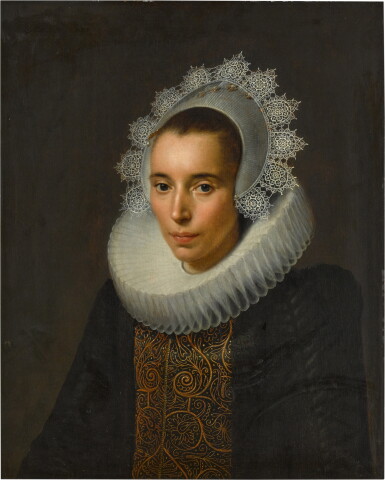
Portrait of a lady, half-length, wearing a black dress with a gold-embroidered stomacher, a white ruff and lace head-dress
Lot Closed
April 9, 11:17 AM GMT
Estimate
15,000 - 20,000 GBP
We may charge or debit your saved payment method subject to the terms set out in our Conditions of Business for Buyers.
Read more.Lot Details
Description
Property from a Distinguished Private Collection
Paulus Moreelse
Utrecht 1571–1638
Portrait of a lady, half-length, wearing a black dress with a gold-embroidered stomacher, a white ruff and lace head-dress
signed and dated upper left: PMorel. fe. 1620 (PM in ligature)
oil on oak panel
unframed: 68.4 x 55.1 cm.; 26¾ x 21¾ in.
framed: 97 x 84.8 cm.; 38¼ x 33⅜ in.
With Dowdeswell & Dowdeswells, London;
Esmond Cecil Harmsworth, second Viscount Rothermere (1898–1978), Mereworth Castle, Kent;
By whom sold ('The [...] property of the Right Hon. The Viscount Rotheremere, [...] removed from Mereworth Castle, Kent'), London, Christie's, 2 August 1946, lot 25, for 260 guineas, to Lord Camrose;
William Ewart Berry, 1st Viscount Camrose (1879–1954), Hackwood Park, Hampshire;
John Seymour Berry, 2nd Viscount Camrose (1909–1995), Hackwood Park, Hampshire;
By whose descendants anonymously sold, London, Christie’s, 9 July 1999, lot 45;
Where acquired by the present owner.
Note on Provenance
The newspaper proprietor Esmond Cecil Harmsworth, second Viscount Rothermere (1898–1978), initially entered politics, accompanying Lloyd George to the Paris peace conference in 1919. In 1922 he became heir to his father's newspaper empire, and in 1929 abandoned politics to concentrate on his business interests. Becoming chairman of Associated Newspapers in 1932, he expanded its holdings, with the revitalized Daily Mail as its flagship. After his father’s death in 1940, he became one of Britain's two major press magnates, diversifying into television, property, North Sea Oil, and Canadian paper-making. His home housed his book and art collection, which was dispersed following his death.


