
Property of a British Private Collector
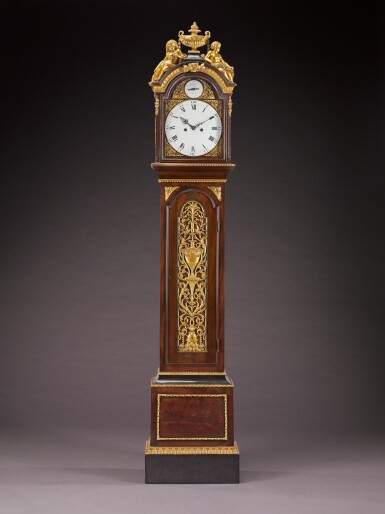
A George III mahogany and carved giltwood longcase clock, Thomas Mudge and William Dutton, London, circa 1770
Auction Closed
May 22, 05:01 PM GMT
Estimate
30,000 - 50,000 GBP
Lot Details
Description
12-inch dial plate with rococo spandrels, enamel dial, strike/silent lever at XII, the arch with enamel date dial signed Thos Mudge, Willm Dutton, London, the substantial 8-day movement with five knopper pillars, anchor escapement, rack striking on a bell, the pendulum with massive lenticular bob, steel rod and roller suspension, the case surmounted by a neoclassical urn flanked by reclining putti, representing Night and Day, above a moulded break-arch carved with lotus palmettes, foliate side frets, the finely moulded hood door flanked by fluted canted corners, the broken-arch trunk door inset with a finely carved panel pierced with an urn with ram masks and surrounded by palms and foliate scrolls, the panelled plinth with an ebonised base
231cm. 7ft. 7in. high
Thomas Mudge (1715-1794) was born in Devon and at the age of fourteen was sent to London and apprenticed to George Graham, successor of Thomas Tompion. He was free of the Clockmakers' Company from 1738 following which he set up his own business close to Graham in Fleet Street. In 1755 Mudge was joined in business by William Dutton who had also been apprenticed to Graham and was Freed in 1746. Initially their clocks continued to be signed as Thomas Mudge but by the 1760's this was changed to Mudge & Dutton. Thomas Mudge is regarded as one of England's most important makers and is best known for his skills as a chronometer maker but is also renowned for his fine longcase clocks which were made in partnership with Dutton. In 1771 Mudge moved to Plymouth where he continued to work on perfecting his marine chronometers. William Dutton succeeded to the London business with his sons Matthew and Thomas but continued to sign their clocks using Mudge's name until 1794.Mudge and Dutton are renowned for the high quality of their clock movements, which are undoubtedly influenced by their apprenticeships with George Graham, but also for the highly refined nature of their dials and cases. Identifying English clock cabinet makers is very difficult as the cases are invariably unsigned. We know from records that the Rich family, working in Fleet Street, London, supplied clock cases to Mudge & Dutton, Benjamin Vulliamy and John Holmes. Most of these cases have certain similarities such as very fine mouldings and canted hood corners. The basic carcass of the present case follows these rules. The Rich family would certainly have had access to the services of carvers and gilders but it is currently impossible to identify the individual craftsmen responsible for this extremely fine work. Executed in limewood, the carving is highly detailed and beautifully proportioned. The inclusion of miniature portrait medallions on the surmounting neoclassical urn and the vase within the door carving demonstrate remarkable attention to detail.
Sadly, the early provenance of the present clock is not known but it is tempting to conjecture that this outstanding case may have been commissioned by European nobility or even Royalty. Indeed, we know that Thomas Mudge was supplying watches to King Ferdinand VI of Spain from as early as 1750 until the King's death in 1759. He was watchmaker to King George III from 1775 until his death.
You May Also Like


