
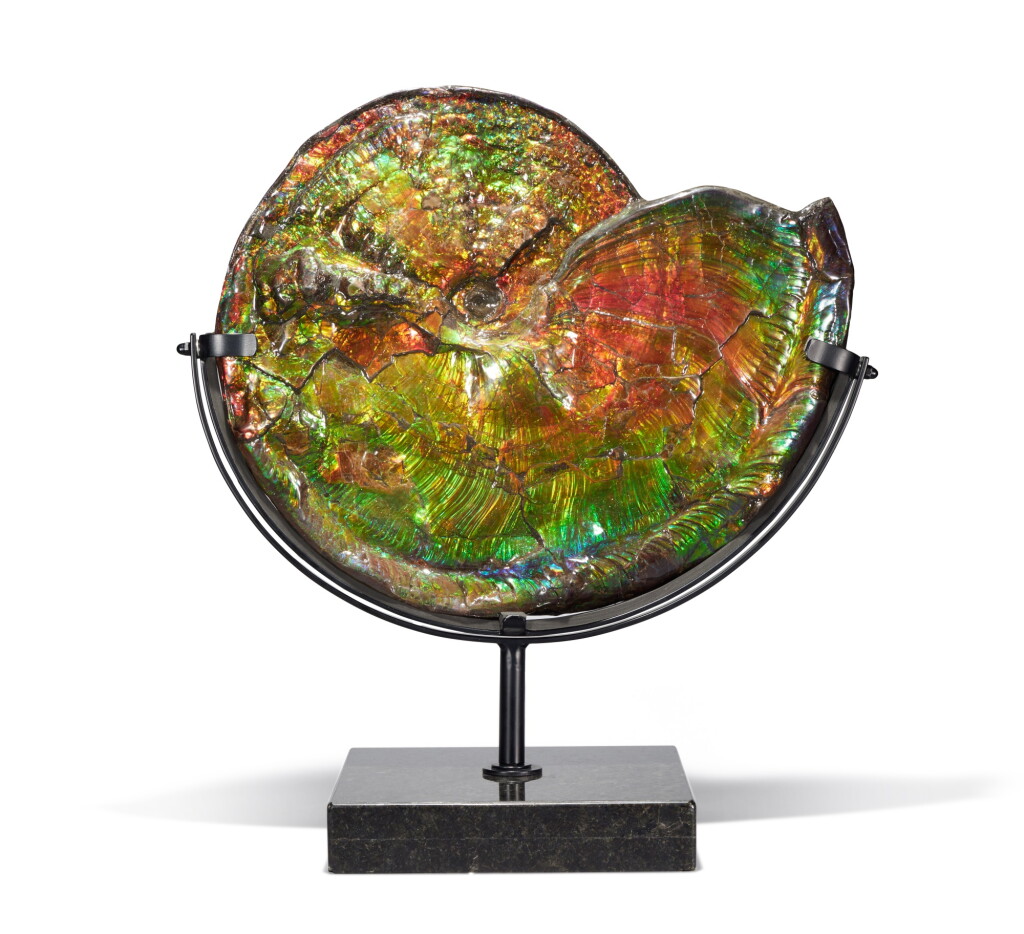
Very Large Iridescent Ammonite
Late Cretaceous Period (approx. 71 million years ago), Bearpaw Formation, Alberta, Canada
Auction Closed
July 16, 06:46 PM GMT
Estimate
50,000 - 70,000 USD
Lot Details
Description
Very Large Iridescent Ammonite
Placenticeras costatum
Late Cretaceous Period (approx. 71 million years ago)
Bearpaw Formation, Alberta, Canada
21¼ x 18¾ x 2 inches (54 x 47.6 x 5.1 cm), 27¼ inches (69.2 cm) tall on stand. 27 pounds (12.2 kg).
A very large, exceptional specimen displaying superb mineralization in ammolite on both faces, with shimmering and iridescent reds, greens, yellows, blues, and purples. The colors shift in hue and intensity as they diffract light from different viewing angles. 61 pounds (27.7 kg) in total with marble display base.
A RAINBOW AMMONITE PRESERVED IN SHIMMERING AMMOLITE GEMSTONE
Placenticeras ("flat horn") was a fast-swimming, predaceous cephalopod — a taxonomic class that includes present-day nautilus, octopus, and squid. Much like a submarine, ammonites employed gas- and liquid-filled chambers to regulate their position in the water column. The animal itself lived only in the outermost compartment, employing its tubular siphuncle to connect its chambers along the shell's ventral surface.
While dinosaurs ruled the land during the Late Cretaceous Period, Placenticeras flourished in the oceans and spanned the globe. However, the vast majority of these species resided in the Western Interior Seaway, an ocean that cut North America in half from the Arctic Circle to what is now the Gulf of Mexico. In ideal circumstances for preservation, a recently-deceased ammonite would sink to the bottom of the sea and become covered in sediment. Over time, its muddy tomb would become converted to shale, and it is these ancient shale deposits in the Canadian Rockies that yield the world's most significant — and only gem-quality — ammolite deposits.
Along with amber and pearl, ammolite is one of the world's only biogenic gems. Resembling inorganic opal, it is found exclusively in the shells of ammonites that have undergone the fossilization process known as permineralization.
The quality of gem ammolite is determined by a number of factors, first and foremost being its number of primary colors: reds and greens are somewhat more common, whereas blues and purples are more rare. Also of great significance is the range of the ammolite's chromatic shift, graded by the way its colors change in hue and intensity as they diffract light when viewed from different angles. Lastly, the ammolite's magnitude of iridescence impacts its quality and value, with the finest specimens displaying large and uninterrupted swaths of lustrous, rainbow-like colors. On each of these metrics, this very large specimen's ammolite is first-rate.

