
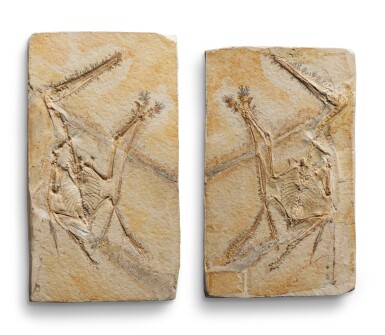
Pterodactylus Fossil Plates (Positive & Negative)
Late Jurassic Period, Kimmeridgian Stage (approx. 155-150 million years ago), Solnhofer Plattenwerk Victor Henle Quarry, Mörnsheim, Eichstätt District, Bavaria, Germany
Auction Closed
July 16, 06:46 PM GMT
Estimate
70,000 - 100,000 USD
Lot Details
Description
Pterodactylus Fossil Plates (Positive & Negative)
Pterodactylus sp.
Late Jurassic Period, Kimmeridgian Stage (approx. 155-150 million years ago)
Solnhofer Plattenwerk Victor Henle Quarry, Mörnsheim, Eichstätt District, Bavaria, Germany
Pterodactylus specimen measures 9 inches (22.9 cm) in length, from top of head to end of toes. Head measures 4 inches (10.2 cm) in length, from back of head to tip of beak. Positive plate (on right) measures 11½ x 7 x ⅝ inches (29.2 x 17.8 x 1.6 cm), negative plate (on left) measures 12¼ x 7 x ⅝ inches (31.1 x 17.8 x 1.6 cm). Plates weigh 8 pounds (3.6 kg) combined.
This fossil represents a virtually complete skeleton of Pterodactylus, preserved in positive and negative slabs of split limestone. The skeleton is articulated with most of the bones in place, lying flat with appendages partially extended. The skull is laterally positioned allowing the cranial openings and jaws to be viewed. The delicate wings are close to the body. The fossil is in a raw state, unfinished and without restoration, and the occurrence of dendrites can be seen all over. The natural condition of this specimen is highly desirable to the purist collector.
From the collection of the owner of the Solnhofer Plattenwerk Victor Henle Quarry, Mörnsheim, Eichstätt District, Bavaria, Germany
Jura Museum, Willibaldsburg Castle, Eichstätt, Germany
AN EXTREMELY RARE AND REMARKABLY WELL-PRESERVED PTERODACTYL FOSSIL IN ITS NATURAL CONDITION, FROM THE FAMED SOLNHOFEN LIMESTONE OF BAVARIA, GERMANY
Pterodactyls ("winged finger") were the first pterosaur to be discovered, a group that encompasses all ancient flying reptiles. Close relatives of the dinosaurs, they branched off from a shared ancestor about 230 million years ago, independently following their own evolutionary path. About 80 million years before birds appeared, pterosaurs evolved into the first vertebrates capable of powered flight, and gained air superiority over the feathered dinosaurs and birds during the Mesozoic Era before going extinct approximately 66 million years ago at the end of the Cretaceous Period.
The paleontological history of pterosaurs began with the identification of a Pterodactylus fossil much like this one from Solnhofen, Germany in 1784. The fossil record indicates that pterosaurs were covered in hair-like filaments that insulated their bodies against the cold, providing strong evidence that these animals were warm-blooded. In addition, pterosaurs had hollow bones containing air sacs that formed part of their respiratory system. Although their hollow bones made them lightweight and helped pterosaurs become the dominant flying animals during their time, they also made fossilization extremely rare. As a result, fewer than three dozen pterodactyl fossil specimens have ever been recovered.
A magnificent characteristic of these extremely well-preserved positive and negative fossil plates is the presence of iron and manganese dendrites encircling much of the skeleton. A feature of some fossils from Solnhofen, these fractal-like crystals appear when mineral-rich water fills in microscopic cracks in the limestone and then evaporates, leaving the metallic solids behind.
In 2022, the International Union of Geological Sciences (IUGS) included the fossil sites of the Solnhofen limestone in its first list of 100 Geological Heritage Sites. The rise of industrial extraction, alongside a significant decline in quarrying activity, means that new and important fossil discoveries in the Solnhofen limestone are becoming increasingly rare.