
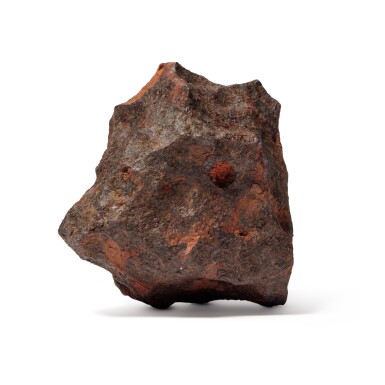
Henbury
An Ancient and Important Meteorite From the Australian Outback
No reserve
Auction Closed
July 16, 06:46 PM GMT
Estimate
5,000 - 8,000 USD
Lot Details
Description
Henbury — An Ancient and Important Meteorite From the Australian Outback
Iron – IIIAB
Henbury, Northern Territory, Australia (24° 34'S, 133° 10'E)
96 x 89 x 76 mm (3¾ x 3½ x 3 inches). 2,288 grams (5.04 lb).
The Henbury meteorite fell to the ground in the Australian Outback approximately 4,700 years ago and produced over a dozen craters, the largest of which is 180 meters wide. It is quite likely that aboriginal Australians have known about the craters for thousands of years, passing down stories of the craters and the event that produced them in their oral traditions. Although the craters were found by Western settlers by 1899, the first pieces of Henbury were only identified as being meteoritic in origin in 1931 — an important year as it was the same year that Springwater was discovered in the Canadian Prairies (See Lot 85).
Henbury meteorites are distinguished by having two different types of exteriors, sometimes appearing on the same meteorite, as is the case here. One is so-called "desert varnish," a type of coating can occur in arid environments and is made up of clay, iron oxides, and manganese oxides, creating a shiny black patina. In addition to desert varnish, one can also find caliche, an orange or red-colored crust made up of calcium carbonate and iron oxide that can occur on meteorites when in contact with the ground. This meteorite displays both types of exterior surface.
If this meteorite were to be sliced open, etched, and polished, it would display a distinctive Widmanstätten pattern, like many of the meteorites you see in this catalogue. A Widmanstätten pattern is the result of slow cooling over millions of years, providing sufficient time for the two iron-nickel alloys present in a meteorite to orient into a crystalline habit. As Widmanstätten patterns can only occur within certain types of asteroids in the vacuum of space, their presence is diagnostic in the identification of a meteorite.
REFERENCES: