
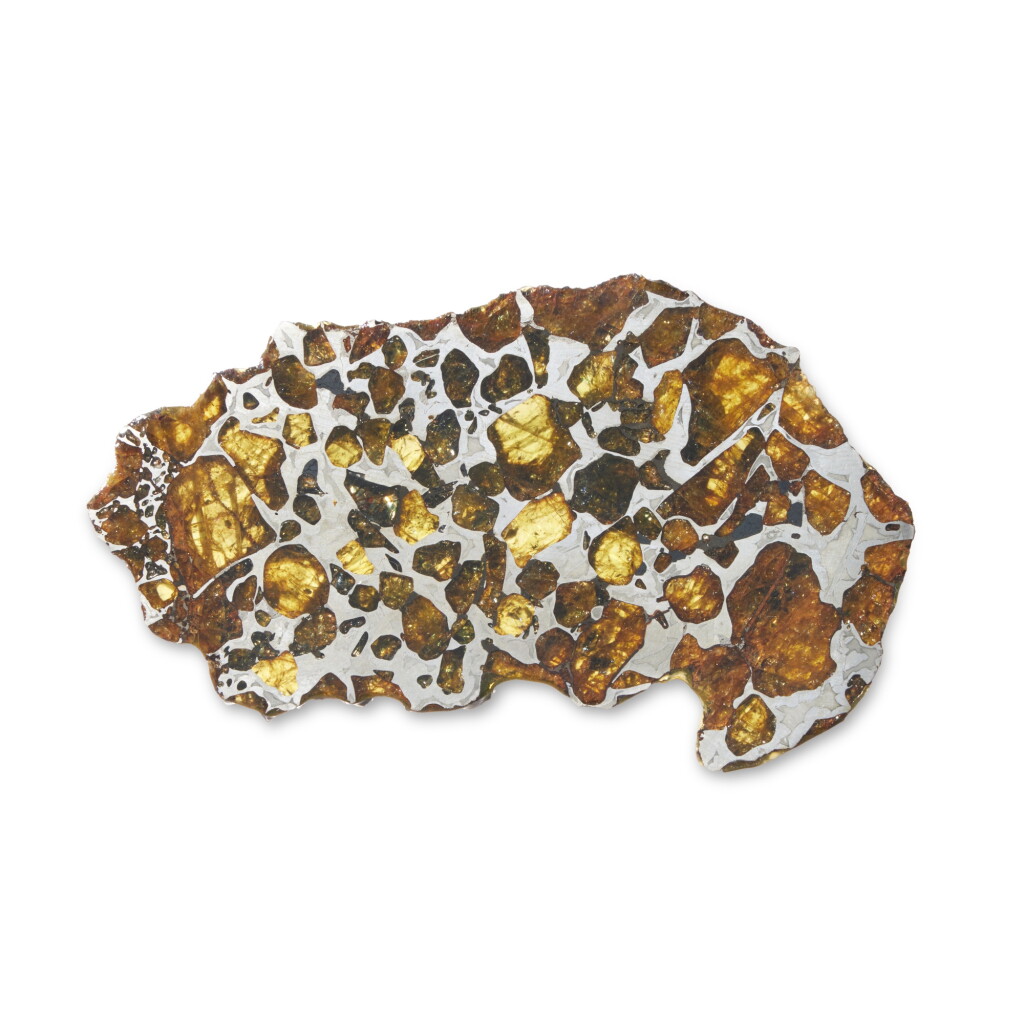
Complete Slice of an Imilac Meteorite
From the Highest Desert on Earth
No reserve
Auction Closed
July 16, 06:46 PM GMT
Estimate
1,500 - 2,500 USD
Lot Details
Description
Complete Slice of an Imilac Meteorite — From the Highest Desert on Earth
Pallasite – PMG
Atacama Desert, Chile (24° 12' 12"S, 68° 48' 24"W)
105 x 54 x 3 mm (4⅛ x 2⅛ x ⅛ inches). 61 grams (.13 lb).
A GORGEOUS METEORITE FROM THE HIGHEST DESERT ON EARTH
Imilac was found in 1822 in the Atacama Desert high atop the Andes, the highest desert and driest place on Earth outside of the polar regions. Although Imilac originated from the asteroid belt between Mars and Jupiter, the Atacama Desert was also a fitting place for this extraterrestrial visitor to land: not only does it host many high-powered telescopes used in cutting-edge astronomical research, but NASA and other space agencies perform many of their Martian studies in the Atacama desert because its dryness and soil chemistry are remarkably similar to the Red Planet.
Pallasites such as Imilac are incredible rare, accounting for .2% — or just 1 out of 500 — of all meteorite finds. The olivine crystals found embedded in Imilac are particularly large and translucent, the remnants of pieces of an asteroid's stony mantle becoming suspended in the molten metal of its iron-nickel core. The prominent metallic latticework found on the display side of the slice is referred to as a Widmanstätten pattern and is the result of slow cooling over millions of years, providing sufficient time for the two iron-nickel alloys present in the meteorite to orient into a crystalline habit. As Widmanstätten patterns can only occur within certain types of asteroids in the vacuum of space, their presence is diagnostic in the identification of a meteorite.
REFERENCES:
You May Also Like


