
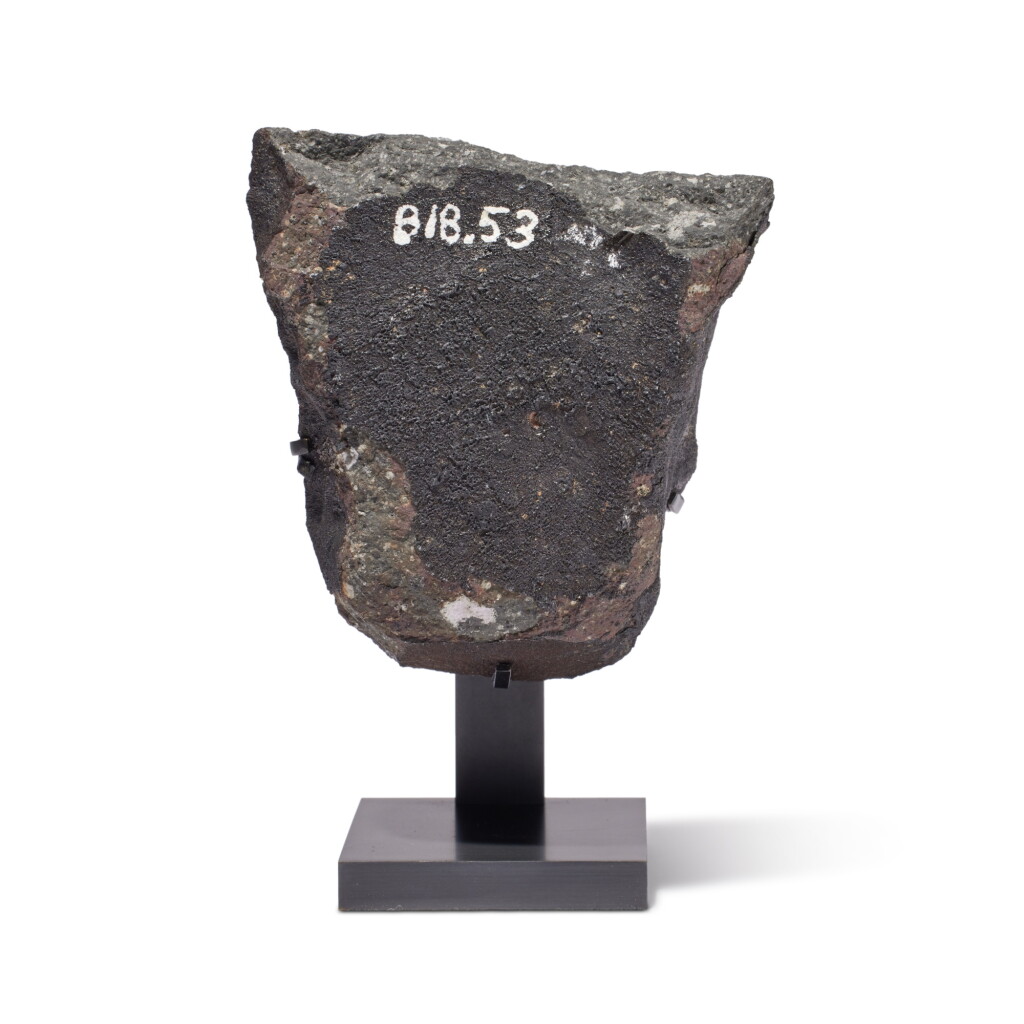
Allende
"The Oldest Matter That Can Be Seen and Touched"
No reserve
Auction Closed
July 16, 06:46 PM GMT
Estimate
3,000 - 5,000 USD
Lot Details
Description
Allende — "The Oldest Matter That Can Be Seen and Touched"
Carbonaceous chondrite – CV3
Pueblito de Allende, Chihuahua, Mexico (26° 58'N, 105° 19'W)
Witnessed Fall on February 8, 1969
70 x 69 x 35 mm (2¾ x 2¾ x 1⅜ inches). 280 grams (.62 lb).
4 inches tall on custom stand.
Deaccessioned in 2009 from the Buseck Center for Meteorite Studies, Arizona State University, Tempe, Arizona. Inventory no. 818.53.
"THE OLDEST MATTER THAT CAN BE SEEN AND TOUCHED"
On the morning of February 8, 1969, a fireball was seen streaking across the skies of Northern Mexico, Texas, and New Mexico. After falling in the area of Pueblito de Allende in Chichuahua, locals began collecting pieces, followed only days later by a team of visiting Smithsonian scientists. As an observed fall, the Allende meteorite is sought after by scientists and collectors because eyewitness accounts can tell us about the orbit of the meteoroid as it entered the atmosphere. In addition, the pieces collected shortly after impact are pristine, not having been altered by their time here on Earth.
Allende is often described as "the most studied meteorite in history," having been cited in over 14,000 published articles. In addition, it has been called "the Rosetta Stone for planetologists" because it features calcium-aluminum-rich inclusions, some of the first solid matter to form in the early solar system. These calcium-aluminum-rich inclusions, or CAIs, appear as white speckles seen throughout the meteorite.
Scientists from NASA, the Smithsonian Astrophysical Observatory, and the National Museum of Natural History studied Allende with equipment that had been acquired to analyze the Moon rocks they were waiting to receive from Apollo 11. It was during these examinations that scientists realized Allende contained CAIs, some of the oldest matter that can be seen and touched.
REFERENCES:
You May Also Like


