The Geri Brawerman Collection: A Tribute to Los Angeles and A Legacy of Giving
Hans Hofmann
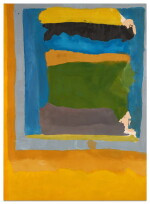
String Quartet
Auction Closed
November 21, 01:55 AM GMT
Estimate
1,500,000 - 2,000,000 USD
Lot Details
Description
The Geri Brawerman Collection: A Tribute to Los Angeles and A Legacy of Giving
Hans Hofmann
(1880 - 1966)
String Quartet
signed Hans Hofmann and dated 60 (lower right); signed again, titled, dated 1960, and numbered 1022 (on the reverse)
oil on canvas
50 ⅛ by 40 ¼ in. 127.3 by 102.2 cm.
Executed in 1960.
Kootz Gallery, New York
Leigh B. and Mary Lasker Block (acquired by 1961)
Kootz Gallery, New York
Raymond and Patsy Nasher, Dallas (acquired by 1963)
Gerald Peters Gallery, Dallas
Swanton Investment S.A., Geneva (acquired by 1991)
Acquired from the above in December 1991 by the present owner
New York, Kootz Gallery, Hans Hofmann, 1961 n.p., illustrated
Nuremberg, Fränkische Galerie am Marientor; Cologne, Kölnischer Kunstverein; Berlin, Kongreßhalle and Munich, Städtische Galerie, Hans Hofmann, 1962-63, no. 79
New York, The Museum of Modern Art; Denver, International House; East Lansing, Michigan State University; Akron Art Institute; Bloomington, Indiana Art Museum; Auburn University; Chattanooga, Hunter Museum of American Art; The Carillon, Richmond Artists Association; Elliott Hall, The University of North Carolina at Greensboro; Athens, Ohio University; Tampa, University of South Florida; Portland Museum of Art; State University of New York College of Education at Oswego; Ackland Art Museum, The University of North Carolina at Chapel Hill; Towson, Goucher College and Joe and Emily Lowe Art Gallery, University of Miami, Hans Hofmann and His Students, 1963-65
Fort Worth Art Museum, Twentieth Century Art From Fort Worth Dallas Collections, 1974, n.p., illustrated
Washington, D.C., Hirshhorn Museum and Sculpture Garden and The Museum of Fine Arts, Houston, Hans Hofmann: A Retrospective Exhibition, 1976-77, no. 51, p. 20 and p. 89, illustrated
Dallas Museum of Art and Washington, D.C., National Gallery of Art, A Century of Modern Sculpture: The Patsy and Raymond Nasher Collection, 1987-88, no. 93, p. 125 and 202; p. 127, illustrated in color and p. 201, illustrated
Robert Hatch, "At the Tip of Cape Cod," Horizon, Vol. 3, No. 6, July 1961, p. 16; p. 17, illustrated in color (in progress) (with the artist in his Provincetown studio, 1960)
Lawrence Smith, "In the Galleries: Hans Hofmann," Arts 35, no. 7, April 1961, p. 58, illustrated
Sam Hunter, Hans Hofmann, New York, 1963, pl. 134, n.p., illustrated in color; p. 30
Harold Rosenberg, "Hans Hofmann," Vogue, vol. 145, May 1965, no. 9, p. 236
Harold Rosenberg, "The Teaching of Hans Hofmann," Arts Magazine, vol. 45, no. 3, December 1970/January 1971, p. 19, illustrated
Lawrence Campbell, ARTnews, vol. 73, no. 7, November 1974, illustrated in color (on the cover) (in progress) (with the artist in his Provincetown studio, 1960) and p. 5, illustrated (in progress) (with the artist in his Provincetown studio, 1960)
Cynthia Goodman, Hans Hofmann, New York, 1986, p. 87
Exh. Cat., New York, Whitney Museum of American Art (and traveling), Hans Hofmann, 1990-91, p. 10, illustrated (in progress) (with the artist in his Provincetown studio, 1960)
Exh. Cat., New York, André Emmerich Gallery, Painting in Provincetown: Milton Avery, Hans Hofmann, Jack Tworkov, 1998, illustrated in color (in progress) (with the artist in his Provincetown studio, 1960) (on the back cover)
Exh. Cat., Livorno, Galleria Peccolo, Hans Hofmann. Opere da una collezione (dipinti su carta 1959-1962), 1999, n.p., illustrated (in progress) (with the artist in his Provincetown studio, 1960)
James Yohe, ed., Hans Hofmann, New York, 2002, p. 34; p. 201, illustrated in color
Exh. Cat., Musée Départemental Matisse Le Cateau-Cambrésis, Ils ont regardé Matisse: une réception abstraite, États-Unis/Europe, 1948-1968, 2009, p. 129, illustrated in color (in progress) (with the artist in his Provincetown studio, 1960)
Suzi Villiger, ed., Hans Hofmann Catalogue Raisonné of Paintings, vol. III, Surrey, 2014, no. P1281, p. 82, illustrated in color
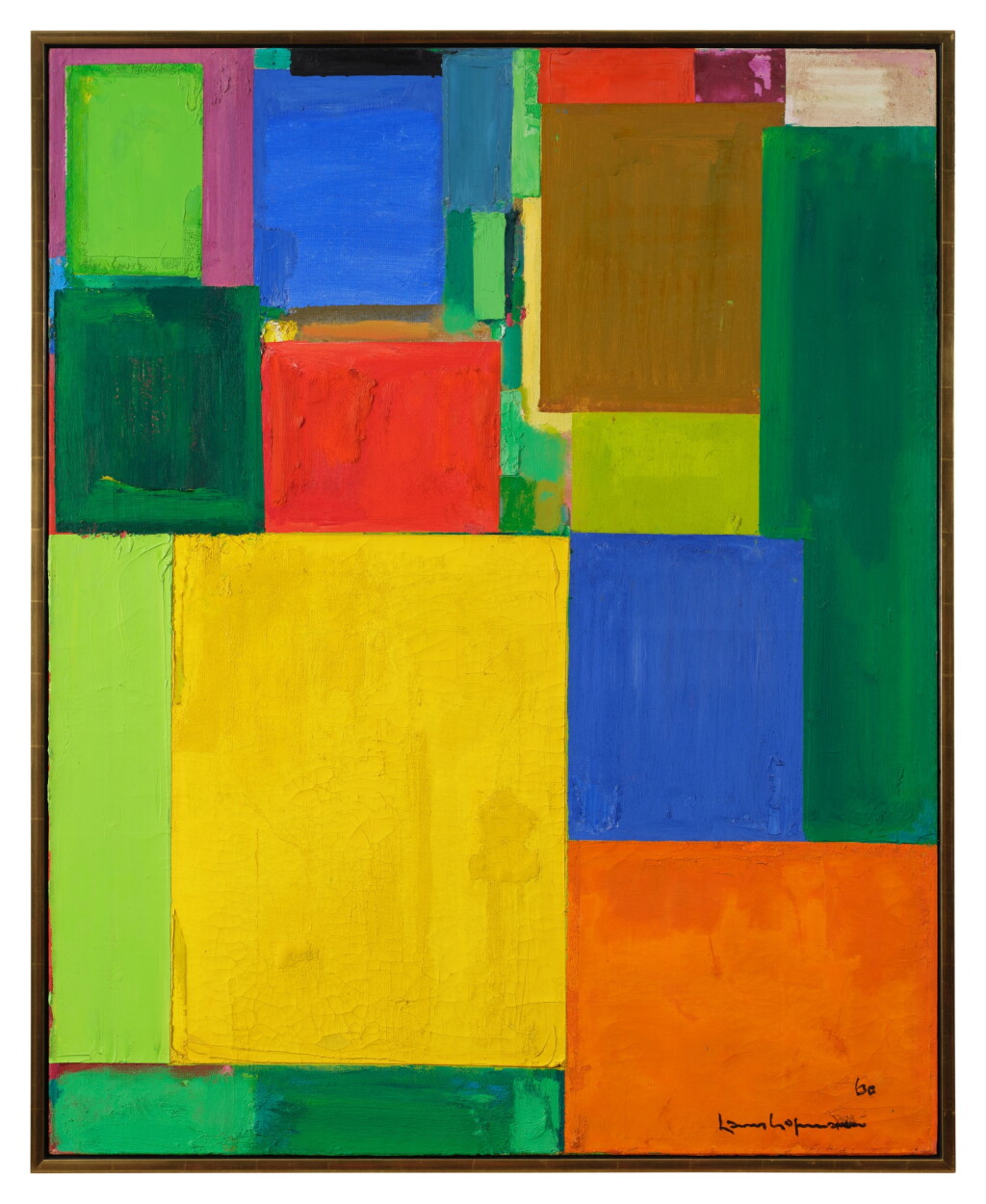
The dazzling symphony of azure, citrine, saffron and emerald in Hans Hofmann’s String Quartet epitomize the artist’s transcendent mastery of color, balance of form and status as a legendary leader of twentieth-century art. Executed in 1960, String Quartet is at once revolutionary and replete with reference to art history. Through the precise equilibrium achieved between the delicately overlapping rectangular layers of Hofmann’s composition, elements of Cubism and Fauvism emerge, yet the artist’s distinctive visual vernacular endures. A preeminent figure in the trajectory of twentieth-century art, Hofmann is widely considered a forefather of Abstract Expressionism who left an indelible impact on a generation of Contemporary artists. Painted just following his retirement from teaching in 1958, String Quartet is an ode to the painterly brava of Hofmann at the peak of his liberated creative passion. A uniquely iconic painting within Hofmann’s oeuvre, String Quartet is featured alongside the artist in Arnold Newman’s 1960 photographs of Hofmann’s Provincetown studio prior to his death in 1966. Bearing exceptional provenance, String Quartet hails from the collection of Geri Brawerman, a leading patron of the arts and celebrated philanthropist. Further testament to the importance of the work in Hofmann’s oeuvre, String Quartet has been exhibited in various international institutions, such as The Museum of Modern Art, New York, the Fort Worth Art Museum and the National Gallery of Art, Washington, D.C.
A joyous concert of color and form achieve perfect harmony in Hofmann’s String Quartet. Executed during a critical period of Hofmann’s career, String Quartet encapsulates the artist’s signature ‘push-pull’ synthesis, a theory he initially developed in the 1950’s intended to achieve visual dynamism through planes of overlapping color. A master colorist, Hofmann meticulously constructs his compositions through careful layering of pigment in geometric so-called “slabs,” juxtaposed to create volumetric dynamic tension on the surface of the canvas. Hofmann applies his pigments against layers of rich impasto, balancing the rigid architecture of his rectangular forms with the expressive energy of his brushstrokes. The effect is radiant: greens, blues, yellows, reds, and oranges reverberate from each other with an irrepressible energy. The artist explained of his practice, “push and pull is a colloquial expression applied for movement experienced in nature or created on the picture surface to detect the counterplay of movement in and out of depth. Depth perception in nature and depth creation on the picture-surface is the crucial problem in pictorial creation.” (the artist quoted in: Exh. Cat., New York, Whitney Museum of American Art (and traveling), Hans Hofmann, 1990, p. 177) A synthesis of the artist’s devotion to color theory and masterful ability to construct his compositions, String Quartet is a paragon of Hofmann’s revered practice.
Hofmann’s dynamic compositions draw upon the work of his predecessors yet equally shatters the existing conventions of the picture plane entirely. Through the artist’s signature geometric slabs emerges not only reference to the compositional order of Piet Mondrian’s grid, but also the complete departure of Barnett Newman’s zips or Jackson Pollock’s drips. The push-pull effect of Hofmann’s compositions were radical in their own right. As Cynthia Goodman has noted, “Hofmann considered form and color synonymous, and he was fond of repeating Cézanne's maxim that 'when color is fullest, form is richest.’” (Cynthia Goodman, Hans Hofmann, New York, 1986, pp. 75-76). Employing his layered slabs as the architecture of his picture plan, Hofmann exploited the sheer visual potential of color through his painterly application of oil pigments. Color and the interaction between colors became the centerpiece of his work. In a written statement from 1955, Hofmann explained: "In nature, light creates the color: in the picture, color creates the light.” (Cynthia Goodman, Hans Hofmann, New York, 1986, p. 81)
Aptly titled, String Quartet evokes the influential role of music throughout Hofmann’s career. Hofmann described his consummate artistic process as being “to form and to paint as Schubert sings in his songs and as Beethoven creates a world in sounds.” (the artist quoted in: Hans Hofmann: 1880–1966, Exh. Cat., London, Tate Gallery, 1988, p. 12). In attempting to create a harmonious duality within the synthetic composition, Hofmann paid homage to Wassily Kandinsky and his theories of color. During Hofmann’s influential teaching career at the Hofmann Schule für Moderne Kuns in Munich, where Hofmann counted Helen Frankenthaler, Joan Mitchell, Lee Krasner and Louise Nevelson among his students, Hofmann developed a relationship with Kandinsky’s former partner Gabriele Münter. Entrusting Hofmann with the security of some of Kandinsky’s works while the artist was in Russia, Hofmann became a trusted resource and friend; experiencing incredible exposure to Kandinsky’s work that left a profound effect on Hofmann’s artistic theories and practices. String Quartet is a jubilant expression of Hofmann’s practice, evoking a symphonic sensation of the interplay and balance between colors.
In 1958, Hofmann retired from five legendary decades as a teacher and mentor to fellow leading artists of the twentieth century. In the last eight years of his life, he devoted himself exclusively to his own practice, realizing a particularly successful period of his career in which he began his slabs. Remarking upon the artist’s characteristic use of varied rectangular forms, Irving Sandler has suggested that “Hofmann may have derived the idea of using rectangles in his painting from one of his teaching techniques: attaching pieces of construction paper to the canvases of his students.” (Irving Sandler, The Triumph of American Painting: A History of Abstract Expressionism, New York 1970, p. 147, note 5) Newman’s treasured photographs of Hofmann’s studio reveal that he was working in this very method, seemingly using rectilinear papers to map out his composition before applying pigment. Hofmann’s methodical yet expressive practice is undoubtedly one of the most influential of his century. A harmonious union color and form, String Quartet is a paradigmatic example of Hofmann’s revolutionary practice.
You May Also Like