Property from the Phillips Collection Sold to Benefit Future Acquisitions
Arthur Garfield Dove
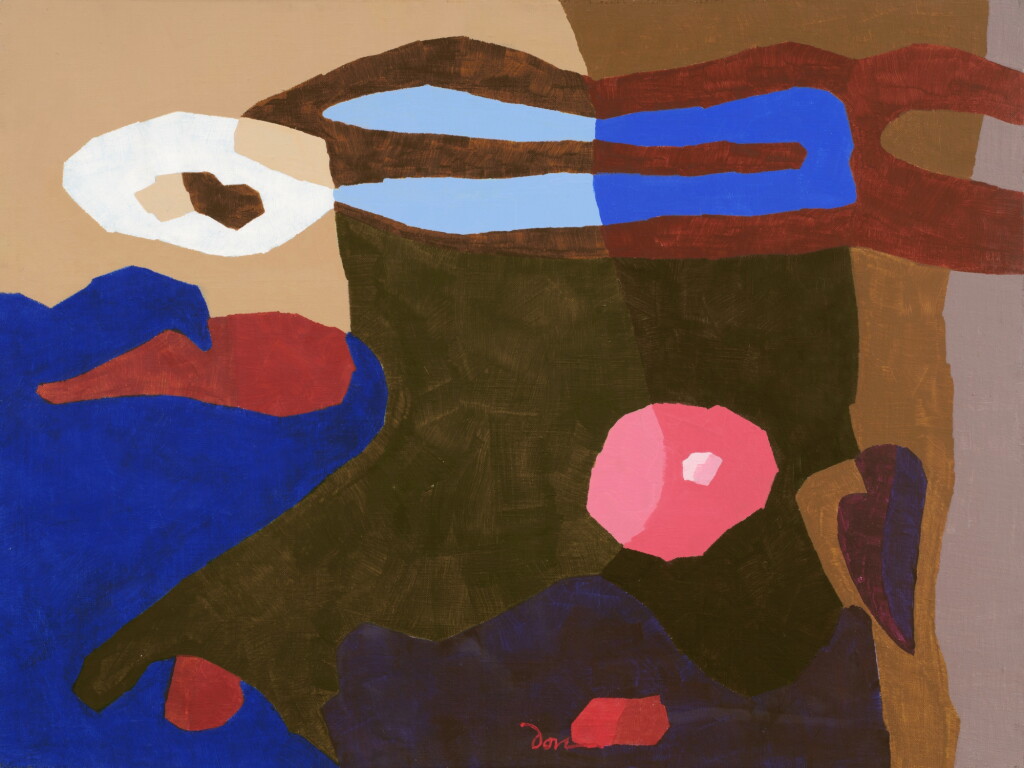
Rose and Locust Stump
Auction Closed
November 21, 01:55 AM GMT
Estimate
1,200,000 - 1,800,000 USD
Lot Details
Description
Property from the Phillips Collection Sold to Benefit Future Acquisitions
Arthur Dove
(1880 - 1946)
Rose and Locust Stump
signed Dove (lower center)
oil and wax emulsion on canvas
24 by 32 in. 61 by 81.3 cm.
Executed in 1943.
An American Place, New York (acquired directly from the artist in 1944)
Acquired from the above in 1944 by the present owner
New York, An American Place, Arthur G. Dove: Paintings, 1944
Washington, D.C., Phillips Memorial Art Gallery, Retrospective Exhibition of Painting by Arthur G. Dove, 1947 (dated 1944)
College Park, University of Maryland Art Gallery, Arthur Dove: The Years of Collage, 1967, no. 10, p. 49 (dated 1944)
New York, Terry Dintenfass Gallery, Essences: Arthur G. Dove, 1975
Washington D.C., The Phillips Collection; Atlanta, High Museum of Art; Kansas City, William Rockhill Nelson Gallery and Atkins Museum of Fine Arts; Museum of Fine Arts, Houston; Columbus Museum of Art; Seattle Art Museum and New Milwaukee Art Center, Arthur Dove and Duncan Phillips: Artist and Patron, 1981-82, no. 77, pl. 78, p. 143, illustrated in color (dated 1944)
Huntington, New York, Heckscher Museum of Art, Arthur Dove and Helen Torr: The Huntington Years, 1989, no. 61, p. 92, illustrated
Newport Beach, California, Orange County Museum of Art; Chadds Ford, Pennsylvania, Brandywine River Museum of Art; Potsdam, Museum Barberini; Cincinnati, Taft Museum of Art; Vero Beach Museum of Art and Denver Art Museum, American Mosaic: Picturing Modern Art through the Eye of Duncan Phillips, 2016-24
Princeton University Art Museum, The Artist Sees Differently: Modern Still Lifes from The Phillips Collection, 2018
Ann Lee Morgan, Arthur Dove: Life and Work, with a Catalogue Raisonné, Cranbury, 1984, no. 43.15, pp. 62 and 301-02, illustrated
Rachel Z. DeLue, Arthur Dove: Always Connect, Chicago, 2016, fig. 23, pp. 36-37, illustrated and p. 39
Debra Bricker Balken, Arthur Dove: A Catalogue Raisonné of Paintings and Things, New Haven, 2021, no. 1943.14, p. 307, illustrated in color
Widely celebrated as one of the leading American modernists of his generation, much of Arthur Dove’s early success can be attributed to his support and patronage from Duncan Phillips. Following his establishment of the Phillips Memorial Gallery in 1921, Phillips became acquainted with Dove’s body of work soon thereafter in 1922. He developed a deep appreciation for Dove’s ability to “suggest the sense of things – of both inert and living elements” (Duncan Phillips, “A Collection in the Making,” 1926, p. 63). The whimsical quality to Dove’s practice quickly enticed Phillips, who purchased his first works by the artist in 1926 and became a regular patron of his art for the remainder of Dove’s life.
Dove and Phillips entered into an agreement in the early thirties in which Phillips would receive first choice of Dove’s art from his annual exhibition at An American Place, and in return, he would fund the modernist painter with a monthly stipend to support the continuation of his practice. “You have no idea what sending on those checks means to me at this time,” Dove thanked him in a letter written during the final year of his life. “I realize that your backing has saved it for me and I want to thank you with all my heart and soul for what you have done. It has been marvelous" (letter from Arthur Dove to Duncan Phillips dated October 1946). Anchored by the financial support of Phillips and his gallery representation by renowned dealer Alfred Stieglitz, Dove established himself in the New York modernist circle among the likes of John Marin, Marsden Hartley, and Georgia O’Keeffe.
Dated to 1943, by which point Dove had long established his unique artistic style, Rose and Locust Stump showcases the increasingly vibrant palette and bold fluidity of form that characterize the artist’s mature body of work. Often considered the first American artist to experiment with nonrepresentational imagery, Dove’s approach to abstraction possesses a certain mysticism that is grounded in the natural world. His fascination with natural cycles, growth, space, and light creates an animated spirit that pervades his work. Beyond just his affinity for portraying the natural forces of the world around him, there is a deeply intuitive and spiritual quality to Dove’s overall practice that allows him to communicate color, shapes and light in an extremely profound manner.
Despite upholding a distinctly American artistic identity, Dove traveled to Paris from 1908-09 where he gained exposure to both European modernists as well as fellow American painters working abroad. Dove’s sense of mysticism and belief in art as “music for the eyes” from an early moment in his career recalls Wassily Kandinsky’s synesthetic approach, and his bold application of large swathes color harkens back to Paul Cézanne’s own sweeping, parallel brushstrokes. Although Dove returned from France with gathered insights from cubists, fauves, and other pioneers of abstraction, his distinct visual language set out to capture the natural landscape and events taking place directly around him. “I could not use another’s philosophy except to help find direction any more than I could use another’s art or literature” (Arthur Dove, Exh. Cat., The Intimate Gallery, An Idea, 1927).
Synthesizing form and feeling, Rose and Locust Stump celebrates the artist’s emotive application of color to convey his sentiments involving his natural surroundings. “Few forms and a few colors sufficed for the creation of an object,” Dove declared of his practice early on in his career, signaling his appreciation for a reduced palette with highly abstracted forms (as quoted in Arthur Jerome Eddy, Cubists and Post-Impressionism, Chicago, 1914, p. 48). Dove’s ability to paint from instinct and nature contributed heavily to Duncan Phillips’ early fascination with the artist, who likened him to the “romantic notion of the ‘nature poet,’” often discussing Dove within the context of Walt Whitman and Henry David Thoreau for their outlooks on the American landscape (“A Collection in the Making,” p. 197).
In 1938, Dove and his wife Helen Torr moved to the town of Centerpoint on Long Island. In a diary entry dated August 5, 1942, he described his approach in those late years to finding the “point where abstraction and reality meet” (Archives of American Art, Smithsonian Institution). His backyard in Centerpoint possessed both locust trees and rose bushes, likely directly inspiring the subject matter of the present work. “Dove worked with a renewed intensity,” curator William C. Agee describes of this decade of the artist’s career (William C. Agee, “New Directions: The Late Work, 1938-1946,” in Arthur Dove: a Retrospective, 1997, p. 133). The early forties were a particularly productive period for Dove, who completed more than fifty paintings from 1940-43, with nineteen recorded paintings executed in 1943 alone. Many of his paintings from this period now reside in institutional collections, further signifying their importance within the canon of American modernism.
Dove’s late years coincide with the rise of abstract expressionism in New York, with fellow Americans like Adolph Gottlieb, Mark Rothko, and Barnett Newman responding to the horrors of World War II with increasing mysticism and biomorphic motifs in their respective oeuvres. Dove’s keen observations of his natural surroundings showcase a clear resonance between the organic imagery expressively conveyed in paintings by his contemporary peers. The influence of Dove’s artistic tendencies on future generations of abstract painters, both in terms of his emotive application of color and free-thinking approach to form, became apparent over the course of the late twentieth-century.
Rose and Locust Stump is among the final sixteen paintings the artist completed in his lifetime, before his eventual passing in 1946. It commemorates his shift toward what the artist called “pure painting” just one year prior in 1942 (diary entry dated 17 December 1942). Whimsical and lyrical, Rose and Locust Stump celebrates Dove’s lifelong commitment to exploring abstraction through the lens of the natural world. Vibrant and dynamic, this painting expresses the vitality that characterizes Dove’s forties subjects and his artistic career more broadly. Having resided in the Phillips Collection’s permanent collection for nearly its entire existence, Rose and Locust Stump makes its first appearance at public auction this November.