The Matthew and Carolyn Bucksbaum Collection
Jean Dubuffet
Restaurant Rougeot II
Auction Closed
November 21, 01:55 AM GMT
Estimate
6,000,000 - 8,000,000 USD
Lot Details
Description
The Matthew and Carolyn Bucksbaum Collection
Jean Dubuffet
(1901 - 1985)
Restaurant Rougeot II
signed J Dubuffet (lower center); signed again, titled and dated avril 61 (on the reverse)
oil on canvas
35 ⅝ by 45 ¾ in. 90.5 by 116.2 cm.
Executed in March-April 1961.
Galerie Daniel Cordier, Paris
Richard and Florence Weil, St. Louis (acquired in 1961)
The Lefevre Gallery, London (acquired by 1981)
Mr. and Mrs. Lawrence I. Schneider, New York
Acquavella Galleries, New York
Richard Feigen Gallery, New York
Acquired from the above in 1985 by the present owner
New York, Cordier & Ekstrom Gallery, Dubuffet: Paris Circus, 1962, no. 4, n.p., illustrated
City Art Museum of St. Louis, Jean Dubuffet, 1970
London, The Lefevre Gallery, Important XIX & XX Century Works of Art, 1981, no. 10, p. 22 (text) and p. 23, illustrated in color
London, The Lefevre Gallery, Important XIX & XX Century Works of Art, 1981
Washington, D.C., Hirshhorn Museum and Sculpture Garden, Smithsonian Institution, Jean Dubuffet 1943–1963: Paintings, Sculptures, Assemblages, 1993, no. 90, p. 136, illustrated in color
Max Loreau, ed., Catalogue des travaux de Jean Dubuffet: Paris Circus, fascicule XIX, Lausanne, 1965, no. 30, p. 28, illustrated
Mildred F. Schmertz, “A Dual Endeavor in Chicago: Life and Art Deftly Converge at Water Tower Place,” Architectural Digest, March 2004, p. 180, illustrated in color (installed in Kay and Matthew Bucksbaum's Chicago home, 2004) (detail)
Valérie Da Costa and Fabrice Hergott, Jean Dubuffet: Works, Writings, Interviews, Barcelona, 2006, p. 68
Allix Cott, “These Homes Feature Artwork by Jean Dubuffet,” Architectural Digest, 25 November 2016, illustrated in color (online) (installed in Kay and Matthew Bucksbaum's Chicago home, 2004)
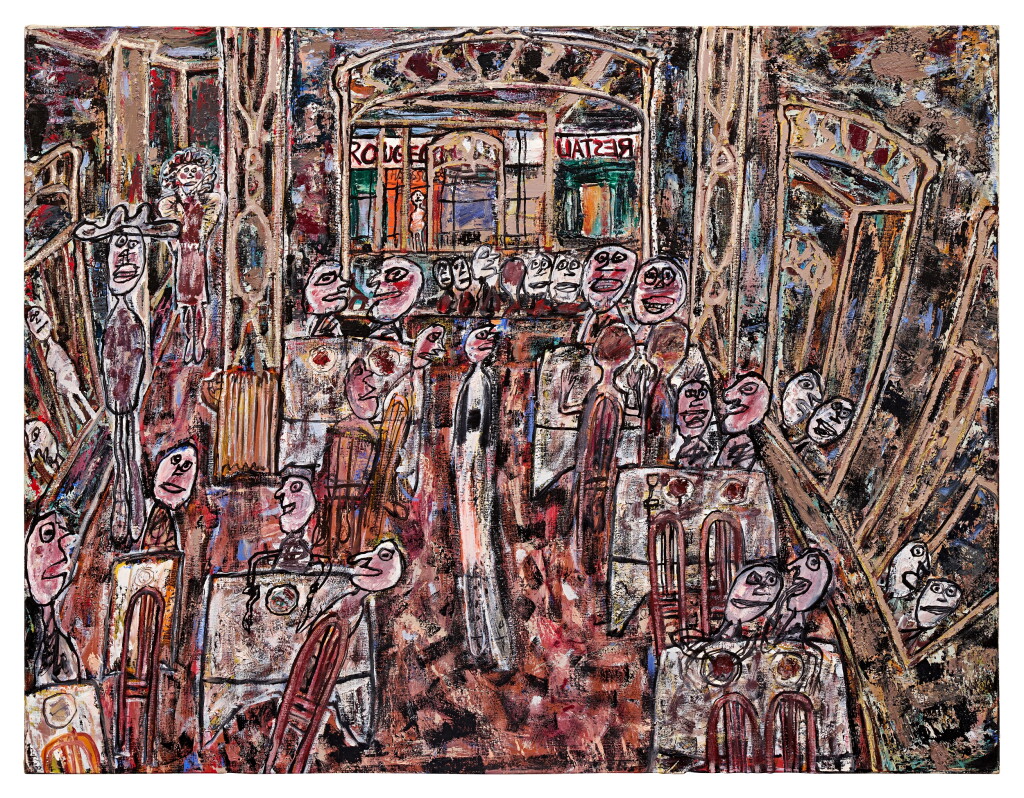
Standing before Jean Dubuffet’s Restaurant Rougeot II, one can almost hear the clatter of dishware, boisterous laughter, symphony of conversation, and spectacle of Parisian nightlife. Dubuffet’s jubilant scene immediately transports the viewer to mid-century Paris, capturing the joie-de-vivre and vibrant atmosphere that characterized a burgeoning era of prosperity and hope in the post-war period. Returning to the bustling urban milieu in Paris after years spent in the Vence countryside, Dubuffet was captivated by the city’s potent sense of optimism and liberation in the wake of World War II. Executed in 1961, a revolutionary year in Dubuffet’s oeuvre, Restaurant Rougeot II is an early example from the artist’s most celebrated and coveted series: the Paris Circus. Dubuffet’s paintings from this limited body of work are poignant vignettes of a rejuvenated Paris: featuring storefronts and street signs, automobiles and local establishments, and city dwellers strewn about wide boulevards. In these works, Dubuffet harnesses a masterful fusion of figuration and abstraction, generating a sensation of unbridled energy through kaleidoscopic coloration and vigorous brushwork. A rare and seminal painting within the Paris Circus series, Restaurant Rougeot II is one of an exceptional suite of just three paintings depicting Restaurant Rougeot, which was once a vibrant enterprise located on the Boulevard Montparnasse. The sister painting to the present work, Restaurant Rougeot I is held in the Dubuffet Foundation’s collection. Furthermore, Restaurant Rougeot II is one of few major city-scene Paris Circus paintings still remaining in private hands; other examples are held in the collections of Musée des Arts Décoratifs, Paris; Tate, London; The Museum of Modern Art, New York; National Gallery, Washington, D.C., and the Centre Pompidou, Paris, among others.
Exuding the boisterous spirit of Parisian urban life, Restaurant Rougeot II crystallizes the ebullience of the dynamic social fabric that Dubuffet encountered upon his return to the city after his sojourn in the country. Here, the viewer is witness to a mesmeric restaurant scene in which patrons lean into gripping conversation, throw their arms up in exclamation, and drink and dine with glee. At the composition’s center, the maître d' outfitted in a white apron commands his audience like the conductor of an orchestra—his swift movement between tables represented by brisk strokes of white pigment. Diners converse over full plates and glasses of wine, at times mingling between tables. Hopeful patrons stand in line at the entrance, waiting their turn for a spot at the beloved Restaurant Rougeot. By the door, a woman presses her hands against her cheeks aghast at a gentleman’s transgression of wearing a hat indoors. A coat check attendant guards his valuables and passersby on the streets peer through paned windows like spectators at the theatre. Dubuffet masterfully navigates the dichotomies between inside and outside, capturing the interior’s lively atmosphere, ornate moldings, and high ceilings, while also situating the viewer in the context of Parisian cosmopolitan life on the street level. Dubuffet’s rendering of the Restaurant Rougeot sign above the entrance and individuality of expression afforded to each character in the scene imbues the painting with an enchanting familiarity, while maintaining the artist’s signature playful, liberated technique. Radically manipulating the perspective of the scene to produce a panoramic-like vantage for the viewer, Dubuffet captures the frenzied energy of Restaurant Rougeot as a microcosm for a vibrant Parisian metropolis.
Begun in 1961, the Paris Circus series marked a revolutionary departure from Dubuffet’s output in the late 1950s. In 1955, in the aftermath of World War II, Dubuffet retreated to rural Vence and began a series of geologically informed works connected to the natural environment. Works of this period, including Topographies, Texturologies, and Matériologies demonstrate the artist’s fascination with exploring his new terrain on a microscopic level and were executed in an austere, earthy palette. After six years in the countryside, Dubuffet’s return to a revitalized Paris sparked watershed development in his practice. The Paris Dubuffet had left was sober and depressed by war, while the new Paris he encountered was a thriving metropolis. Dubuffet responded with a series of works capturing the vitality, speed, and energy igniting the city.
Using a chromatic palette of crimson reds, emerald greens, periwinkle blues, and tangerine oranges, applied in quick strokes over numerous layers, Dubuffet harnessed the essence of a city in progress in Restaurant Rougeot II. Dubuffet’s Paris Circus compositions are densely packed sensory barrages, brimming with information to uncover, just like a metropolitan street. Dubuffet explained his Paris Circus paintings in contrast with his earlier works: "The principle thing about [my paintings of this year] is that they are in complete contrast to those of the Texturology and Materiology series that I did previously. They are in every way the opposite… In reaction against this absenteeist tendency my paintings of this year put into play in all respects a very different intervention. The presence in them of the painter now is constant, even exaggerated. They are full of personages, and this time their role is played with spirit.'' (the artist, "Statement on Paintings of 1961,” in: Peter Selz, The Work of Jean Dubuffet, New York 1962, p. 165)
Boisterous and undaunted, Dubuffet’s Restaurant Rougeot II is an exceptional example from Dubuffet’s most acclaimed series. With a polychromatic palette, vigorous gesture and radical fusion of figuration and abstraction, Dubuffet enchants the viewer with a deluge of color and form, capturing the energy of a new Paris. Held in the same family collection for over forty years, Restaurant Rougeot II is an exceedingly rare and important work within Dubuffet’s exalted oeuvre.
You May Also Like