The Matthew and Carolyn Bucksbaum Collection
Paul Klee
Kopf (Head)
Auction Closed
November 21, 01:55 AM GMT
Estimate
300,000 - 500,000 USD
Lot Details
Description
The Matthew and Carolyn Bucksbaum Collection
Paul Klee
(1879 - 1940)
Kopf (Head)
signed KLEE (upper left)
watercolor and chalk priming on gauze on card
8 ⅛ by 4 ¼ in. 20.6 by 10.8 cm.
Executed in 1919.
Galka E. Scheyer, Braunschweig and Los Angeles (acquired on consignment from the artist in June 1928 and until 1933)
Paul Klee, Bern (acquired from the above in 1933)
Lily Klee, Bern (acquired by descent from the above in 1940)
Klee-Gesellschaft, Bern (acquired from the above in 1946 and until 1948)
Buchholz Gallery (Curt Valentin), New York (acquired in 1948)
Burton G. and Emily Hall Tremaine, Connecticut (acquired in 1948)
Christie's, New York, 5 November 1991, lot 2 (consigned by the estate of the above)
Nancy Whyte Fine Arts, New York
Acquired from the above in April 1996 by the present owner
Los Angeles, Braxton Gallery; San Francisco, California Palace of the Legion of Honor; The Oakland Art Gallery; Santa Barbara, Faulkner Memorial Art Gallery and The Arts Club of Chicago The Blue Four, 1930, no. 11 (Los Angeles); no. 12 (San Francisco); no. 22 (Oakland and Santa Barbara); no. 145 (Chicago)
Hartford, Wadsworth Atheneum, Delaunay to de Kooning, Modern Masters from the Tremaine Collection and the Wadsworth Atheneum, 1991
Kersten Wolfgang and Osamu Okuda, Paul Klee: Im Zeichen der Teilung, Berlin, 1995, p. 335, illustrated
The Paul Klee Foundation, ed., Paul Klee: Catalogue Raisonné, vol. 3, Bern, 1999, no. 2068, p. 38, illustrated
Exh. Cat., Bern, Zentrum Paul Klee and Leipzig, Museum der bildenden Künste, Paul Klee: Sonderklasse—unverkäuflich, 2014-15, no. 29, p. 192, illustrated in color; pp. 193 and 518
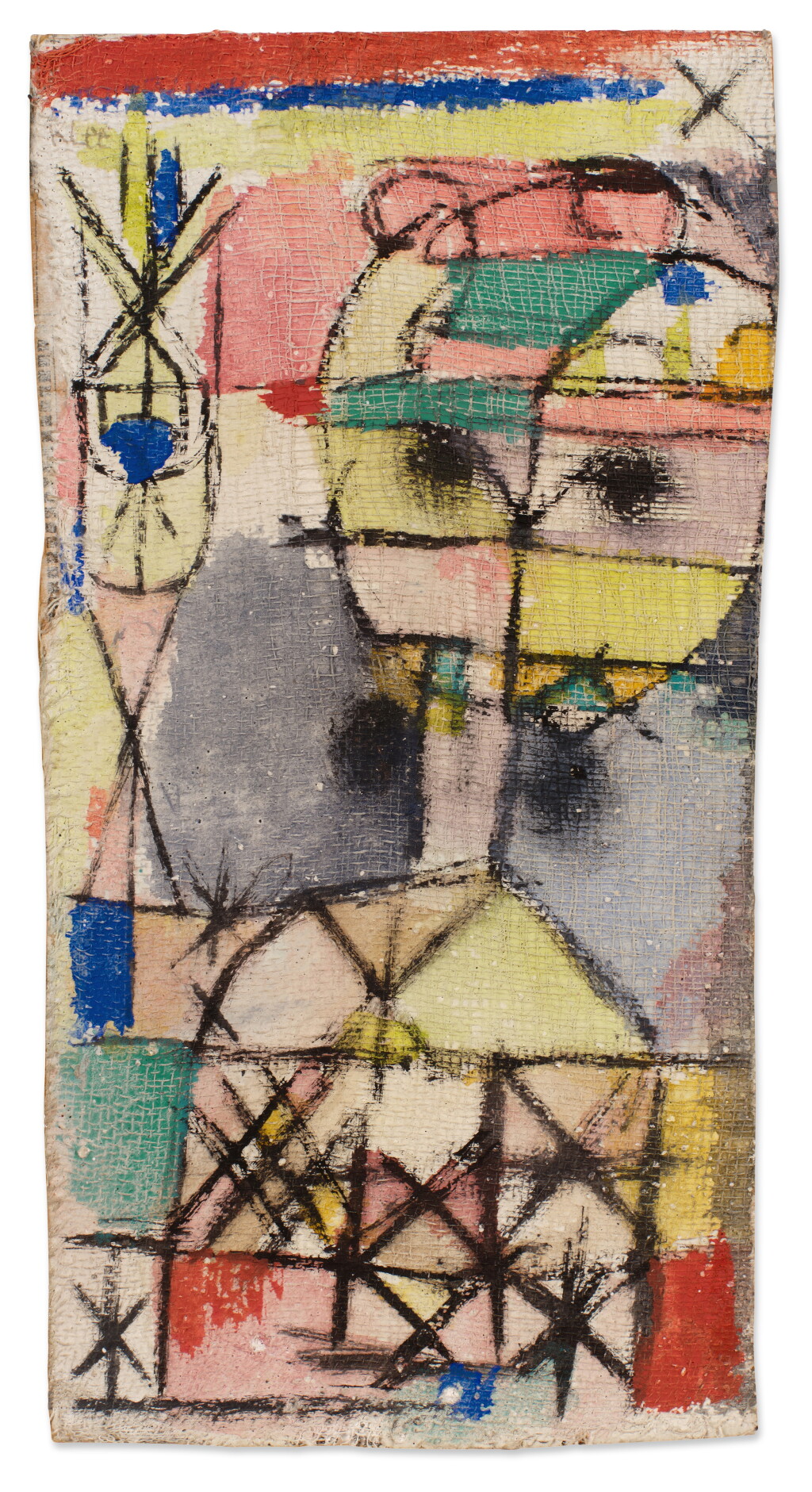
In 1919, as Europe sought to rebuild from the devastation of war, Paul Klee turned to the human face as a site of reconstruction. Painted on chalk-primed gauze, Kopf (Head) embodies this search for renewal—Klee reimagining the head not as likeness but as instrument. The face becomes scaffold, stage, and field of vision: a locus where inner life and formal invention converge. Its geometric framework and translucent color harmonies reveal an artist who had absorbed both the Mediterranean light of Tunisia and the structural rigor of the prewar avant-garde, forging a new, distinctly Kleean language.
The present work originated as part of a single composition that Klee later divided into two autonomous watercolors—Kopf (Head) and Sphinxartig (Sphinx-like)—a process that epitomizes his “destructive–constructive” method (Paul Klee: Sonderklasse Unverkäuflich, Bern, 2015, pp. 192–193). The decision to sever and rework the image was not an act of loss but of transformation: from one pictorial organism, two beings emerged. The band of red, blue, and yellow along the upper edge of Kopf is no mere accent—it anchors the newly cut edge and introduces a chromatic rhythm that stabilizes the composition while asserting its independence.
Seen historically, Kopf bridges two defining moments in Klee’s development. The first is the Tunisreise of 1914, when he declared, “Color possesses me… Color and I are one. I am a painter” (Diaries, London, 1964, p. 297). The second is the constructive formalism he would later codify at the Bauhaus in Das bildnerische Denken (1923). Kopf fuses these legacies: its palette carries the memory of North African light, while its planar structure anticipates the modular geometry of later works, such as Senecio (see fig. 2; also depicted in the background of fig. 4), and the compositional logic of his Bauhaus period (see fig. 3).
The painting’s support—gauze primed with chalk over card—is among Klee’s most experimental surfaces from this period. The open weave of the fabric allows pigment to seep and settle, producing a diaphanous, breathing texture. This technical innovation anticipates the artist’s later Ölpause and transfer drawings of the early 1920s, where image and ground merge through processes of absorption, trace, and reversal (see fig. 5). In Kopf, the porous surface becomes an analogue for consciousness itself: a membrane between inner vision and outward form.
For Klee, the face was never a mere physiognomy. As he wrote in 1901, “I am not here to reflect the surface… but must penetrate inside. My mirror probes down to the heart. I write words on the forehead and around the corners of the mouth. My human faces are truer than the real ones” (Diaries, 1964, pp. 47–48). His heads are psychological portraits—investigations of temperament, social role, and the space between concealment and revelation. In Kopf, the divided planes and translucent layers act not as anatomy but as cues for mood and character: a dialectic of reserve and ardor, distance and exposure.
Klee, a self-described “theater fiend,” conceived much of his art as performance, populating his pictorial world with actors, marionettes, masks, and stages. As Christina Thompson observes, “this enthusiasm for theater reads first of all as an obvious metaphor for Klee’s view of the world, in which human beings act as players on the stage of life and represent existence to themselves in a ‘theater of reality’” (Exh. Cat., Berlin, Neue Nationalgalerie, The Klee Universe, 2008, pp. 165-66). Mask and costume, for Klee, permitted fluid identities—a visual drama of metamorphosis explored through both painting and play.
In Kopf, this theatricality is palpable: the gauze ground reads like a fragile scrim, while the softly lit visage seems to shift between appearance and being. The head is both actor and role—an animated puppet of inner forces and a mirror for the viewer’s gaze. Klee’s handmade puppets, constructed for his son Felix, literalize this interest in staged identity. Their articulated forms and changeable expressions mirror the logic of his painted heads: both investigate how the self is performed, transformed, and made visible.
Formally, Kopf assimilates the legacies of Cubism and Orphism without imitation. Klee absorbed from Cubism a sense of structural rhythm rather than analytic dissection, treating the grid as a living, breathing scaffold. Its lines suture color fields but never imprison them. The chromatic counterpoints—coral, lemon, pale teal—echo the Delaunays’ notion of “color simultaneity,” a harmony that “divides and reunites” in the same act (Der Sturm, 1912). Here, color functions as both emotion and architecture—the pulse of the composition itself.
Picasso and Braque’s late Cubist heads similarly fragment and recompose the human visage (see fig. 6), yet Klee’s approach remains more introspective. His heads do not monumentalize but meditate; they balance precision with lyrical instability. This sensibility, poised between play and structure, would resonate with later modernists—from Miró’s Constellations (see fig. 8) to Calder’s mobiles and Rothko’s radiant color fields (see fig. 7)—all inheriting Klee’s vision of abstraction as a living organism.
Klee’s own esteem for Kopf confirms its centrality within his œuvre. Nearly a decade after its creation, he elevated the watercolor to his Sonderklasse—literally “special class”—the designation he reserved each year for his most exemplary works. Around 1927–28, he inscribed the backing board with “S. Cl.,” a mark of distinction now known only from an archival photograph, as the original board was later removed. When Klee sent the sheet to the German-born art dealer Galka Scheyer in the United States in 1928, the work appeared in her delivery list as “unsellable,” accompanied by the note “S. Cl.” This practical annotation reads more like an act of devotion than a matter of accounting. Between 1930 and 1932, Scheyer exhibited the piece—under the titles Figure and Figure Abstraction—across California and Chicago as part of her “Blue Four” exhibitions, introducing to American audiences a work Klee himself regarded not as a commodity but as a culmination.
The provenance of Kopf traces the arc of Klee’s international reception: from Scheyer’s circle in California to Lily Klee in Bern, through the Klee-Gesellschaft, and into Curt Valentin’s Buchholz Gallery in New York. Acquired in 1948 by Burton G. and Emily Hall Tremaine—whose visionary collection defined mid-century taste—Kopf featured in The Spirit of Modernism (1984) and Delaunay to de Kooning (1991) before entering the collection of the present owner in 1996. Each transition marks the watercolor’s evolving stature: from private treasure to emblem of Klee’s enduring modernity.
Kopf stands among Klee’s most refined meditations on the human image—neither portrait nor abstraction, but a visual consciousness in flux. Its fragile surface, chromatic poise, and crystalline geometry embody the moment when Klee transformed painting into a language of thought. In its synthesis of destruction and creation, its theater of metamorphosis, and its porous materiality, Kopf renders visible the invisible: the act of becoming itself.
You May Also Like