Property of an Important North American Collection
Wifredo Lam
Ídolo (Oyá/Divinité de l'air et de la mort)
Auction Closed
November 21, 01:55 AM GMT
Estimate
6,000,000 - 8,000,000 USD
Lot Details
Description
Property of an Important North American Collection
Wifredo Lam
(1902 - 1982)
Ídolo (Oyá/Divinité de l'air et de la mort)
signed Wifredo Lam and dated 1944 (lower left)
oil and charcoal on canvas
62 by 50 ¼ in. 157.3 by 127.6 cm.
Executed in 1944.
Galerie Pierre, Paris
Carlos Raúl and Margot Villanueva, Caracas (acquired circa 1952)
Sotheby’s, New York, 23 May 2012, lot 8 (consigned by the above)
Acquired at the above sale by the present owner
Avignon, Palais des Papes, Exposition de peintures et sculptures contemporaines, 1947
Caracas, Museo de Bellas Artes, Wifredo Lam, pintura y obra gráfica 1938-1976, 1986-87, no. 31
London, The Hayward Gallery; Stockholm, Moderna Museet and Madrid, Palacio de Velázquez, Art in Latin America, The Modern Era 1820-1980, 1989-90, p. 232, illustrated in color
Washington, D.C., Hirshhorn Museum and Sculpture Garden, Crosscurrents of Modernism, Four Latin American Pioneers: Diego Rivera, Joaquín Torres-García, Wifredo Lam, Matta, 1992, no. 61, p. 201, illustrated in color
New York, The Museum of Modern Art, Latin American Artists of the Twentieth Century, 1993, no. 103, p. 259, illustrated in color
Madrid, Museo Nacional Centro de Arte Reina Sofía, Wifredo Lam, 2016, p. 103, illustrated in color
Boston, McMullen Museum of Art and Atlanta, High Museum of Art, Wifredo Lam: Imagining New Worlds, no. 36, p. 127, illustrated in color
Centre Pompidou Metz, Cartographies for After the End, no. 55 p. 111, illustrated in color
Pierre Loeb, Voyage à travers la peinture, Paris, 1946, pl. XVII, illustrated
"Wifredo Lam et les idoles crépusculaires," Quadrum, no 3, 1957, p. 38, illustrated
Patrick Waldberg, Metafisica, Dada, Surrealismo: le immagini e gli eventi dell'inconscio, Milan, 1967, no. 98, illustrated
Michel Leiris, Wifredo Lam, New York, 1970, p. 150, illustrated
Max Pol Fouchet, Wifredo Lam, Barcelona and Paris, 1976, no. 374, p. 232, illustrated
Lou Laurin-Lam and Eskil Lam, Wifredo Lam: Catalogue Raisonné of the Painted Work, vol. I, 1923-1960, Paris, 1996, no. 44.88, p. 366, illustrated
Lowery Stokes Sims, Wifredo Lam and the International Avant-Garde, 1923 - 1982, Austin, 2002, fig. 2.19, pp. 53 and n.p., illustrated
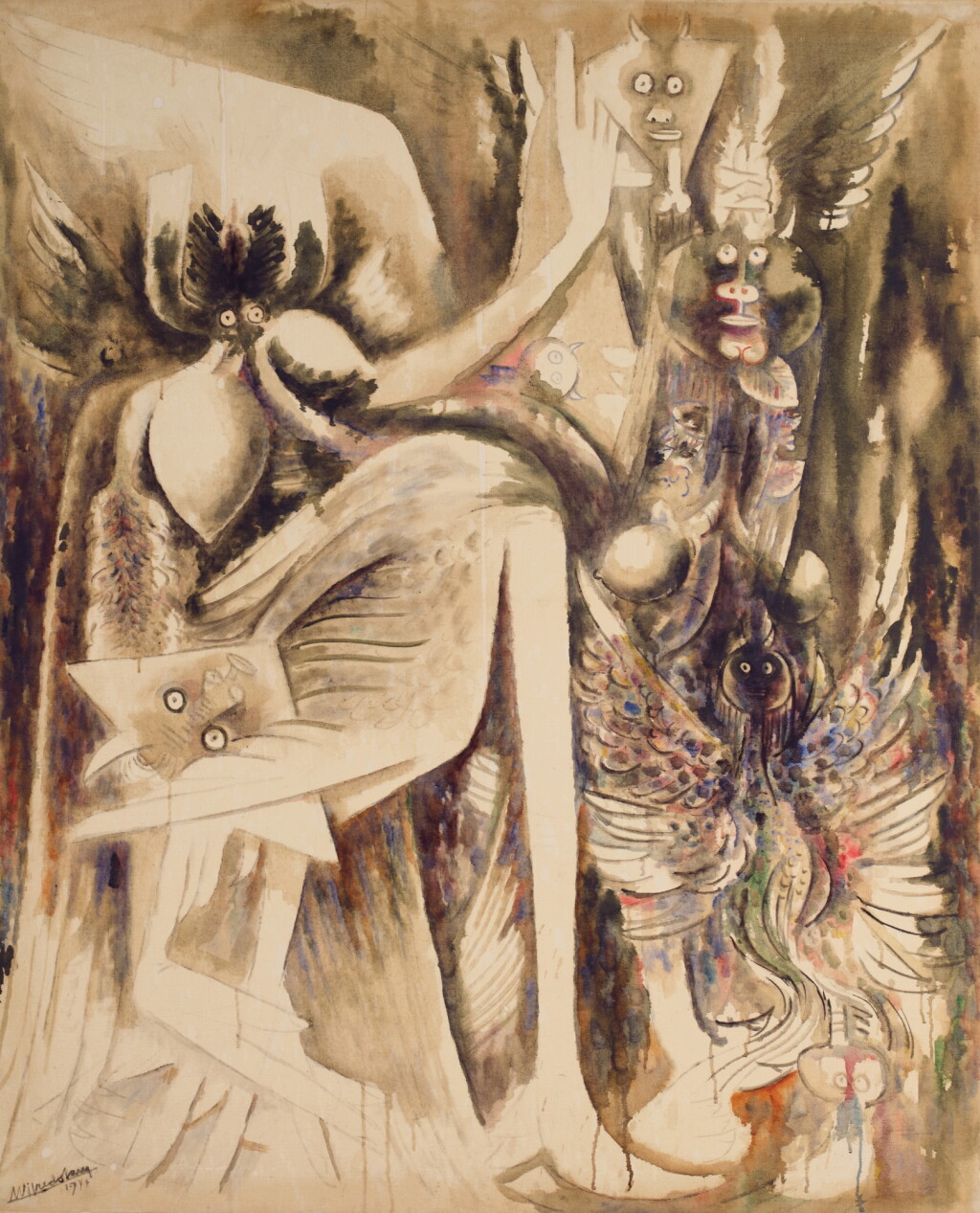
Wifredo Lam’s Ídolo (Oyá/Divinité de l'air et de la mort) synthesizes the formal elements of European Surrealism and the rich cultural iconography of Afro-Cuban Santería, exemplifying a time when Lam was both rediscovering his home of Cuba and establishing his career abroad. A central figure bends backward in a dramatic arch, overseen by three additional figures that emerge from the abyss. Lam’s monumental format brings the figures to nearly human scale, exaggerating the effects of their striking bodily components and creating an immersive visual experience. With heads composed of diamond, triangle, and bulbous geometric arrangements and intertwining arms, legs and wings, the present work exemplifies the captivating visual vocabulary that Lam formulated as a means to visualize the metaphysical.
Painted in the most defining period of Lam’s oeuvre and life, the present work marks a time in which Lam was rediscovering his ancestry and cultural heritage. Born in Sagua la Grande, Cuba to a Chinese father and a mother of African and Spanish ancestry, Lam was awarded a government sponsored scholarship at the age of twenty-one to study art in Europe. Leaving Cuba in 1923, Lam would ultimately spend nearly two decades divided between Spain and France. With the onset of World War II, Lam was forced to leave Paris in 1940 and returned to his birth country of Cuba by way of Marseille and Martinique. During his stay in Marseille, Lam encountered many Surrealist artists and writers, most notably André Breton. Lam conjured fantastic illustrations for Breton’s 1941 publication Fata Morgana as they awaited exit visas from Europe to escape rapidly escalating tensions. Once granted, the two travelled together to Caribbean Martinique as Lam made his return to Cuba.
It was in Martinique that Lam encountered Aimé Césaire, the poet and prominent exponent of 'négritude' who was to become one of the artist's closest friends. Through his friendship with Césaire, Lam became fully conscious of his African roots (his mother, Ana Serafina Lam, was a descendant of a Congolese slave) and he grew to identify with the poet's texts, notably his Cahier d'un retour au pays natal, which Lam would later illustrate in 1943 when it was published in Cuba. Césaire’s writing and persistent dedication to capturing the violence of colonialism that permeated Caribbean nations would have a defining effect on Lam’s work.
Upon disembarking in Cuba in 1941, Lam was deeply wounded to observe the precariousness in which the black population was living. His return also reunited him with the religious influences of his youth. Santería, a syncretic religion that blends West African Yoruba religious rites with Catholicism, was originally introduced to him by his madrina, or Godmother, Mantonica Wilson. Wilson was a revered Priestess and a known healer in the community, and she instilled in Lam a reverence for the religion. Santería and its traditions are fundamentally built upon the worship of a pantheon of Orishas, akin to Catholic saints. These spirits became a pivotal source of inspiration for Lam and appear throughout his compositions, as in the present work. Through his explorations of Santería’s symbols and influences, Lam was committed to preserving Afro-Cuban Culture.
Central to the present work in title and presumably in subject is the orisha Oyá, a principal deity of Santería. A multifaceted orisha, Oyá holds dominion over winds, storms and lightning in addition to guarding the entrances to cemeteries and stewarding the souls of the dead. Both a warrior and mother of many children, her strength is abundant. As an orisha associated with change and transition, Oyá is thought to have shape-shifting powers and often assumes the form of a buffalo. The horns bore by the many figures in the present work, most notably the elaborate headdress of the bulbous, left-most background apparition, are possible nods to Oyá’s animal attribute.
Ídolo (Oyá/Divinité de l'air et de la mort) exhibits the theme of duality that is central to Lam’s work. The figure at center, perhaps Oyá herself, is both upright and reclining, anthropomorphic and animalistic. The paint is concentrated in areas of intensity while the rest of the image hovers at the edge of perception. Objects protrude and recede from the depths, and Lam’s figures are as familiar and inviting as they are foreign. The present work’s monumentality and geometrically derived figures recall Pablo Picasso’s Les Demoiselles d’Avignon, aligning Lam with the Cubist influences that he encountered before departing Europe. The duality within Lam’s subjects and style is reflective of the syncretic, Afro-Cuban culture in which he was raised as well as the range of Western and non-Western influences that circulate within his work.
The present work shows Lam in a more spontaneous and process-oriented mode, engaging a loose, freely dripping painting technique with layered washes of brown and black tones. Lam created several paintings with the present work’s limited palette and inventive treatment of paint, which anticipates the development of Abstract Expressionism in the decades that followed. The dripping technique and Lam’s earthy, neutral hues demonstrate a striking correspondence with developments in the work of Arshile Gorky and the action painting technique established by Jackson Pollock. Lam’s engagement with looser applications of medium leads us to provocative conclusions about the artist’s involvement in the development of Abstract Expressionism, further expanding our understanding of Lam's impact on the global development of modern art in the mid-twentieth century.
In his work, Lam permeates the boundary between the mortal and metaphysical realms, blending Afro-Cuban influences and Western art into striking compositions that act as conduits for dismantling the colonial system and its legacy. His mesmerizing works at this time earned him international recognition, particularly in the buzzing New York art world. In 1944, concurrent with the present work, the Museum of Modern Art (MoMA) in New York had recently acquired Lam’s La Jungla and the artist had become a routine exhibitor at Pierre Matisse’s renowned New York gallery. Executed in a time of ever-expanding global presence, revered and inspired style and institutional recognition, Idolo (Oya/Divinite de l'air et de la mort) is a true reflection of an artist ascending to the highest degrees of distinction.
Ídolo (Oyá/Divinité de l'air et de la mort) and its arrival at auction this fall is complemented by a major retrospective exhibition of Lam’s oeuvre at the Museum of Modern Art (MoMA) in New York. The exhibition, titled Wifredo Lam: When I Don’t Sleep, I Dream and opening on November 10th, traces Lam’s astounding career, spanning several countries over six decades and including 130 works across a variety of mediums. Nearly eighty years after MoMA acquired La Jungla, the exhibition reaffirms the museum’s pivotal role in championing Lam’s legacy and emphasizes the artist as a central figure in the development of modern art.
You May Also Like