The Geri Brawerman Collection: A Tribute to Los Angeles and A Legacy of Giving
Pablo Picasso
Homme et femme. Têtes
Auction Closed
November 21, 01:55 AM GMT
Estimate
3,000,000 - 5,000,000 USD
Lot Details
Description
The Geri Brawerman Collection: A Tribute to Los Angeles and A Legacy of Giving
Pablo Picasso
(1881 - 1973)
Homme et femme. Têtes
dated 21.3.67 and numbered V (on the reverse)
oil and Ripolin on canvas
36 ¼ by 28 ¾ in. 92 by 73 cm.
Executed on 21 March 1967.
Estate of the artist
Maya Picasso (acquired by descent from the above)
Stephen Mazoh, New York
Private Collection, Stockholm
Marisa del Re Gallery, New York
Acquired from the above on 4 November 1991 by the present owner
Christian Zervos, Pablo Picasso: Oeuvres de 1965 à 1967, vol. XXV, Paris, 1972, no. 305, pl. 134, illustrated
Homme et femme. Têtes exemplifies Picasso’s late-period refinement of psychological portraiture, where even the most elemental imagery is charged with a profound tension between individual identity and interpersonal connection. Executed on 21 March 1967, just weeks into the artist’s now-celebrated Mousquetaires series, the painting distills the drama of encounter—between male and female, self and other—into an intimate exchange of gazes.
Through its cropped vantage point, Homme et femme. Têtes achieves a monumental presence. The male figure—defined by bold calligraphic strokes, an arched moustache, goatee and swirling curls—exudes the flamboyant theatricality of the mousquetaire archetype. Opposite him, the female profile balances this energy through a lyrical counterpoise of line and contour. Their shared pictorial space is one of tension rather than separation: eyes, noses, and mouths seem to mirror one another across the vertical axis of the canvas, suggesting both confrontation and communion—an image of two beings who might, in truth, be one.
Picasso’s fluid handling of paint—combining the gestural brushwork of his mature years with passages of smooth Ripolin (a favored enamel paint of the aritst's)—creates a visual rhythm that dissolves distinctions between figure and ground, male and female, subject and reflection.
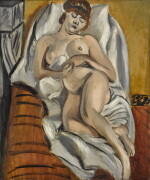
Beyond the overt gendered archetypes, the work may be read as a disguised self-portrait. In his late paintings, Picasso repeatedly inhabited the figures he depicted—whether the dashing mousquetaire, the aged painter, or the contemplative lover. Here, the male visage bears the theatrical mask of the artist himself, while the female figure, with her introspective calm, evokes Jacqueline Roque, Picasso’s muse and companion in the final years of his life (see fig. 1). Yet these are not portraits in any conventional sense; rather, they represent dual aspects of Picasso’s own psyche, intertwined and in dialogue.
The confrontation between male and female echoes a long art-historical lineage, recalling Renaissance double portraits such as Piero della Francesca’s Duke and Duchess of Urbino (see fig. 2) and the reflective exchanges of Velázquez’s Las Meninas—works Picasso revered and reinterpreted throughout his career. In Piero’s diptych, the serene equilibrium between husband and wife embodies ideals of order, harmony, and civic virtue, each profile poised in perfect balance within a rational, perspectival space. Velázquez, in turn, stages a more dynamic exchange between viewer, subject, and mirror, folding perception into the very structure of the image. While Renaissance artists sought ideal harmony, Picasso disrupts this balance by introducing ambiguity and flux. His figures twist and fragment, challenging any fixed notion of identity. What once symbolized complementarity becomes, in Homme et femme. Têtes, a field of psychological tension—an extension of Picasso’s lifelong exploration of fractured form and fluid selfhood that began with the planar innovations of Cubism and deepened through the emotional distortions in his 1930s portraits of Dora Maar.
In this light, Homme et femme. Têtes anticipates the full flowering of the Mousquetaires later that year, yet it stands apart in its distilled emotional directness. At once intimate and charged, the present work also extends the inquiry begun in Picasso’s Le peintre et son modèle series earlier that decade (see fig. 3)—probing the interplay of masculine and feminine identities within a shared pictorial space. In both, the act of looking becomes an act of self-recognition. Moreover, Homme et femme. Têtes may be seen as a precursor to the Le Baiser paintings of 1969 (see fig. 4), in which male and female figures once again appear side by side—this time in a tender embrace—rendered in a comparable palette and infused with a similarly charged psychological atmosphere.
Executed during one of the most productive and introspective phases of Picasso’s life in Mougins, Homme et femme. Têtes displays the exuberance and psychological complexity of his late oeuvre. The Mousquetaires—inspired by Dumas, Rembrandt and Velázquez—became a vehicle for his meditation on time, vitality, and aging. Emblematic of the freedom and spontaneity that defined his final years, Homme et femme. Têtes captures this spirit through its scumbled lines and frenzied brushwork. The painting reflects both a growing awareness of mortality—as Picasso sought to ward off death through a last, urgent burst of creativity—and a deliberate embrace of complete liberty in style and subject.
The gestural energy and immediacy of Homme et femme. Têtes resonate with the developments of the Abstract Expressionists. Its fluid, calligraphic lines and expressive, near-abstract background recall the lyrical freedom of Cy Twombly, where spontaneity becomes a vehicle for emotion and meaning. Likewise, Jackson Pollock’s Portrait and a Dream (see fig, 5) juxtaposes two contrasting faces—psychological doubles inhabiting a single field—mirroring Picasso’s own exploration of duality and fractured identity. Both artists transform gesture into a language of introspection, using abstraction not as escape from form, but as a means to probe the self. As art historian Simonetta Fraquelli observes:
“In an era when non-figurative art was prevailing over figurative art and a linear progression of ‘style’ was considered more relevant than emotion and subject, it was customary for many younger artists and art critics to think of late Picasso as lesser Picasso. However, the extensive re-evaluation of his late work since his death has highlighted its undiminished power and originality. His capacity for emotional depth and painterly freedom in his late painting, together with his wide-ranging engagement with the imagery of the great paintings of the past, was to have a lasting influence on the development of neo-expressionist art from the early 1980s onwards.”
-Simonetta Fraquelli (Exh. Cat., London, National Gallery, Picasso: Challenging the Past, 2009, p. 146)
The painting’s distinguished provenance underscores its significance within Picasso’s late œuvre. Retained by the artist until his death in 1973, it passed to his daughter Maya Picasso, before entering the collection of noted New York dealer Stephen Mazoh, a key advocate of European modernism in America. The work has remained in the Brawerman collection since 1991.
You May Also Like