
The Surya Collection: Property from Mrs. Ute Rettberg
Nelly Sethna
Untitled
Auction Closed
March 17, 05:35 PM GMT
Estimate
18,000 - 22,000 USD
Lot Details
Description
The Surya Collection: Property from Mrs. Ute Rettberg
Nelly Sethna
1932 - 1992
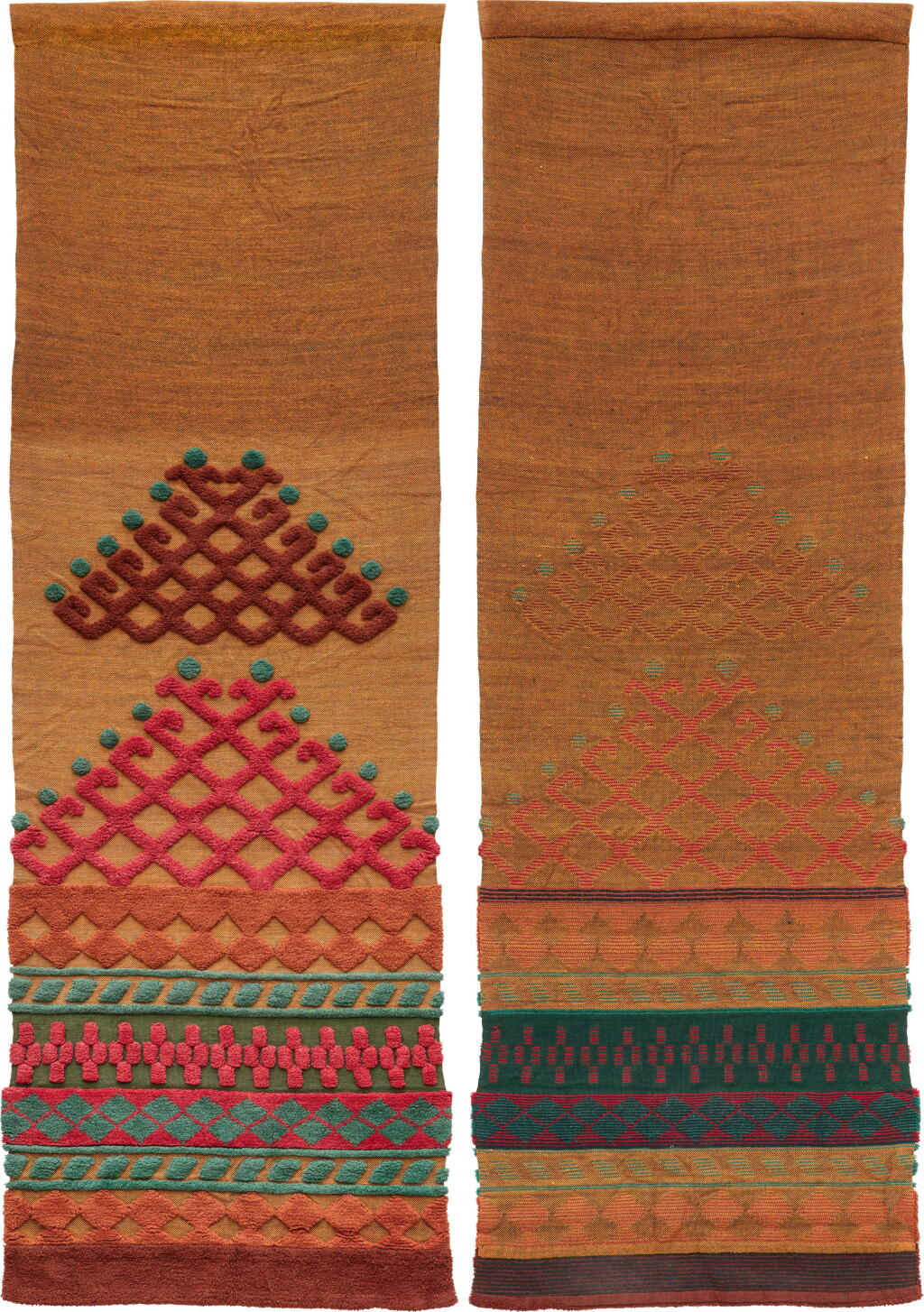
Untitled
Hand-woven wool and cotton
132 x 43 in. (335.3 x 109.2 cm.) (approx.)
Acquired directly from the artist circa 1970s
"There are studio weavers whose works look like paintings. But weaving, for me, is displaying the conditioning method and thread count in myriad forms and styles. Although I am greatly impressed with the Far Eastern and South American weaves, they do not corrupt my originality, as much is home-spun. Sophisticated innovation does not arise as their art, like mine, springs out of life." (Nelly Sethna quoted in C. Maitra, 'Textiles for Interiors, featuring textile designs by Nellie Sethna', Indian Architect and Builder, Vol. 2, No. 12, August 1989, p. 20)
Nelly Sethna stood at the crossroads of textile design, craft research and activism, using her weaving skills to produce new visual languages that defied textile conventions in post-independence India. She began her training at the School of Applied Arts, Bombay, before earning a diploma in textile design and printing from Regent Street Polytechnic in London. In 1957, she worked at a graphic studio in Stuttgart, Germany, before returning to India to become the head textile designer at Bombay Dyeing and Manufacturing Co. Ltd. The following year, a scholarship took her to the Cranbrook Academy of Art in Michigan, where she studied weaving. She returned to the US in 1964, invited by the American Craftsmen’s Council to lecture, exhibit, and represent India at the World Congress of Craftsmen.
Over the years, Sethna held numerous solo exhibitions and undertook prestigious commissions, including works for the Ford Foundation Headquarters in New Delhi, the Chandigarh Museum, Air India, and the Indian Pavilion at the Expo '70 World's Fair. Her relentless experimentation drew on natural motifs, geometric ornaments and ritualistic diagrams, blending traditional materials like wool and cotton with innovative tonal and textural techniques.
This ethos is evident in the present work, which recalls traditional kilim patterns through intricate, vibrant geometric designs infused with esoteric symbolism. The lower end of the tapestry is adorned with a lattice-like composition including two hooked half-medallions above six rows of varied quadrilateral shapes. Breaking away from traditional flat weaves, Nelly Sethna introduced a knotted pile finish, layering intricate colors and motifs to lend the piece striking presence and verticality.
As demonstrated here, Sethna transcended conventional boundaries within her medium. She embraced a vision of inclusivity and excellence, whether restoring marginalized textile traditions to their former vitality or creating works that blur the lines between tapestry, sculpture and installation.