
Property from a French Private Collection
Akbar Padamsee
Untitled
Auction Closed
March 17, 05:35 PM GMT
Estimate
180,000 - 280,000 USD
Lot Details
Description
Property from a French Private Collection
Akbar Padamsee
1928 - 2020
Untitled
Oil on canvas
Signed and dated 'PADAMSEE / '63' lower right and further inscribed indistinctly on reverse
23 ⅝ x 36 ¼ in. (60 x 92.1 cm.)
Painted in 1963
Acquired directly from the artist, Paris, 1963
After graduating from the prestigious Sir J.J. School of Art in Mumbai in 1951, Akbar Padamsee embarked on a transformative artistic journey to Paris. Immersed in the vibrant cultural milieu of the city, he drew profound inspiration from the works of Fauvist painters, notably Georges Rouault. His formidable artistic vision quickly captured the attention of leading French cultural figures, including André Breton, who awarded him a prize in the esteemed Journal d’Arte competition, and Henri-Pierre Roché, a renowned collector who once vowed to make him famous.
Padamsee thrived in Paris, building a close-knit circle of friends and collaborators. His fellow Indian artists and friends Sayed Haider Raza and Francis Newton Souza were frequent visitors, offering support and camaraderie that nurtured his artistic growth. In 1954, Padamsee married Solange Gounelle, a pivotal figure in his personal and professional life. Through her, he was introduced to Mrs. R., the current owner of the present painting. At Solange’s request, Mrs. R., who became a close friend of the couple, posed on multiple occasions for Padamsee in the studio where this canvas was hanging. During these modeling sessions, she gained a profound appreciation for the work and eventually persuaded the artist to sell it to her.
Throughout the 1960s, Padamsee traveled between Mumbai, Paris and New York to paint and exhibit his works, with support from the much-coveted John D. Rockefeller III grant between 1963 and 1964. It is perhaps the relentless succession of urban landscapes imposed by this peripatetic lifestyle that inspired his sustained experimentation with imaginary natural spaces.
'Never subsumed by wispy trees, romantic sunsets, or the limitations of conventional geography, Padamsee’s landscapes often transcended the representation of specific sites and physically accurate settings. Rather than an intent to describe the natural world per se, the artist's object was the total conceptual and metaphysical ken of his visual environment, with his paintings impressing an immediate perceptual experience that relied on expression and sensation rather than realist recognition.' (B. Citron, 'Akbar Padamsee's Artistic "Landscape" of the '60s' in B. Padamsee and A. Garimella (eds.), Akbar Padamsee: Work in Language, Marg Publications and Pundole Art Gallery, 2010, p. 195)
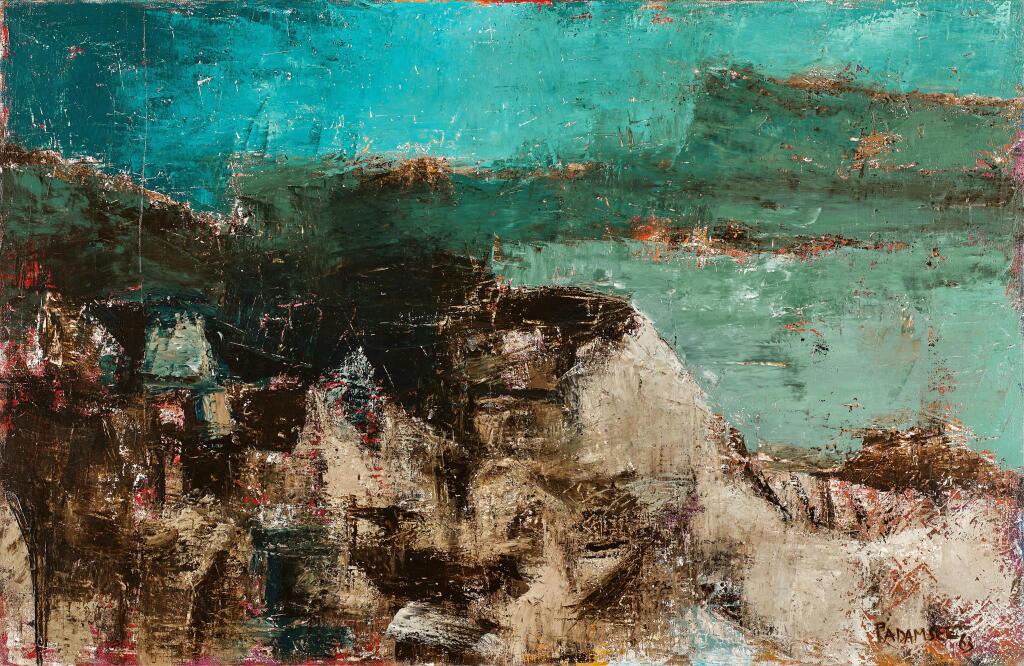
The townscape at the forefront of the painting is rendered in stark, dusky tones with thick rectangular shapes verging on pure abstraction. The mild torpor emanating from the grayed village contrasts exquisitely with the flamboyant cerulean camaïeu of a delicately suggested hillscape visible in the distance, suspended between sky and sea. This mesmerizing composition embodies the unique, otherworldly essence characteristic of Padamsee's landscapes, and serves as a crucial prologue to his Metascape series which gradually dominated his output from the following decade until the end of his career.