Serge Poliakoff
Composition abstraite
Auction Closed
December 3, 04:59 PM GMT
Estimate
300,000 - 400,000 EUR
Lot Details
Description
Serge Poliakoff
1900 - 1969
Composition abstraite
signed (lower left)
oil on canvas
130 x 162 cm; 51 x 63 ¾ in.
Executed in 1959.
Galerie Melki, Paris
Private Collection (acquired from the above)
Sotheby's, London, 21 June 2006, lot 48
Private Collection, USA (acquired at the above sale)
Phillips, London, 27 June 2018, lot 26
Acquired from the above sale by the present owner
Alexis Poliakoff, Serge Poliakoff. Catalogue Raisonné, 1959-1962, vol. III, Munich 2011, no. 59-16, p. 72, illustrated in colour
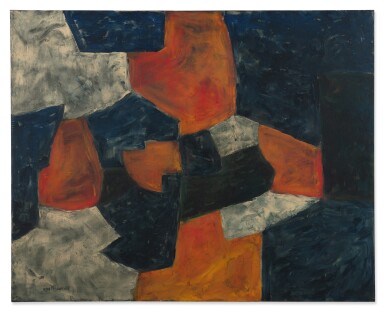
In Composition abstraite, painted in 1959, Poliakoff constructs a dense, meditative space using interlocking planes of colour. Deep blues and blacks contrast with incandescent oranges and reds, while cooler greys traverse the surface like pauses in the rhythm. The composition appears both compact and open: the shapes press against each other without ever locking into symmetry, creating a slow, almost musical rotation that keeps the viewer in a state of calm tension rather than waiting for a narrative.
The surface reveals Poliakoff's characteristic technique, with pigments applied in successive layers rather than uniform flat areas. The dark areas seem to contain submerged blues and greens, while the warmer passages give off a muted inner glow. This subtle vibration of tones reflects his constant search for a balance between form, colour and background. With an early provenance from the Galerie Melki in Paris, the work is a particularly accomplished example of the artist's post-war mature years.
Born in Moscow in 1900, Serge Poliakoff left Russia after the Revolution and finally settled in Paris in the early 1920s, after several years of travelling around Europe. It was there that he abandoned his academic training to turn to abstraction, encouraged by his encounters with artists such as Kandinsky, Sonia and Robert Delaunay, gradually forging his unique language of superimposed chromatic fields. A major figure in the post-war École de Paris, he was the subject of numerous exhibitions during his lifetime and major institutional retrospectives; his works are now held in important public collections around the world, such as the Tate in London, the Guggenheim in New York and the Centre Pompidou in Paris.
You May Also Like