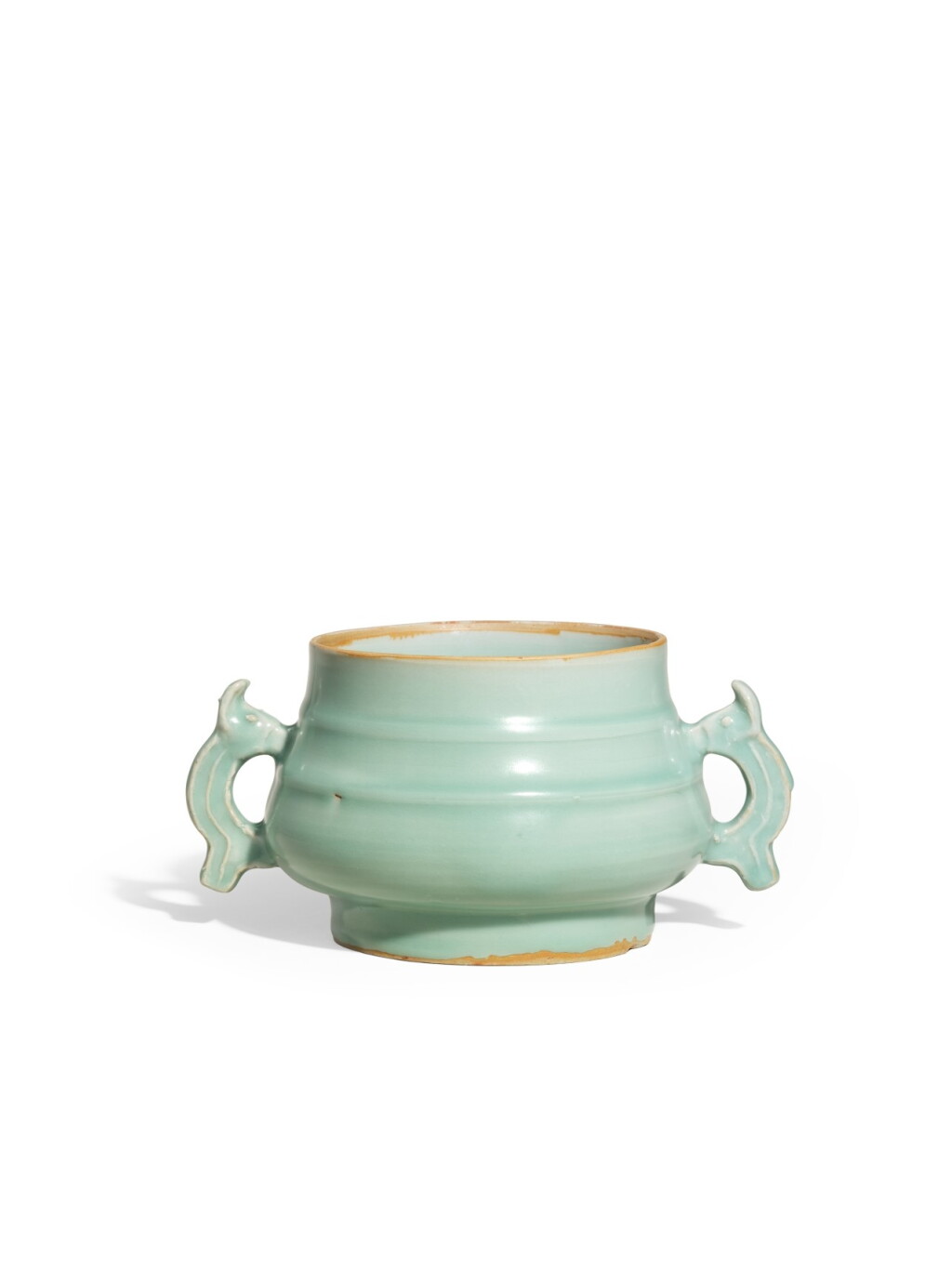
A Longquan celadon incense burner, Southern Song dynasty | 南宋 龍泉青釉弦紋獸耳簋式爐
Auction Closed
September 9, 11:30 AM GMT
Estimate
800,000 - 1,600,000 HKD
Lot Details
Description
of archaic bronze gui form, potted with a rounded lower body tapering towards the rim, the exterior encircled by a pair of raised ribs and flanked by a pair of handles in the form of a stylised beast, covered overall save for the mouth-rim and footring with an even sea-green glaze, Japanese double wood box
w. 23.5 cm
Mayuyama & Co., Ltd, Tokyo.
So Ji – Shinpi no Yakimono [Song Ceramics Utensils of Sublime Beauty], Idemitsu Museum of Art, Tokyo, 2018, cat. no. 92.
An Exhibition of Song Ceramics, Mayuyama & Co., Ltd, Tokyo, 2018, cat. no. 5.
This archaism in Song ceramics first emerged under imperial patronage during the Northern Song dynasty, gaining particular prominence during Emperor Huizong's reign (1100-1125) with the publication of official bronze catalogues such as the Xuanhe Bogu Tu. This vogue flourished further after the Shaoxing period (1131-1162) of the Southern Song, producing refined archaistic wares for both official and private use.
Compare a highly related celadon incense burner in a similar form, attributed to the Southern Song Xiuneisi official kiln, in the collection of the Palace Museum, Taipei , illustrated in Catalogue of Special Exhibition of Southern Sung Kuan Ware, Taipei, 1989, pl. 35. Compare also a close Longquan example, in the British Museum (acc. no. 1947,0712.114), illustrated in Rackham and King Hobson's Chinese Ceramics in Private Collections, London, 1931, p. 54, fig. 110.
來源
繭山龍泉堂,東京
展覽
《宋磁ー神秘のやきもの》,出光美術館,東京,2018年,編號92
《宋磁》,繭山龍泉堂,東京,2018年,編號5
爐作青銅簋式,芒口,短頸,斜肩膀,腹微鼓下垂,收於內收圈足,肩頸起兩道弦紋,兩側粘燒簡化夔龍耳一對,龍身起筋,圈足露胎,全器內外施粉青釉,釉厚潤流脂。
此類仿古器型,最早源自北宋官方的倡導,徽宗時期隨著《宣和博古圖》等官方青銅圖錄出版,而成為一種新風尚。南宋紹興之後此風更盛,由官及名,皆有仿古佳作。如台北故宮藏一件南宋修內司官窰粉青簋式爐或為本件之官窰參考,見《南宋官窯特展圖錄》,台北,1989年,編號35。亦可參考大英博物館藏一件龍泉窰簋式爐,館藏編號1947,0712.114,見 Rackham 及 King Hobson,《Chinese Ceramics in Private Collections》,倫敦,1931年,頁54,圖110。
You May Also Like