
Property from a Swiss Private Collection, Lots 630–637 formerly in the Rothschild Collection
Italian, Montelupo, circa 1480 - 1490
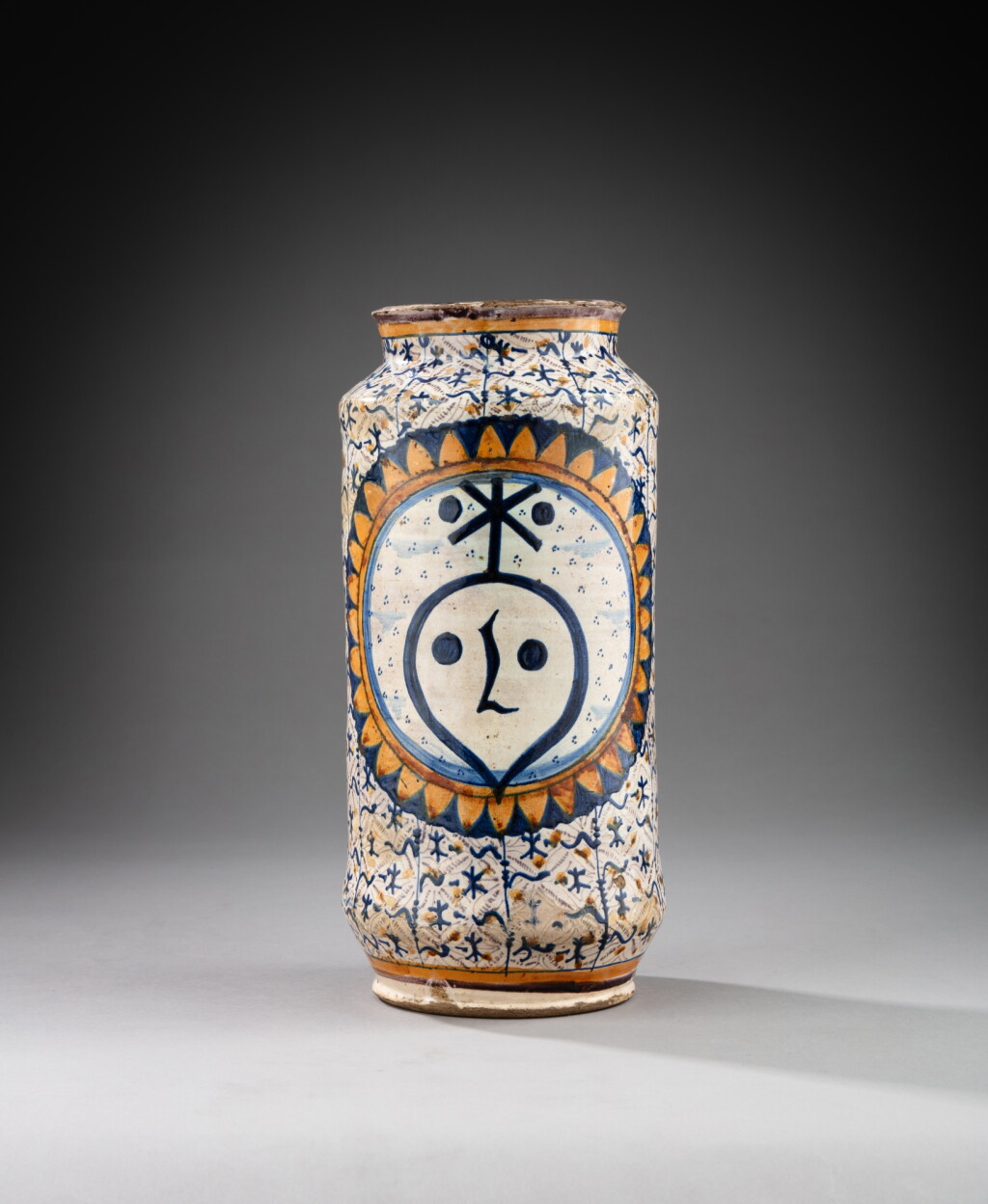
Large Albarello, of “Santa Fina” Type, with Unidentified Pharmacy Emblem
Auction Closed
February 7, 08:37 PM GMT
Estimate
15,000 - 25,000 USD
Lot Details
Description
Property from a Swiss Private Collection, Lots 630–637 formerly in the Rothschild Collection
Italian, Montelupo, circa 1480 - 1490
Large Albarello, of “Santa Fina” Type, with Unidentified Pharmacy Emblem
painted with a large blue medallion surrounded by a band of lappets in orange, encircling a symbol with a stylized head surmounted by a cross, with a ground of Hispano-Moresque-type, so-called "parsley leaf” decoration; the reverse with the numbers 1024 and 2888 (?) in black
tin-glazed earthenware (maiolica)
height: 13 ½ in.; 34.3 cm
A Tuscan hospital pharmacy;
Alexandre Imbert (1865 - 1943), Rome;
Adolf von Beckerath (1834 - 1915);
His sale, Rudolph Lepke’s, Berlin, 4 - 5 November, 1913, lot 32;
Max Bondi sale, Milan, 1929, lot 176;
Fernand Adda;
Collection Arnold Seligmann (d. 1935), Paris;
Confiscated by ERR Paris (Einsatzstab Reichsleiter Rosenberg, inv.no. Sel. 304), 1940;
Restituted after World War II
Collection d’un grand amateur, Paris 29 November - 3 December 1965, lot 583;
Jean-Georges Rueff, Paris;
Pandolfini, Florence, 28 October 2014, lot 5.
Paris, Union Centrale des arts décoratifs, 1911.
A. Dubrujeaud, Faïences italiennes de la collection Al. Imbert, Paris, Union centrale des arts décoratifs, Pavillon de Marsan Central Union of Decorative Arts, 1911, no. 224;
B. Rackahm, Islamic Pottery and Italian Maiolica, Illustrated Catalogue of a Private Collection, London, 1959, no. 269, pl. 109;
L. Cotinat, ‘Les prestigieuses faïences pharmaceutiques de la vente Adda’ in Revue d’Histoire de la Pharmacie, 1967, LV, no. 193, pp. 479 - 480, no. 25;
G. Conti, ‘Les prestigieuses faïences pharmaceutiques de la vente Adda’ in Revue d’Histoire de la Pharmacie, 1967, LV, no. 193, pp. 479 - 480, no. 25;
C. Galeazzo, Storia della maiolica di Firenze e del Contado secoli XIV e XV, Florence, 1973, no. 164;
L. Riccetti, Alexandre Imbert, J. Pierpont Morgan e il collezionismo della maiolica italiana fino al 1914, Florence, 2017, illus. p. 29.
This large albarello is striking and unique for its distinctly modern – almost caricaturish - central design, displaying an emblem (likely representing the pharmacy for which it was made, being a commercial “merchant’s mark” rather than heraldic in nature) in the form of a face.
From the second half of the 13th century, ceramic workshops were active in the small town of Montelupo, on the banks of the Arno, near Florence. Its production gained great success in the 15th century, but this early production was largely unknown until the discoveries made in the 1973 excavations of the "Pozzo dei lavatoi" (Wash house Well) in Montelupo. The wash houses were built on a well in which were found fragments of early ceramics, largely from a local kiln active during the Renaissance, which provided extensive archeological documentation of fifteenth-century Montelupo production, subsequently amplified by further excavations in the town. Wares of this kind can now positively be attributed to Montelupo, with a date range in the last quarter of the fifteenth century. The most celebrated example of this sort of ornament on Montelupo maiolica is a wing-handled vase in the Detroit Institute of Arts with the dimidiated arms of Lorenzo de’ Medici and his wife Clarice Orsini.1
Throughout the fifteenth century, the most prestigious and expensive ceramics available in Florence were lusterware imports from Spain made by Muslim potters mainly in Manises near Valencia. These were commissioned by Tuscan families and exported from the port of Valencia, perhaps via Majorca and Pisa, to Florence. These were the wares that Italians originally called maiolica, sometimes under the incorrect supposition that they had been made on the island of Majorca.2
Among the most popular types of ornament on these imported wares was a design of repeated stylized hoja de perejil leaves, sometimes described as “bryony leaf”. This was imitated by Montelupo potters, though they were generally unable to replicate the luster of the Spanish prototypes and used an orange-brown pigment instead. The Montelupo version, used on both pharmacy vessels and table wares is known to Italian specialists as “Santa Fina”, with reference to a substantial pharmacy series from the Hospital of Santa Fina in the town of San Gimignano.3
Rackham published the present albarello in 1959, attributing it to a Florentine workshop, dating it between 1450 and 1460. In 1973, Cora also published this albarello as a work from the Florentine region. Fausto Berti4 analyzed and classified the designs and firmly associated pieces of this kind with Montelupo workshops.
Only five other albarelli with this Hispano-Moresque type background design, have been noted. Among them, four are painted with the IHS symbol of Christ in Gothic script in the center of the medallion (one of which is in the Victoria and Albert Museum, London, Inv. C.728-1909) and one, with the portrait of a man in profile to left echoing portraits of the Byzantine Emperor John Paleologus, is in the British Museum (Inv. 1906, 0418.1).
The present albarello is the largest recorded and perhaps the most striking, indeed one of the most memorable pieces of all fifteenth century maiolica.
A PRESTIGIOUS PROVENANCE: IMBERT, BECKERATH, ADDA AND RUEFF
Alexandre Imbert (1865 - 1943) established an important ceramics collection in Rome in 1897, specializing in 15th and 16th century earthenware. Between 1907 and 1912, he was one of J. P.Morgan's personal art advisors. In 1911, Imbert lent more than five hundred pieces of maiolica to a major exhibition in Paris where the present piece was exhibited.
The German collector Adolf von Beckerath (1834-1915) had a close relationship with the great art historian and museum curator in Berlin, Wilhelm von Bode, a pioneer in the taste for early Renaissance maiolica among collectors. Most of von Beckerath’s collection, which was especially strong in fifteenth-century maiolica, was sold at auction in 1913.
This albarello then passed into the collection of the Egyptian industrialist and remarkable ceramics collector Fernand Adda (1890-1965). In 1959 the English maiolica scholar Bernard Rackham wrote an important catalogue of Adda's collection which included this piece. Subsequently, the albarello was with Jean-Georges Rueff, a refined and passionate antique dealer and the owner of the Galerie Alavoine in Paris, before it was acquired by an important Italian collector and then sold in Florence in 2014.
The object is documented in the database of the research project Cultural Plunder by the Einsatzstab Reichsleiter Rosenberg. Database of objects at the Jeu de Paume (a project by Claims Conference and the United States Holocaust Memorial Museum).
We are grateful to Professor Timothy Wilson and Mrs. Greta Kaucher for their invaluable contributions to the research on this entry.
1 T. Wilson in A. Darr, P. Simons, and T. Wilson, ‘Italian Renaissance and Later Ceramics’ in Bulletin of the Detroit Institute of Arts 87, 2013, no. 1-4, no. 9.
2 M. Spallanzani, Maioliche ispano-moresche a Firenze nel Rinascimento, Florence, 2006.
3 F. Berti, la farmacia storica fiorentina, Florence 2010, pp. 49-58, suggesting a date for the San Gimignano series of circa 1480-1490.
4 F. Berti, Storia della maiolica di Montelupo, vol. I, Montelupo 1997, pp. 235-263.