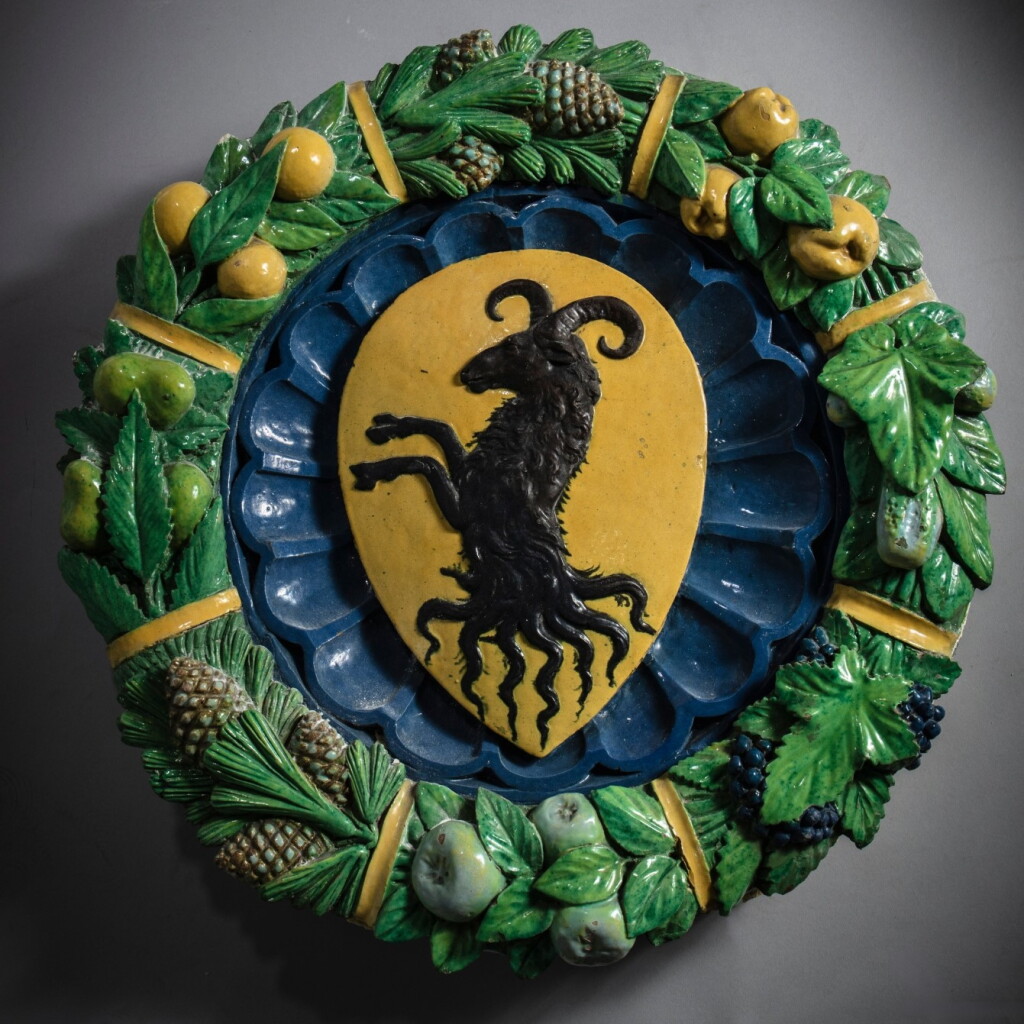
Workshop of Andrea Della Robbia (1435 - 1525)
Stemma of the Fortebracci family
Auction Closed
November 13, 02:30 PM GMT
Estimate
40,000 - 60,000 EUR
Lot Details
Description
Workshop of Andrea Della Robbia (1435 - 1525)
Florence, second half of the 15th century
Stemma of the Fortebracci family
polychromed glazed terracotta
Diam. 61 cm, 24in.
Private collection, Belgium, since the mid 20th century
Over the course of more than a century, the Della Robbia family enjoyed the sustained patronage of both the church and a great number of noble families, including the Medici, the Pazzi, and the Tornabuoni. The family produced sculpture to adorn churches, facades of Florentine palazzi, and for private devotion, as they had done since the founding of the studio by the pioneering Luca della Robbia (1399/1400- 1482). Luca’s nephew Andrea (1435-1525) took over the running of the workshop and expanded its production in the High Renaissance. The most distinguished of his sons, Giovanni della Robbia (1469-1529), continued this legacy with much success, introducing several innovations of his own to the workshop production.
The technique of using polychrome enamelled terracotta to create high relief sculptures like the present one, was conceived in imitation of ancient marbles. The popularity of these glazed terracottas, which could be produced relatively quickly and in sections for easy transport and assembly, kept the family enormously active from the early 15th century to and throughout the lifetime of the youngest of Andrea’s sons, Girolamo (1488-1566). Luca della Robbia first appropriated the form of a fluted medallion surrounded by a wreath of leaves on the underside his famous marble Cantoria in the 1430s (now in the Museo dell'Opera del Duomo, Florence).
According to Gentilini, the earliest use of such a heraldic tondo in glazed terracotta is the Stemma della Mercanzia on the Orsanmichele, Florence, from circa 1440-1445 (op. cit., 1998, p. 64). The Pazzi chapel in Santa Croce, the decoration of which is arguably the workshop’s most celebrated accomplishment, contains several simple foliate garlands framing medallions in glazed terracotta including the Pazzi family stemma in the celebrated dome. The demand for these eye-catching coats of arms proved insatiable. Andrea, and later Giovanni, therefore, continued to model such works for Tuscany’s foremost noble families.
The coat of arms on the present stemma, figuring a black ram on a gold background, can be identified as that of the noble family of the famous Perugian condottiere Andrea Fortebraccio, known as Braccio da Montone (1368 - 1424), and perhaps, for chronological reasons, linked to his son Carlo Fortebraccio, known as Carlo da Montone (Perugia 1421 - Cortona 1479), Count of Montone, Lord of Assisi, Gualdo Tadino and Todi. This hypothesis is reinforced by the fact that Andrea della Robbia (1435 - 1525) worked assiduously in Assisi and other centers in Umbria from the early 1470s onwards.
The device is set within a luxuriant vegetal garland of plants containing bunches of fruits and vegetables (in a section of three). The roundel may have been destined for the façade of a local palazzo podestarile, or it may have been an independent work, marking one of the Fortebraccio family residences, placed above a portal or in the vault of a porch or large chamber.
RELATED LITERATURE
R. Dionigi, Stemmi Robbiani in Italia e nel Mondo, Florence, 2014;
A. Marquand, Robbia Heraldry, Princeton, 1919;
G. Gentilini (ed.), I Della Robbia e l’arte nuova della scultura invertriata, exh. cat. Basilica di Sant’ Alessandro, Fiesole, 1998, pp. 64-65;
G. Gentilini, I Della Robbia. Il dialogo tra le Arti nel Rinascimento, exh. cat. Museo Statale d’Arte Medievale e Moderna, Arezzo, 2009.
You May Also Like