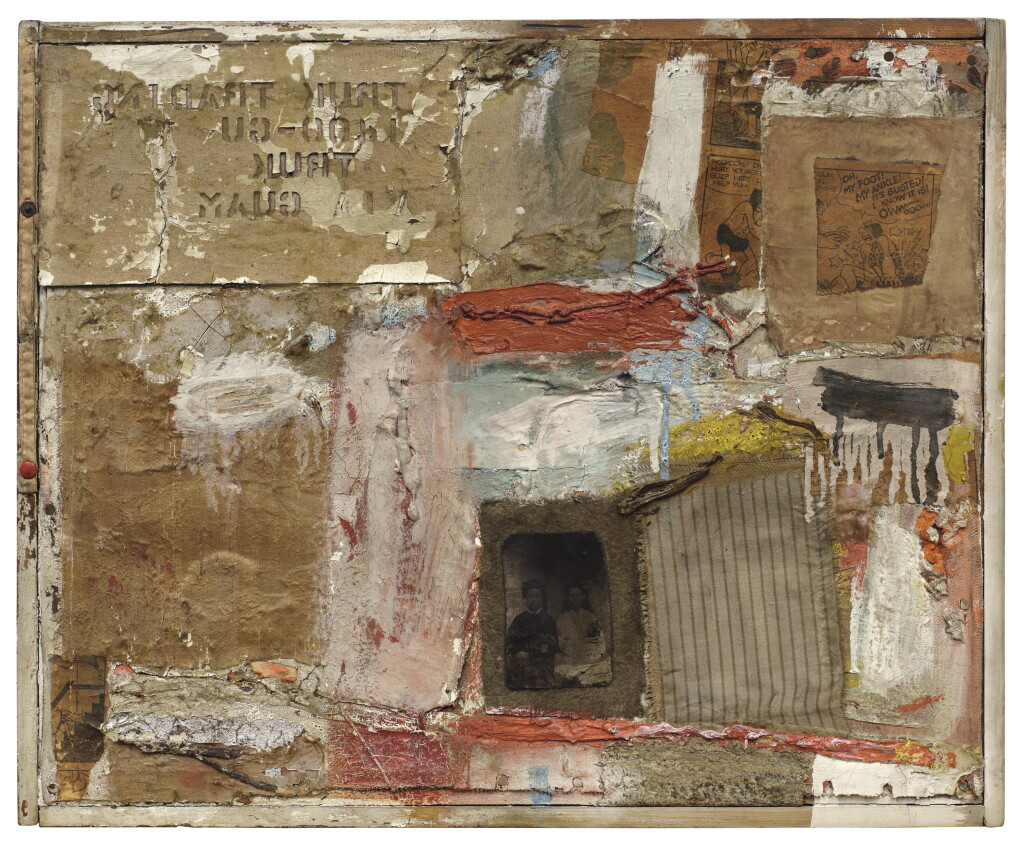
View full screen - View 1 of Lot 19. Untitled.

Leonard A. Lauder, Collector

Robert Rauschenberg

Untitled

Auction Closed

November 19, 12:41 AM GMT

Estimate

1,500,000 - 2,000,000 USD

Lot Details

Description

Leonard A. Lauder, Collector

Robert Rauschenberg

(1925 - 2008)


Untitled

signed RAUSCHENBERG and dated 1958 (on the reverse); signed RAUSCHENBERG, dated 1958 and dedicated FOR K.H. (on the stretcher) 

oil, fabric collage, paper stencil, newsprint and tintype on fabric, in artist's frame

16 ½ by 20 ¼ in.  41.9 by 51.3 cm.

Executed in 1958.

Kay Harris, New York (acquired as a gift from the artist)

Christie's, New York, 5 May 1982, lot 59 (consigned by the above)

Estée Lauder Company, New York (acquired at the above sale)

Acquired from the above in November 1995 by the present owner 

Exh. Cat., New York, The Metropolitan Museum of Art (and traveling), Robert Rauschenberg: Combines, 2005-07, pl. 86, p. 100, illustrated in color; p. 296

Untitled

By Julia Blaut


Small, yet richly conceived, Robert Rauschenberg’s Untitled Combine has a notable, personal history. In 1958, on assignment for Charm magazine, Kay Harris found herself at 128 Front Street to photograph Rauschenberg in his new downtown studio. It was in March of that year that Rauschenberg had his breakthrough solo-exhibition at the recently opened Leo Castelli Gallery on Manhattan’s Upper East Side. Harris was undoubtedly aware of the thirty-two-year-old artist’s status as the Texan-born “enfant-terrible” of the New York avant-garde. The scene that she documented in the series of portraits shot in his studio would certainly have confirmed that reputation. Rauschenberg stands confidently among what are now some of his most famous Combines, including Bed (1955; Museum of Modern Art, New York) and an early state of Monogram (1955–59; Moderna Museet, Stockholm) (see fig. 3). These works broke completely from any previously understood definitions of painting and sculpture by using such mundane materials as a quilt or an automobile tire respectively as materials for making art. It was in this historic context that Untitled was made and inscribed on the verso: “For K.H.” Given by Rauschenberg as a gift, it belonged to Kay Harris until its sale in 1982.


In addition to the April 1959 issue of Charm, one of Kay Harris’ photographs of Rauschenberg was published that year in the catalogue accompanying Dorothy Miller’s watershed exhibition at the Museum of Modern Art, Sixteen Americans. The publication also included Rauschenberg’s now famous statement that succinctly articulated the artist’s expansive artistic philosophy behind the Combines: “Painting relates to both art and life. Neither can be made. (I try to act in that gap between the two.) A pair of socks is no less suitable to make a painting with than wood, nails, turpentine, oil and fabric” (Robert Rauschenberg quoted in New York, The Museum of Modern Art, Sixteen Americans, 1959, p. 58).


Transcending the traditional boundaries of medium, the Combines represent a wholly new approach to art making. Its surface is jagged and varied; thick areas of impasto and collaged elements of paper protrude outward. Executed in varied shades of ochre, juxtaposed against bright crimson, stark white, and deep black, the composition's interlocking shapes, composed of assorted materials, coalesce into a methodical whole. Crucially, like many Combines, the use of ready-made and found elements gives the already richly textured surface a sense of intrigue. The inclusion of fabric, newspaper clippings, and an archival photograph offers Untitled a sense of objecthood, but its painterly surface and relatively two-dimensional form situate it as a painting. Neither can it be called a true Ready-made, at least in the traditional Duchampian mode. Rauschenberg does not emphasize the ready-made elements; rather, they simply serve the whole of the composition. In fact, in opposition to Duchamp, Rauschenberg's Combines are distinctly non-reproducible. He takes mass media and the scraps of mass production and transforms their products into the realm of the singular, the personal, and the peculiar.


The Combines—the term Rauschenberg coined to describe the series of artworks that he made between 1954 and 1964—marked a radical shift in postwar art. They challenged the status quo by disregarding sanctioned distinctions between the artistic categories of painting and sculpture and between art and everyday life. Characteristic of the series and fully realized within the tight, grid-like composition of Untitled is the thoughtfully balanced tension between handmade painted brushstrokes, found objects, and mechanically reproduced images.


Pushing at the edges of the artist-made wood frame is an ornate and carefully considered picture surface painted, pasted, and tacked onto a red fabric support. The smaller components of varied textures, materials, and colors coalesce into a broader geometric composition. The collage includes textiles ranging from diaphanous stripes to densely textured solids and a grosgrain strap from a piece of clothing. At the upper left is a stiff paper stencil with the punched-out words appearing in reverse—“Truk Trading” and “via Guam.” The reference to the Pacific Islands would have had historic significance for Rauschenberg, a World War II veteran. At the center is an antique tintype portrait of two women seated stiffly, each holding a bouquet, one entirely dressed in black and the other all in white. Likely picked up at a flea market, the image would have appealed to Rauschenberg not only because he was an avid photographer since his student days at Black Mountain College in North Carolina, but also for the unexplained pairing of the women. Doubling, a motif employed by Rauschenberg over the course of his career, appears again throughout the painting. For example, the black and white horizontal paint strokes to the left and right of the photograph appear to be spontaneous gestures with dripping paint. In fact, Rauschenberg used these strokes so regularly in his compositions that he gave them a name, calling them “hinges.” For him, they were visual obstacles which redirected the viewer’s eye.


Doubling appears again in the torn newsprint cartoon. It is taken from Alley Oop, a comic strip that was published in the Sunday, November 2nd,1958 issue of the New York Herald Tribune, where the Gran Wizer lends a helping hand to Guz, king of Moo. Despite the cleaved paper, this pre-historic, time-traveling duo are still read as a pair, united by the dialogue in their speech bubbles. The precocious use of cartoon imagery in Rauschenberg’s Combines of the 1950s is among the reasons that Rauschenberg is regularly cited as presaging Pop Art of the early 1960s.


In 1972, art critic Leo Steinberg referred to Rauschenberg’s brand of de-sanctified modernism as postmodern. Steinberg described Rauschenberg’s paintings as ushering in an entirely new vantage point. Rather than the painting extending the viewer’s line of vision from a standing position, Rauschenberg’s canvases, while hanging vertically on the wall, were like horizontal “receptor surfaces.” Steinberg referred to this as the “flatbed picture plane” which, like the bed of a printing press accumulates often unrelated visual material (Leo Steinberg, “Reflections on the State of Criticism.” Artforum, Vol. 10, No. 7, March 1972, pp. 37–49).


Despite Rauschenberg’s extraordinary innovations, his experiments were deeply rooted in 20th century art history. At the start of the century, the Cubists pioneered the use of collage. While they used the pasted elements for illustrative purposes, by contrast, Rauschenberg employed found images and materials to retain their original associations. Marcel Duchamp’s readymades—works that Rauschenberg knew well and regularly sought out—also set a precedent for bringing of the everyday into the context of art. In Rauschenberg’s Combines, however, he specifically brought them into the domain of abstract painting. His freely painted gestures evoke the style of Willem de Kooning, the Abstract Expressionist painter of the previous generation who Rauschenberg most admired. The lushly applied passages of oil paint in red, blue, ochre, silver, black and white serve as the connective tissue of Rauschenberg’s “syncopated grid”— the irregular linear composition that was characteristic of the artist (Dorothea Rockburne and Nan Rosenthal, “Tribute to Robert Rauschenberg (1925–2008),” Brooklyn Rail, June 2008, p. 43).


Kay Harris consigned Untitled to Christie’s in 1982, where it was acquired at auction by the Estée Lauder company. In 1995, it entered Leonard A. Lauder’s collection; he chose it for his office where it hung for the rest of his life. Lauder had been a longtime Rauschenberg fan. He likely first saw the artist’s work when it was shown at Castelli Gallery located at 4 East 77th Street, in close proximity to his parent’s apartment. Certainly, Lauder had watched Rauschenberg’s meteoric rise as a leading artist of their generation. (They were born eight years apart.) In 1963, Rauschenberg was honored with his first museum retrospective at the Jewish Museum in New York and in the following year became, with artworks predominantly from the Combine series, the first American artist to receive the International Grand Prize in Painting at the Venice Biennale. This was not only a victory for elevating U.S. art to the world stage, but it also pointed painting in entirely innovative directions.


It was not his fame, however, that attracted Leonard A. Lauder to Rauschenberg. Rather it was a shared sensibility. Lauder prized the everyday, mundane objects such as his collection of postcards with the same passion as he collected Cubist paintings. The humanity referred to by the ordinary appealed to Lauder. Furthermore, Rauschenberg believed that the viewer played an active role in the creative act; he invited his audience to interpret his work for themselves and in this way brought his art in dialogue with the spectator’s individual experience of the outside world. Lauder would have jumped at this invitation. As with Cubist works, he would have experienced something new each time he looked at this deceptively complex little painting. For Lauder, the work appealed to both his eye and his mind. As Rauschenberg said, “Looking…had to happen in time” (Robert Rauschenberg quoted in G. R. Swenson, “Rauschenberg Paints a Picture,” Artnews, Vol 62, No. 2, April 1963, p. 45). This Untitled Combine rewards prolonged looking. Hanging centered, directly in front of his desk for two decades, Leonard A. Lauder was able to look at this work and then look at it again, just as it was intended.


Julia Blaut is Senior Director of Curatorial Affairs at the Robert Rauschenberg Foundation.


Thanks to Helen Hsu, for her identification of the Alley Oop comic strip and the Kay Harris Charm assignment.