Leonard A. Lauder, Collector
Gustav Klimt
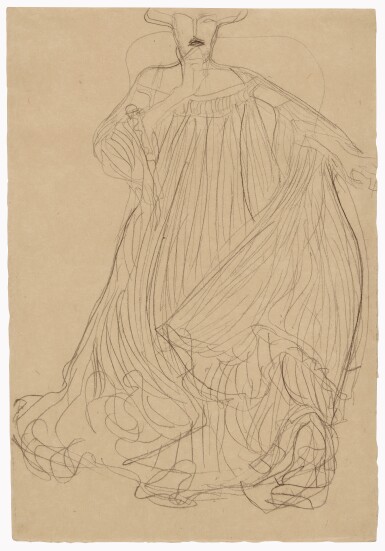
Sitzend von vorne mit ausgestrecktem linkem Arm, das Kinn aufgestützt (Studie für das Porträt I der Adele Bloch-Bauer) (Study for Portrait I of Adele Bloch-Bauer)
Auction Closed
November 19, 12:41 AM GMT
Estimate
150,000 - 250,000 USD
Lot Details
Description
Leonard A. Lauder, Collector
Gustav Klimt
(1862 - 1918)
Sitzend von vorne mit ausgestrecktem linkem Arm, das Kinn aufgestützt (Studie für das Porträt I der Adele Bloch-Bauer) (Study for Portrait I of Adele Bloch-Bauer)
pencil on paper
18 by 12 ⅜ in. 45.7 by 31.4 cm.
Executed in 1903-04.
Kornfeld und Klipstein, Bern, 13 June 1968, lot 495b
Serge Sabarsky Gallery, New York (acquired at the above sale)
Acquired from the above on 6 December 1968 by the present owner
Alice Strobl, Gustav Klimt, Die Zeichnungen, 1878-1903, vol. I, Salzburg, 1980, no. 1126, pp. 314-15, illustrated
Adele Bloch-Bauer was the daughter of a prominent Viennese banking family and the wife of the industrialist Ferdinand Bloch. A prominent socialite in Hapsburg Vienna during the heyday of its “sacred spring” at the beginning of the twentieth century, she has been immortalized by Gustav Klimt’s two famous oil portraits of her made in 1907 and 1912 respectively (see figs. 1 and 5). Adele was a significant presence in the artist’s life over several years and many people believe she is also the subject of Klimt’s highly eroticized 1901 painting Judith I and perhaps also of his masterpiece, Der Kuss (The Kiss) of 1908 (see figs. 2 and 3). It has also been speculated that, at one time, she and Klimt were lovers.
Sitzend von vorne mit ausgestrecktem linkem Arm, das Kinn aufgestützt and Stehend von vorne are two of the very first drawings that Gustav Klimt made for his first and most famous portrait of Adele, the “golden” portrait of 1907, now sometimes referred to as “The Woman in Gold” that is today so prominently displayed in the Neue Galerie in New York. Executed between 1903 and 1904, these drawings of Bloch-Bauer were made several years before Klimt completed this luxuriant portrait, now considered “a masterpiece of his ‘golden period’”—the period that included his famous painting Der Kuss and his work for the Palais Stoclet (Tobias Natter, ed., Gustav Klimt, The Complete Paintings, Munich, 2012, p. 603).
As Alice Strobl, author of the catalogue raisonné of Klimt’s drawings has pointed out, Klimt seems to have already conceived of his portrait of Adele as a gold portrait from as early as 1903. This is because drawings such as these show him working closely upon the central idea of a design that integrated the figure onto an empty, abstract field of color. Later designs, show the artist painstakingly readjusting the details laid down by these first works; these adjustments went on for several years. Even by Klimt’s exacting standards, four years was a long time—the longest he was to take on any portrait—for the preparation and execution of a painting. These two drawings, Sitzend von vorne mit ausgestrecktem linkem Arm, das Kinn aufgestützt and Stehend von vorne, are among the very first of over a hundred that Klimt would make before completing the painting.
Klimt’s 1907 portrait of Adele Bloch-Bauer marked a major development in his art precisely because of the innovative way in which it sought to integrate the figure into a highly decorative, abstract background comprised, in the main, of a shimmering field of real gold. In Western art, such an expanse of gold is traditionally reserved only for the depiction of emperors and saints. In 1903, around the same time that he made these drawings, Klimt had paid a visit to see the mosaics in the church of San Vitale in Ravenna with their unforgettable images of the Empress Theodora (whom Adele resembled) isolated in just such a way against a field of gold (see fig. 4). In his 1907 portrait, Klimt, drawing heavily upon the influence of Japanese lacquer painting, ancient Egyptian art and these Byzantine mosaics, set out therefore, not only to immortalize Adele, but also to imperialize her and transform her into a monumental and magisterial presence.
Writing in 1903, with reference to Klimt’s earlier painting Judith I (which perhaps also depicts Adele), the critic Felix Salten was to point out, in a way that applies equally to the golden portrait of 1907, that Klimt was used to making brilliant use of an imposing frontality in his portraits. Klimt could, he wrote, take “a figure from the present day, a living being, whose pulsating warmth has the capacity to intoxicate him, and transpose her into the magic shadows of distant centuries, so that for all her reality she is elevated and appears transfigured...” (Felix Salten, Gustav Klimt. Gegentliche Anmerkungen, Vienna, 1903).
In the finally realized composition of his 1907 portrait of Adele, Klimt deliberately depicts her in an ambiguous position between sitting and standing. At first glance, she appears to be standing but the chair behind her is rendered in such a way that its abstract patterning fuses into the folds of her dress, which flows around her in a manner that indicates that she is sitting. These two drawings—one, showing Adele standing and the other, depicting her seated—show Klimt exploring both possibilities, revealing how the resultant painting came to be an amalgam of both ideas.
As is common throughout all of Klimt’s many studies for the painting, both these works crop across the head of Adele at the top of the sheet and make extensive use of its edges and empty page to indicate space and form. Adele’s face is rendered in both works simply as a cipher. It was often Klimt’s practice to work out the precise facial details of his sitters while in the act of painting. Here, in these drawings of 1903-04 he is concerned almost entirely with the effect of Adele’s figure on the surrounding space. Klimt’s cropping and use of the empty page was a pioneering device unique to him at this time, but one soon afterwards utilized and developed into even more dramatic forms by his young protégé Egon Schiele (see fig. 6).
As Marian Bisanz-Prakken, author of the supplementary volume of Gustav Klimt’s drawings, has written about these early drawings for his first portrait of Adele, they mark a new sophistication in Klimt’s approach to drawing, one that is perhaps also reflected in his adoption of a higher quality of Japanese paper around this same period:
“What had emerged so tentatively in his studies of Sonja Knips and Serena Lederer had by now become a clear maxim: the edges of the paper had become a determining factor in the dynamism of the planar structure…Klimt [now] sought to achieve an ideal synthesis between the individual character of the sitter and her position in the overall geometry of the work…[and]...skillfully applied these new principles in his Bloch-Bauer studies, which rank among the finest of all his drawings, revealing as they do the very quintessence of his artistic intentions. With unprecedented levity, the artist accepts the constraints dictated by the limitations of the paper. The starting point of the compositional structure in almost all the Bloch-Bauer drawings is the point at which the forehead is cropped by the upper edge of the paper. In the actual face, certain parts are deliberately omitted or rendered only sketchily. The stylized, triangular mouth is strongly emphasized and is in itself an easily recognized trait and focal point of all the Bloch-Bauer studies. A typical feature of almost all the drawings in which the model is seated is the way the loosely draped, pleated robes spread out in waves from the shoulders across the picture plane, so that they are sometimes even cropped by the edge of the paper….[Several of these works demonstrate] the principle of parallel, overlapping, distinctly delineated layers of space, with the soft, flowing lines cleverly offset against angular geometric elements. In this complex of mutual dependence and dynamic tension, the negative space also plays an active role. This, in turn, is defined within by the outlines of the main form and externally by the edges of the paper”
Marian Bisanz-Prakken, op.cit., p. 200
You May Also Like