Property from a New York Private Collection
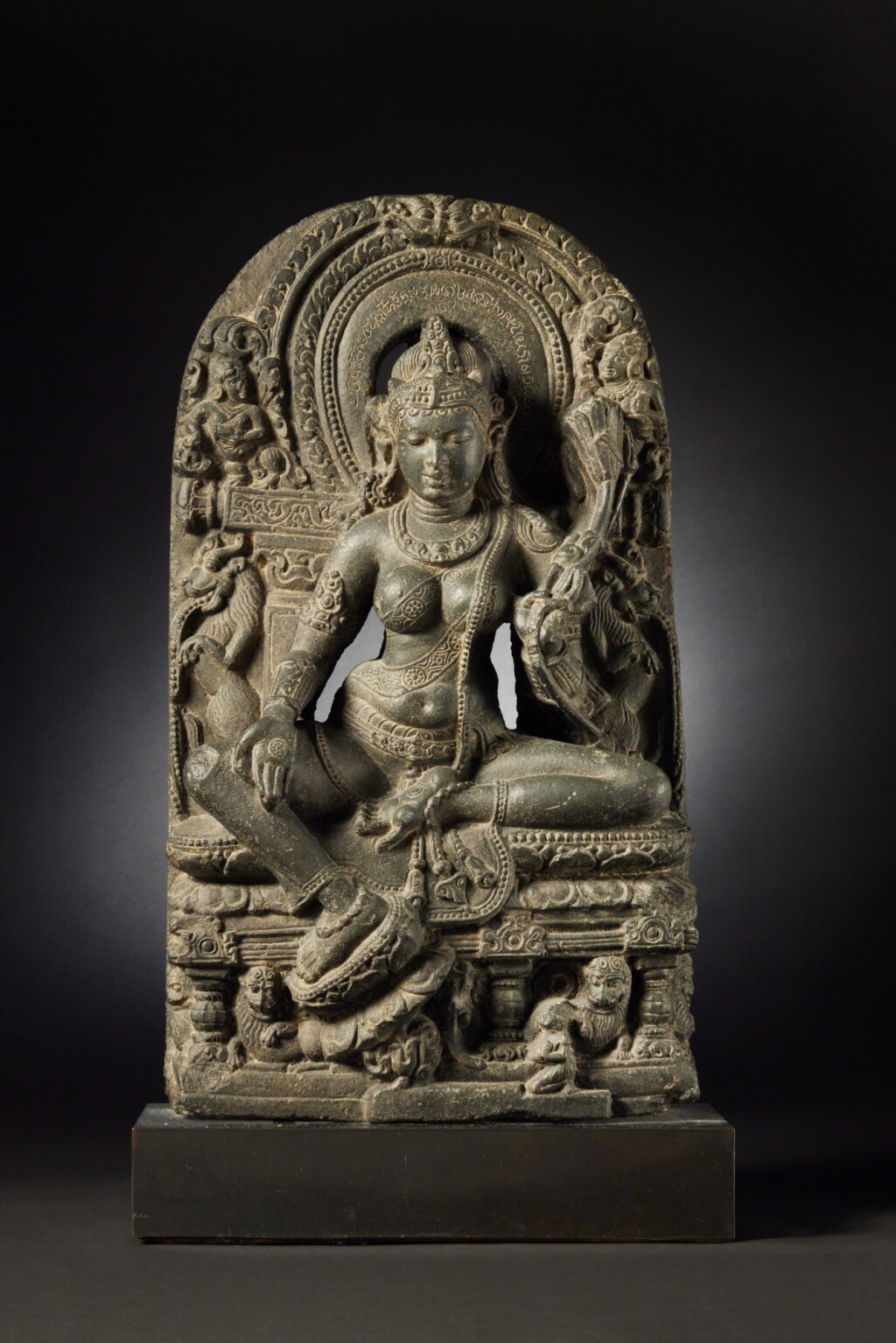
A black stone stele of Syamatara, Eastern India, Pala kingdom, possibly Kurkihar, circa 10th century
Auction Closed
March 20, 05:22 PM GMT
Estimate
40,000 - 100,000 USD
Lot Details
Description
Height 26⅜ in., 67 cm
Private American Collection.
Sotheby’s New York, 26th March 1998, lot 48.
The Menil Collection, Houston, 2014 - 2015.
The International Red Cross and Red Crescent Museum, Geneva, 2016.
Josef Holfenstein, Experiments with Truth: Gandhi and Images of Nonviolence, Houston, 2014, p. 271.
The finely carved figure is depicted seared in lalitasana on a lotus throne, her right hand in varada mudra, her left carrying a lotus flower, adorned in a close-fitting dhoti with beaded hemline, belt, two sashes decorated with rosettes falling across her torso, beaded upavita (sacred thread), armlets, foliate collar, differing ear ornaments and crown, her hair drawn up into a chignon, a Pali inscription incised around the nimbus, a kirttimukha mask adorning the arched top.
A closely related Pala period stone stele of Tara is preserved in the Brooklyn Museum, accession number 1995.136. Compare also a fragmentary Pala stone stele of Tara formerly in the Alsdorf collection, illustrated in Pratapaditya Pal, A Collecting Odyssey: Indian, Himalayan, and Southeast Asian Art: from the James and Marilynn Alsdorf Collection, Chicago, 1997, cat. no. 266, and sold in these rooms, 18th March 2009, lot 40.
You May Also Like