
Cartier, Paris
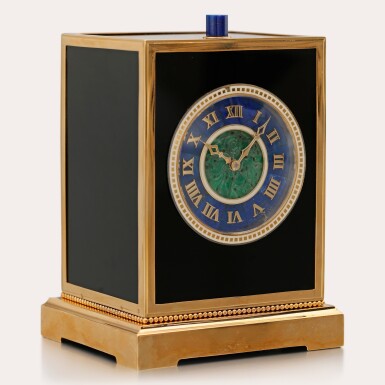
An exceptional 18ct yellow gold, silver, onyx, jade, lapis lazuli, agate and enamel minute repeating 8-day Cube Clock | Nos. 2320, 4020 | Circa 1925
Auction Closed
May 11, 11:29 AM GMT
Estimate
50,000 - 80,000 CHF
Lot Details
Description
Nos. 2320, 4020
London Stock No. · 1592 ·
Movement No. 7127
Circa 1925
· frosted gilded 8-day movement, lever escapement, bi-metallic compensation balance, two polished steel hammers repeating on two coiled gongs, signed Nocturne within floral banner and stamped Brevet 30225
· dial with carved jade centre separated from the chapter ring by a white enamel ring set in gold, lapis lazuli chapter ring with applied polished gold Roman numerals, gilded Cathédrale hands
· the case composed of polished onyx panels bound by gold pillars and frame, set upon an 18ct yellow gold architectural pediment with beaded border mounted over concealed wooden base, lapis lazuli repeating pusher to case top, aperture for dial surrounded by a gold, silver and white enamel bezel with repeated gold square motifs in relief, apertures to onyx back panel for winding and hand-setting, bezel with French boar/eagle mixed metal assay mark for silver and gold and numbered to underside 712[X], French eagle’s head assay mark to rear of base in hexagonal cartouche, underside of concealed wooden base engraved Cartier, 2320, Made in France, the concealed top side of the onyx base scratch numbered 2320, 4020 and marked ‘Devant’
Soon after joining the family firm in 1898, Louis Cartier made the decision to expand Cartier’s offerings to include table and desk clocks.1 Among the earliest designs introduced was the cube-form clock and repeating models quickly becoming a Cartier speciality. Particularly valued for their practicality during the hours of darkness, repeating clocks allowed their owners to hear the time at the press of a pusher.
The movement of this clock was supplied through Cartier’s watch and clockmaking arm, the European Watch and Clock Co., by Nocturne, a sub-brand of E. Matthey-Tissot & Cie. Founded in 1910, Nocturne’s factory was located in Les Ponts-de-Martel, just west of Neuchâtel, Switzerland. In their book Technique and History of the Swiss Watch, Jaquet and Chapuis note that Matthey-Tissot had already established a reputation for fine repeaters prior to the First World War.2
Early cube-form Cartier clocks often featured guilloché enamel decoration, drawing inspiration from the Fabergé or Russian style. These designs reflected the prevailing garland style of the early 20th century, characterised by delicate neoclassical motifs and refined ornamentation. However, as the garland aesthetic gave way to the bold geometric language of the Art Deco period, Cartier’s clocks evolved in form and decoration.
This repeating desk clock follows the structured form of the Cube clock, with its monochromatic black and gold case creating a striking contrast that naturally draws the eye toward the dial. The design exemplifies Cartier’s ability to merge classical Louis XVI influences with the modernist aesthetic of the Art Deco period, while also incorporating subtle references to Asian art and design—an increasingly important source of inspiration for the Maison in the 1920s—seen here through the use of carved jade. At the centre of the dial, the jade panel carved with stylised leaves and flowers introduces a note of delicate ornamentation, while the surrounding chapter ring, made from lapis lazuli, reflects Cartier’s growing use of hardstone materials during this period, adding rich depth of colour that beautifully complements the refined palette of the case.
1 François Chaille & Franco Cologni, The Cartier Collection: Timepieces, Paris: Flammarion, 200, p. 33.
2 Eugène Jaquet, Alfred Chapuis, Technique and History of the Swiss Watch, London: Hamlyn Publishing, revised edition, 1970, p. 125.