
Cartier, Paris
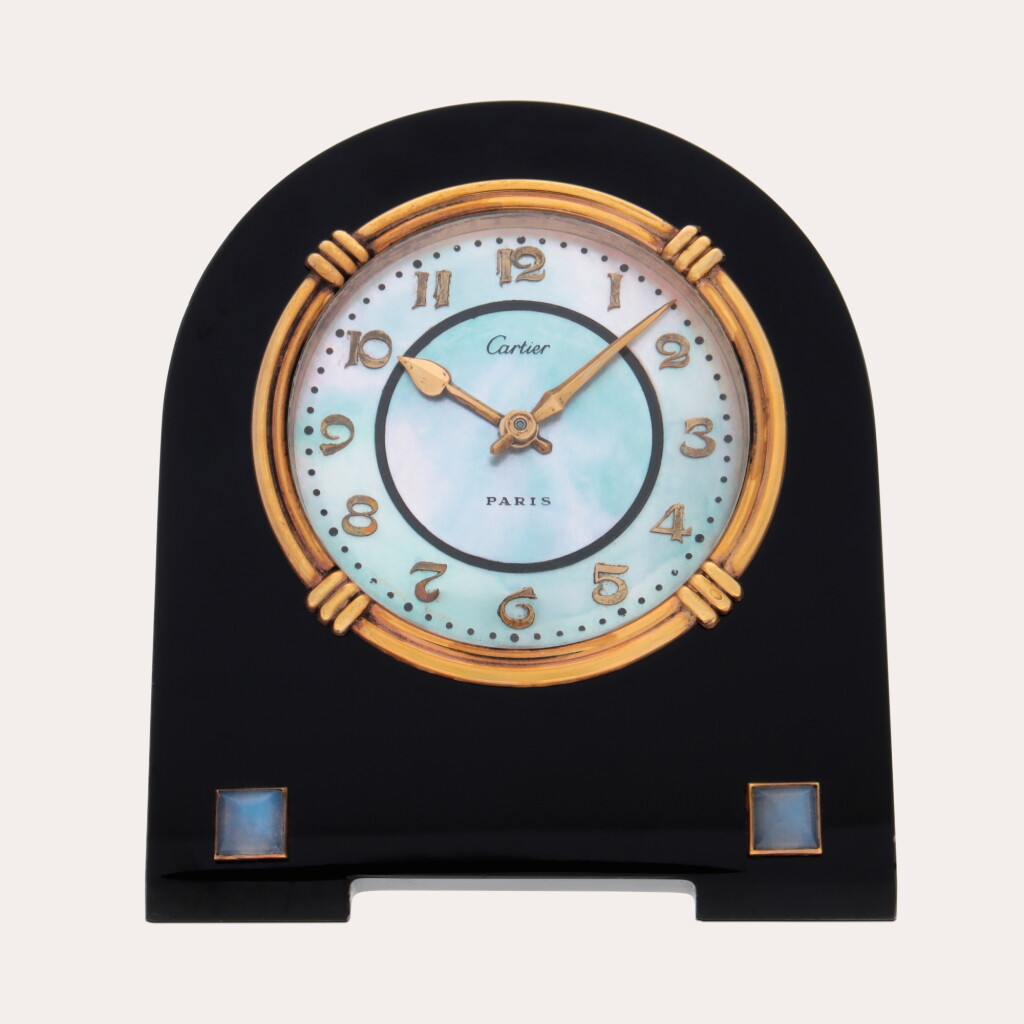
A fine onyx, gold, mother-of-pearl and moonstone 8-day arched desk timepiece | Nos. 1514, 2831 | Circa 1925
Auction Closed
May 11, 11:29 AM GMT
Estimate
20,000 - 40,000 CHF
Lot Details
Description
No. 1514, 2831
Subsidiary Stock No. 0480
Circa 1925
· frosted gilded movement, lever escapement, bi-metallic compensation balance, unsigned
· two-part mother-of-pearl dial, central section signed Cartier Paris bordered by a black lacquered circular frame, separate mother-of-pearl chapter ring, applied stylised Arabic numerals, pearled outer minute track, gilded spade and sword-shaped hands
· onyx arched case, gold bezel composed of twin stepped rings with triple banded tied ornamentation, two collet-set moonstone cabochons to left and right, gilded strut support to case back signed Cartier Paris and numbered 1514, gilded movement cover with apertures for winding and hand-setting, hand stamped to interior 2831, 1514
Dimensions 79.5 x 67 mm
Please note that Sotheby's is not able to assist buyers with the shipment of any lots containing restricted materials into the US. A buyer's inability to export or import these lots cannot justify a delay in payment or a sale's cancellation.
The humpback strut clocks, designed in the form of roadside milestones (known in French as les bornes), first appeared around 19091 and became one of Cartier’s most celebrated designs during the Edwardian and Art Deco periods. In 1911, Maurice Coüet (1885–1963) began an exclusive partnership with Cartier, and through his workshop, he often revisited the Borne design, developing an extraordinary range of timepieces for the Maison.
As Cartier’s design sensibilities transitioned from the ornate language of the Belle Époque to the structured geometric forms of Art Deco, bold shapes and striking material contrasts emerged. In this evolution, the use of stark black onyx—a favoured material of the period—creates a dramatic contrast against the shimmering mother-of-pearl dial. The dial itself is composed of two sections, with a central panel set apart from the chapter ring by a black surround, producing a two-tone effect that provides further contrast. Adding to this interplay of light and dark, the ethereal quality of moonstone cabochons set at the corners of the onyx case enhances the sense of balance and refinement.
The gold bezel is highly distinctive with its stepped form and triple banded tied ornamentation. A similar application of this bezel design can be seen on other Cartier timepieces of the period. For another onyx desk clock with this style of bezel, but in a square case, see: R. Ehrhardt & J. Demesy’s Cartier Wrist & Pocket Watches Clocks (1992, p. 93).
1 Hans Nadelhoffer, Cartier - Jewelers Extraordinary, London: Thames & Hudson, 1984, p. 246.