
Exceptional Discoveries: The Olmsted Complications Collection
LS. Gallopin & Cie, Succrs de Henry Capt
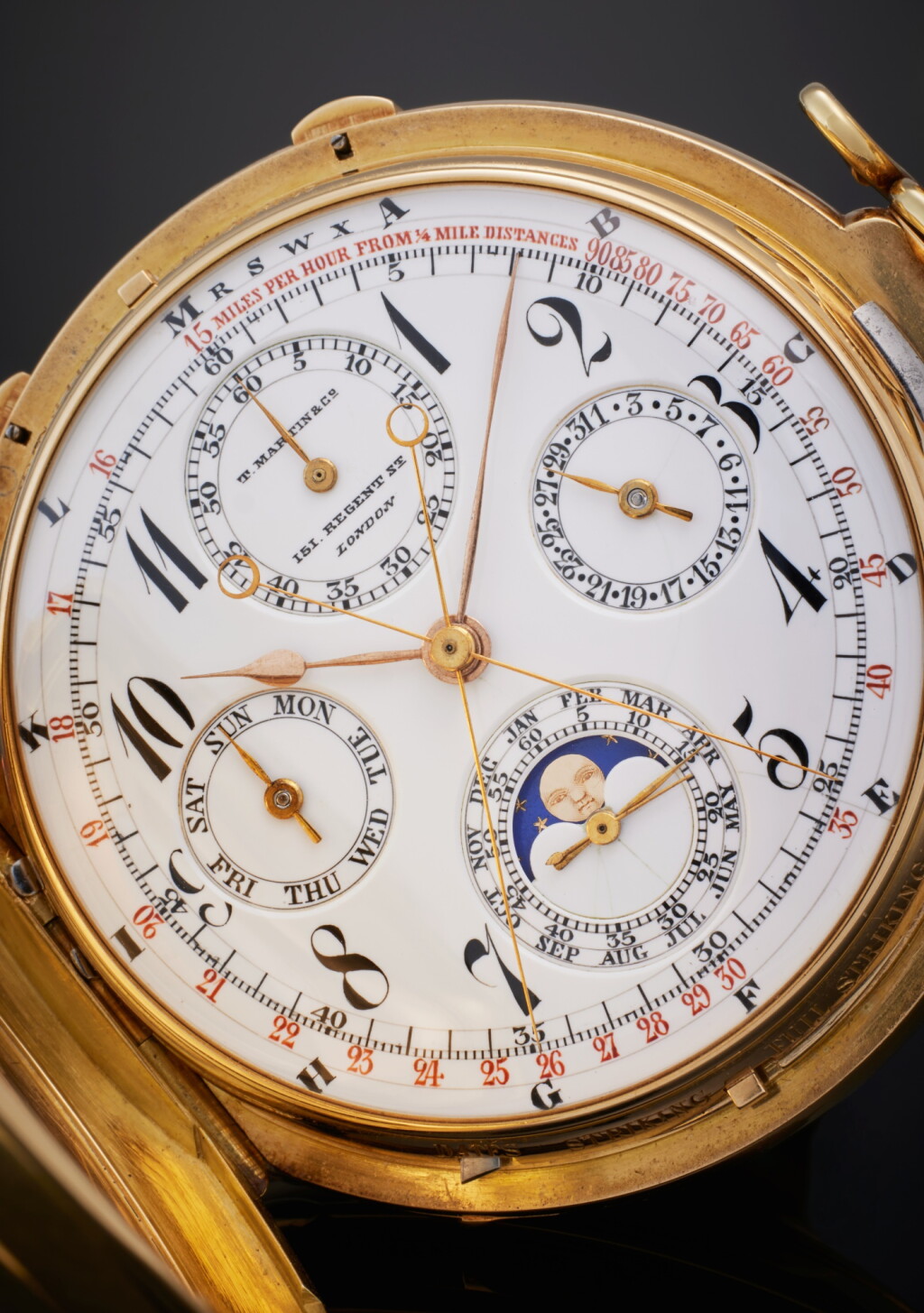
Retailed by T. Martin, Regent St.: A heavy yellow gold and enamel half-hunting cased two train keyless perpetual calendar minute repeating split-seconds grande and petite sonnerie clock watch with red ¼ mile tachymeter and alphabetic scale, No. 41300, 2409, Made in 1894
Auction Closed
December 8, 10:03 PM GMT
Estimate
30,000 - 50,000 USD
Lot Details
Description
Movement: two-train frosted gilded movement with tandem winding, highly jewelled, bi-metallic compensation balance, grey finished balance spring with overcoil, chronograph and split work partially visible to the backplate, polished steel hammers repeating on coiled gongs
Dial: white enamel dial, black Arabic numerals, recessed subsidiary dials for day, 60-minute register, date, months combined with subsidiary seconds and aperture for moon phases, outer scale for minutes/chronograph seconds calibrated for fifths, red ¼ mile tachymetric scale, outermost alphabetic, gold hands, dial signed T. Martin & Co., 151 Regent St., London
Case: 18k yellow gold half-hunting case, aperture to front lid with glazed aperture surrounded by white enamel chapter ring with black Roman numerals and minute ring, two pushers for chronograph/split to band, short trip-repeat slide to band between VII and VIII, slides beneath the bezel for striking/silence and striking/full striking, nibs for calendar correctors beneath the bezel for date and moon phases, cuvette engraved No. 2409 T. Martin & Co. Regent St., inside back lid with spread eagle Henry Capt and P & P marks, numbered 41300, front lid numbered 300, case back and pendant with French owl import assay
Signed: dial and case signed T. Martin & Co., case stamped with spread eagle Henry Capt mark
Diameter: 54.3 mm
Accompanied by letter from E. Gallopin & Cie, Succrs de Henry Capt dated 7 August 1964 confirming the year of manufacture in 1894.
In addition to the exceptional complexity of the movement, this watch has a most unusual dial featuring an additional alphabetic scale placed above the hour numerals, with the letters A to M (omitting J) corresponding sequentially to the hours 1 to 12. Between 12 and 1 o’clock, a further group of letters, “RSWX”, appears within the chapter ring. The omission of J follows earlier alphabetic conventions familiar from 19th-century telegraphic and signalling codes, while the inclusion of this secondary letter scale suggests the dial may have been intended for coded or other specialist purposes. The watch’s outer red tachymeter scale, calibrated for quarter-mile distances, indicates that it was designed for the rapid calculation of speed in miles per hour over short, standardised intervals. Such a system would have been especially useful in equestrian or military contexts, where the quarter-mile (equivalent to two furlongs) was a conventional measure for timing horse or messenger runs. The added letters may have provided a means of quick reference, notation, or coded recording during such trials. Whether intended for horse-racing, cavalry training, or field signalling, the combination of a quarter-mile tachymeter and an auxiliary alphabetic scale is exceptionally rare.
The watchmaking firm of Henri (or Henry) Capt was originally founded by Henri-Daniel Capt, who was born in 1773 at Le Chenit in Switzerland’s Vallée de Joux. A highly skilled and influential watchmaker, Capt specialised in creating watches and boxes incorporating music and automata, in addition to repeaters. He is credited with being the first to manufacture steel teeth capable of playing all notes of the musical scale. From 1802 to 1811, Capt partnered with Isaac-Daniel Piguet under the business name Piguet & Capt. When Piguet left the partnership in 1811 to collaborate with Philippe Meylan, Capt continued independently until 1830, when he entered a new partnership with Aubert, forming the firm Aubert & Capt. From 1844, the company was run by Henri Capt’s son, also named Henri, and the firm was re-named Henri Capt & Cie. Around 1880, Louis Gallopin became involved with the firm and by 1893 had become the sole proprietor. Initially the company continued to trade under the name Henri Capt. It was subsequently re-named H. Capt Horloger, Maison Gallopin Successeurs, and later still, E. Gallopin & Cie, Successeurs de Henri Capt. The company continued to specialise in precision and complicated watches.
One of the finest watchmaking firms of the 19th century, Henri Capt was a regular competitor at the major chronometer trials and received numerous awards. In the 1882 Geneva Observatory trials, a Henri Capt watch with a palladium balance spring was awarded First Prize, placing first in the Class A category. During its 40-day test period, the watch’s mean daily rate of variation was just 0.21 seconds. In the same year, a further two of Henri Capt’s watches placed within the top 25 of the trials (a total of 208 watches were entered by a wide range of makers). In 1887, Henri Capt (Gallopin) became the first Swiss watchmaker to enter a watch for the Kew Observatory trials in England, submitting a repeating watch for the contest.
Interestingly, in the Horological Journal of March 1888, the firm of Henri Capt was recorded as having a London branch at 151 Regent Street and was advertising for “an Englishman, experienced watchmaker, speaking French fluently, to act as a salesman.” Emile Capt was also recorded at the same Regent Street address in February 1889, when he was elected a member of the British Horological Institute. The lease of the 151 Regent Street premises was put up for sale in September 1889 and advertised as a “well-established and high-class [premises with]… splendidly fitted-up shop.” Given the date of the present watch, 1894, it would appear that it was T. Martin who took on the lease, while evidently maintaining a connection with Henri Capt/Gallopin.