
Property of an Important West Coast Collector
Patek Philippe
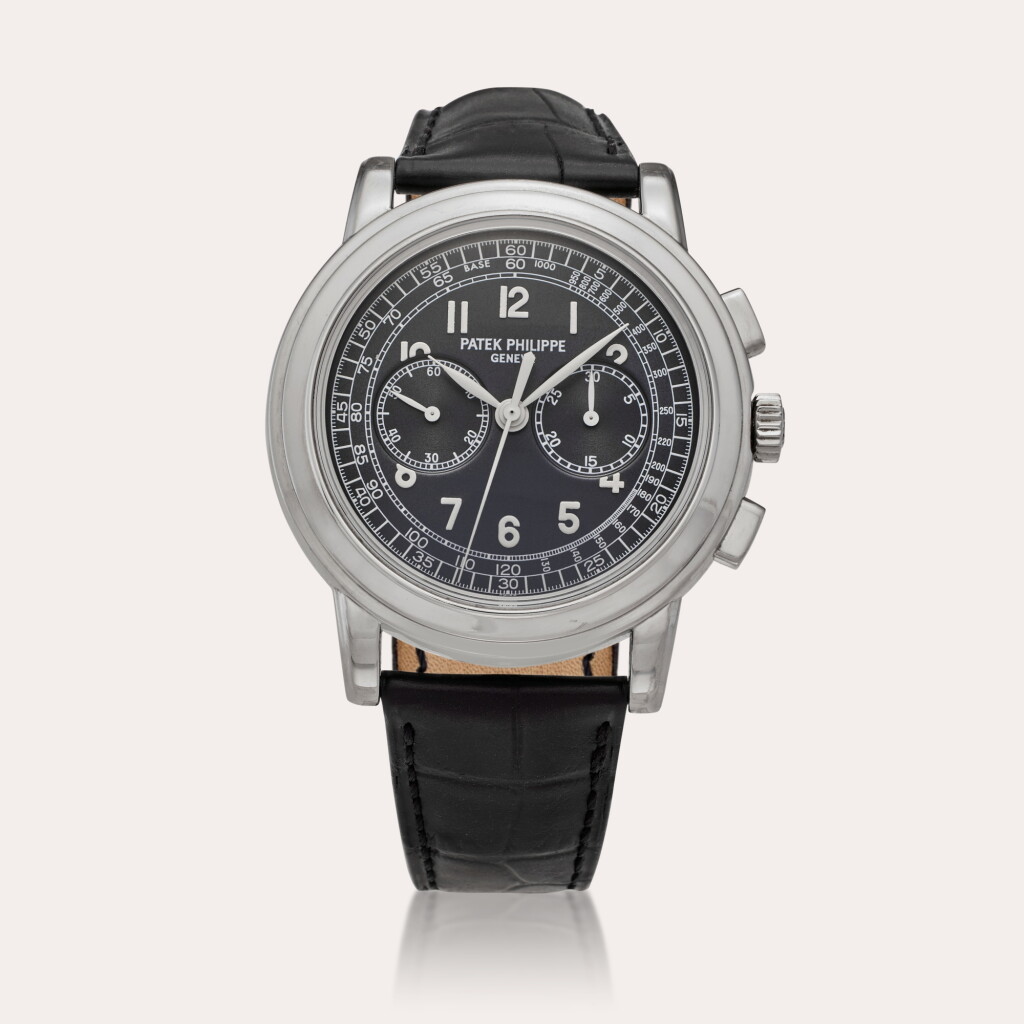
Reference 5070P-001 | A unique platinum chronograph wristwatch, Circa 2009
Auction Closed
December 8, 10:03 PM GMT
Estimate
120,000 - 180,000 USD
Lot Details
Description
Dial: blue, with white hands and Arabic markers
Caliber: cal. CH 27-70/157 mechanical, 24 jewels
Movement number: 3'715'814
Case: platinum, screw down sapphire crystal display back
Case number: 4'494'945
Closure: platinum Patek Philippe folding clasp
Size: 42 mm diameter
Signed: case, dial and movement
Box: yes
Papers: no
Accessories: Patek Philippe presentation box with outer packaging, facsimile of correspondence confirming modifications made by Patek Philippe in their workshop and recorded in their archives dated November 4th, 2014, Extract from the Archives confirming the year of manufacture in 2009, Operating Instructions booklet, booklets, leather bi-fold, service box, and hangtag
When the Patek Philippe reference 5070 was unveiled at Basel in 1998, it marked a historic moment for the manufacture. For nearly three decades, Patek Philippe had not produced a manually wound, two register chronograph, the last being the legendary reference 1463 of the 1960s. The 5070 therefore represented not just a revival of a classic complication, but a declaration that traditional chronograph watchmaking still had a place in the brand’s modern era.
Inspired by the proportions and aesthetic of the 1950s aviator’s chronograph reference 2512, the 5070 introduced a bold, architectural case design that stood in striking contrast to the elegant restraint of earlier Patek models. Measuring 42 mm in diameter, at the time, the largest case ever produced by the firm, it was a statement of both heritage and evolution.
The present example, the Ref. 5070P in platinum, represents the final and most exclusive iteration of the series. Produced only between 2008 and 2009, the platinum model closed the 5070 chapter with quiet grandeur. Its dial, rendered in a deep slate-blue tone unique to this reference, is accented by applied white-gold Roman numerals and a discreet diamond set between the lugs at 6 o’clock, the subtle hallmark of all platinum Patek Philippe watches.
Inside beats the celebrated calibre CH 27-70, based on the Nouvelle Lemania 2310 ébauche but extensively re-engineered and hand finished by Patek Philippe to their exacting standards. The movement’s column wheel architecture and horizontal clutch ensure a smooth, tactile operation of the chronograph, the pushers offering a mechanical precision that collectors continue to prize. The sapphire case back reveals immaculate finishing: Geneva-striped bridges, polished screw heads, and chamfered edges, all executed with the restrained artistry synonymous with Patek Philippe’s mechanical identity.
The 5070P balances its generous proportions with refined symmetry and dial depth. The twin registers, continuous seconds at 9 and 30-minute counter at 3 are complemented by an outer tachymeter scale, a nod to its mid-century inspiration. Despite its size, the watch remains perfectly harmonious, a study in proportion and visual equilibrium.
Produced for barely two years and in notably smaller quantities than its yellow, white, or rose-gold counterparts, the 5070P is today one of the most coveted neo-vintage chronographs in Patek Philippe’s modern history. It represents the culmination of the 5070 lineage and the final manual-wind, Lemania-based chronograph before the introduction of the in-house calibre CH 29-535 PS in the 5170 series.
This current example is a unique iteration of this most storied chronograph references from Patek Philippe. It was returned to the manufacture by its distinguished owner with a special request to enhance legibility. To achieve this, the hands and hour markers were iterated in white, creating a striking contrast against the original blue-black dial and resulting in a distinctive, bespoke appearance. This modification is documented both in the archives of Patek Philippe and in those of the Henry Stern Agency in New York.