
Exceptional Discoveries: The Olmsted Complications Collection
Victorien Boseet, Paris
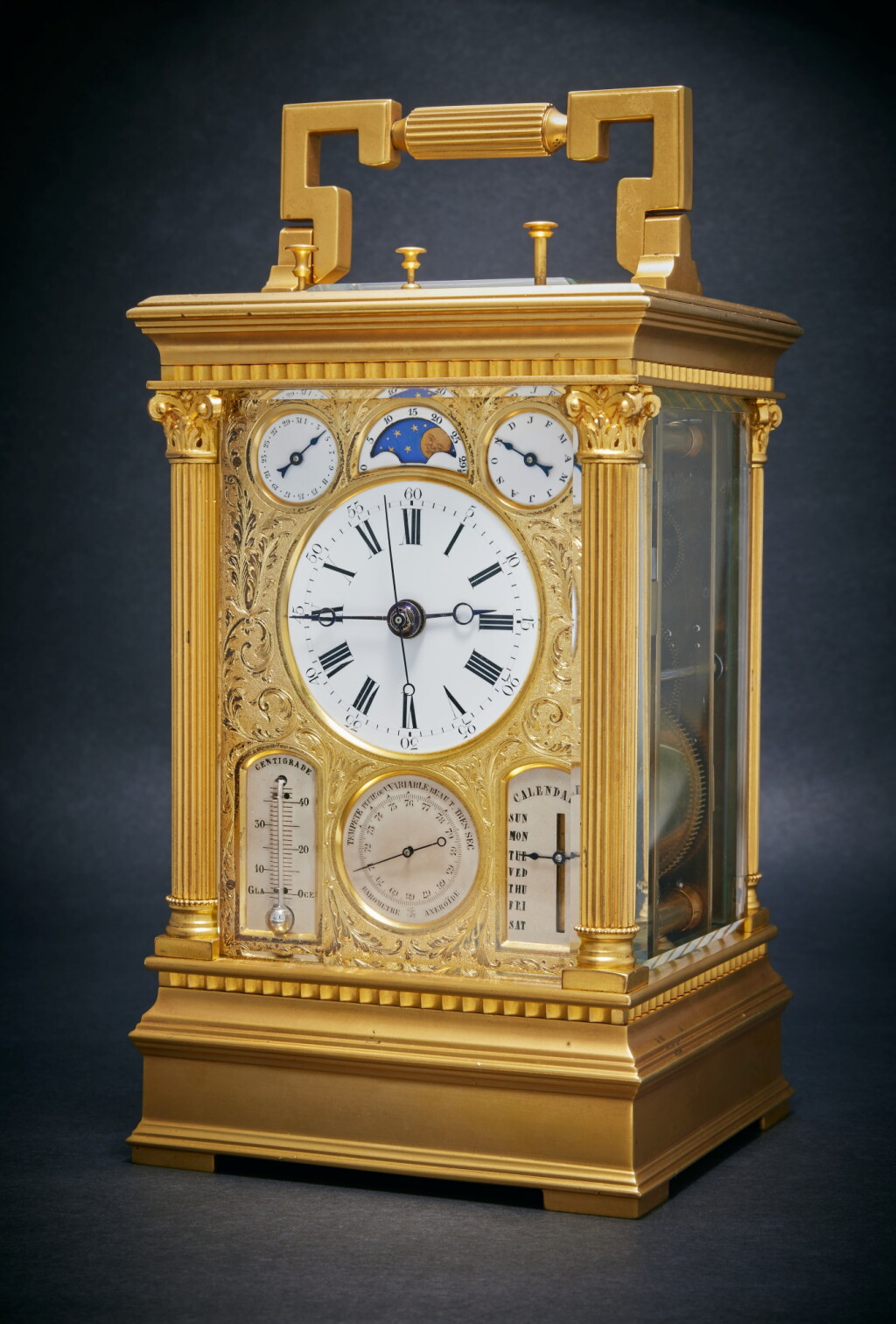
A rare French gilt-brass grande sonnerie, minute repeating center-seconds carriage clock with fly-back calendar, thermometer, barometer and moon phases, Circa 1880
Auction Closed
December 8, 10:03 PM GMT
Estimate
20,000 - 40,000 USD
Lot Details
Description
Movement: platform lever escapement, grande sonnerie, two train for going and striking, strike/repeat on two gongs mounted on the underside of the movement
Dial: 2-inch white enamel dial, Roman numerals, center seconds with subsidiary dials above 12 o’clock for date, day, moon phases and ages of the moon, the bottom with silver tablet-form dials for centigrade and fly-back months flanking the barometer, gilt foliate scrolled-engraved surround
Case: Anglaise Riche gilt-brass rectangular molded case with striated columns with Corinthian capitals and ripple moldings, buttons to the top for setting date, phases and ages of the moon, and a third for repeating function, hinged back and heavy bevel-glazed top, side and back panels, glazed back plate etched with winding and setting instructions, strike work positioned on the back plate, also with three position lever for silence and grande sonnerie selection, top back of the case with slide for strike/silent
Dimensions: 10.79 W x 18.54 H cm
i. Charles Allix, Carriage Clocks, pl VIII/14, VIII/15, p. 204-205
This exceptional example by Boseet exemplifies the rich trajectory of French clockmaking. It features a rare fly-back calendar mechanism, where a pointer moves down a vertical scale one day at a time and ‘flies back’ to Monday at midnight on Sunday. In addition to this unique weekday display, the clock is equipped with subsidiary circular dials for the date and month, a semi-circular moon phase dial, as well as both barometer and thermometer functions.
Further complications include grande sonnerie striking, centre-seconds, and a minute-repeating mechanism. While the piece was almost certainly cased and finished in Paris, the design of the movement clearly reflects the influence of Franche-Comté traditions.
The clock is topped with a central button that repeats the hours and quarters and allows for correction of the lunar display via an integrated selection lever. A right-hand plunger releases the quarter-chiming train and also winds and releases a watch-type minute-repeating mechanism. The left-hand button is dedicated solely to manual adjustment of the calendar.
Such is the quality and horological importance of this timepiece that it was illustrated in Charles Allix’s Carriage Clocks: Their History and Development.i