
Exceptional Discoveries: The Olmsted Complications Collection
Dent, London
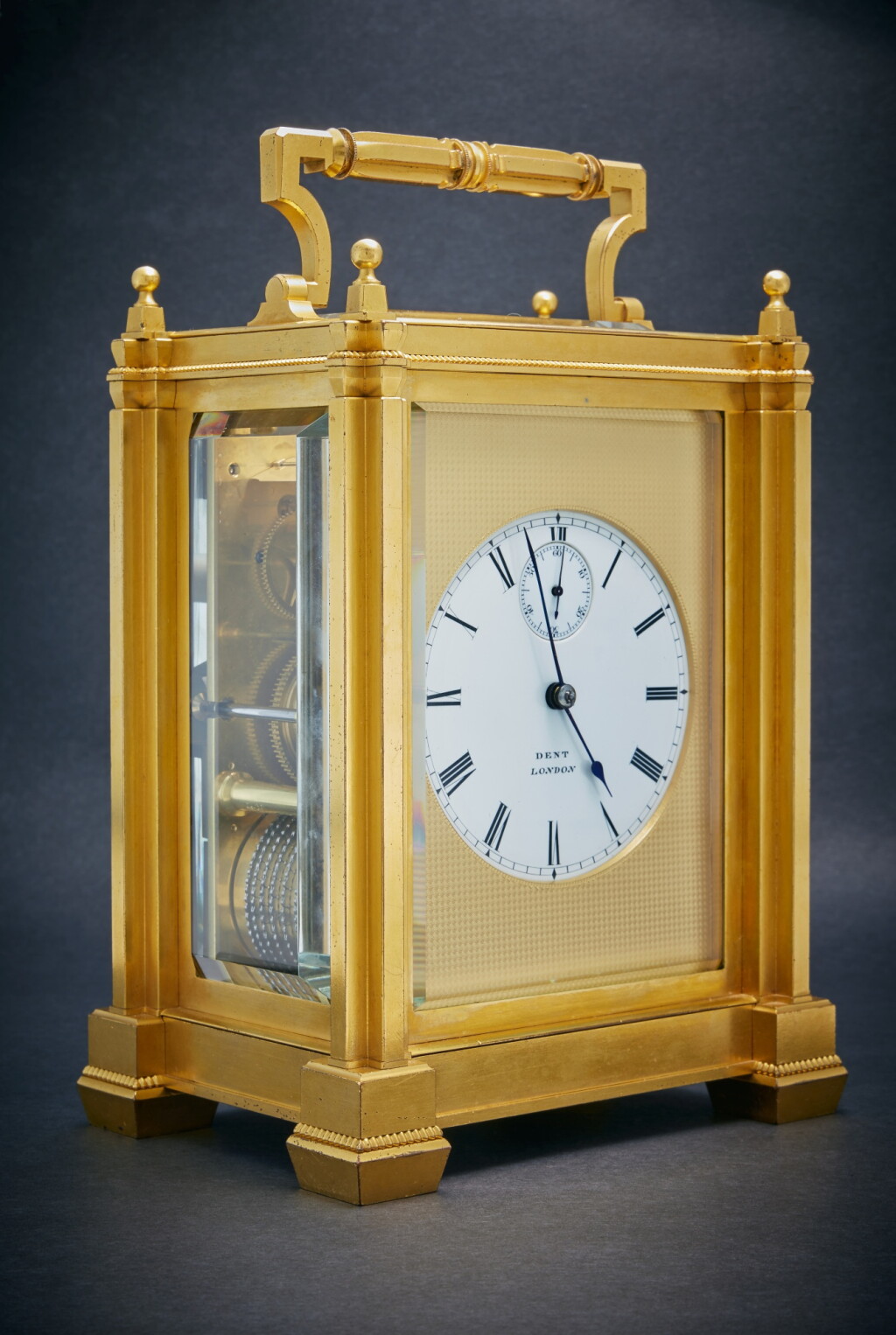
A rare and large English gilt-brass eight-day hour striking and repeating chronometer carriage clock with Dent’s patented staple balance, No. 20378, Circa 1850
Auction Closed
December 8, 10:03 PM GMT
Estimate
20,000 - 40,000 USD
Lot Details
Description
Movement: deeply planted platform with Earnshaw spring detent escapement, Dent’s patented free-sprung staple balance with a blued steeled helical hairspring, maintaining power, gong striking with repeat button to the side, two train fusee movement, strike/silent lever mounted on the backplate, No. 20378
Dial: 3 ½-inches, circular white enamel dial, Roman numerals, recessed subsidiary seconds at 12 o'clock, gilt engine-turned surround, signed Dent, London
Case: gilt brass case with cruciform pillars with ball finials and folding handle, repeat button to right side glass, shuttered back with winding holes for hand setting, and heavy beveled-glazed top, side and back panels, strike/silent lever on the back
Signed: dial, backplate signed Dent, 33 Cockspur Street, London, 20378
Accessories: accompanied by Charles Frodsham & Co. service invoice dated June 9th, 1970; and winding key specially made and fitted by Charles Frodsham at the time of restoration
Dimensions: 13.46 W x 21.59 H cm
Edward John Dent, (1790-1853), was originally apprenticed to a tallow chandler but was allowed to transfer to Edward Gaudin, a clockmaker, after he became fascinated by horology through his contact with his cousin Richard Rippon, a watchmaker. Between 1815 and 1829 he worked as a chronometer maker for various firms including Vulliamy, Barraud and McCabe. By 1830 he was so highly regarded that he was invited by John Roger Arnold to enter into partnership with him at 84 Strand. The partnership lasted for ten years. In 1840 Dent opened his own business at 82 Strand and in 1843 opened further premises at 33 Cockspur Street, the address on this clock. That same year he married his cousin's widow, Elizabeth Rippon.
Edward Dent died in 1853 leaving his business to his two stepsons, Frederick and Richard Rippon on the condition that they took their stepfather's family name. Edward Dent is probably best remembered as the clockmaker who was awarded the contract to build the great Westminster Clock, commonly known as Big Ben.
For similar Dent Chronometer carriage clocks with the same case design and Dent patented staple balance, see Charles Allix, Carriage Clocks: Their History and Development, p. 259, pl. IX/28-IX/29 and another see, Sotheby’s London, November 6, 2012, Lot 69, 'The George Daniels Horological Collection’ . For an image of Dent’s staple balance see Derek Roberts, Carriage and Other Travelling Clocks, p. 316, fig. 21-17. Also see another image in Vaudrey Mercer, Edward John Dent and his successors p. 608 pl.146 . Op.cit. p. 602 Mercer writes that carriage clocks with staple balance and grand sonnerie striking were of the best