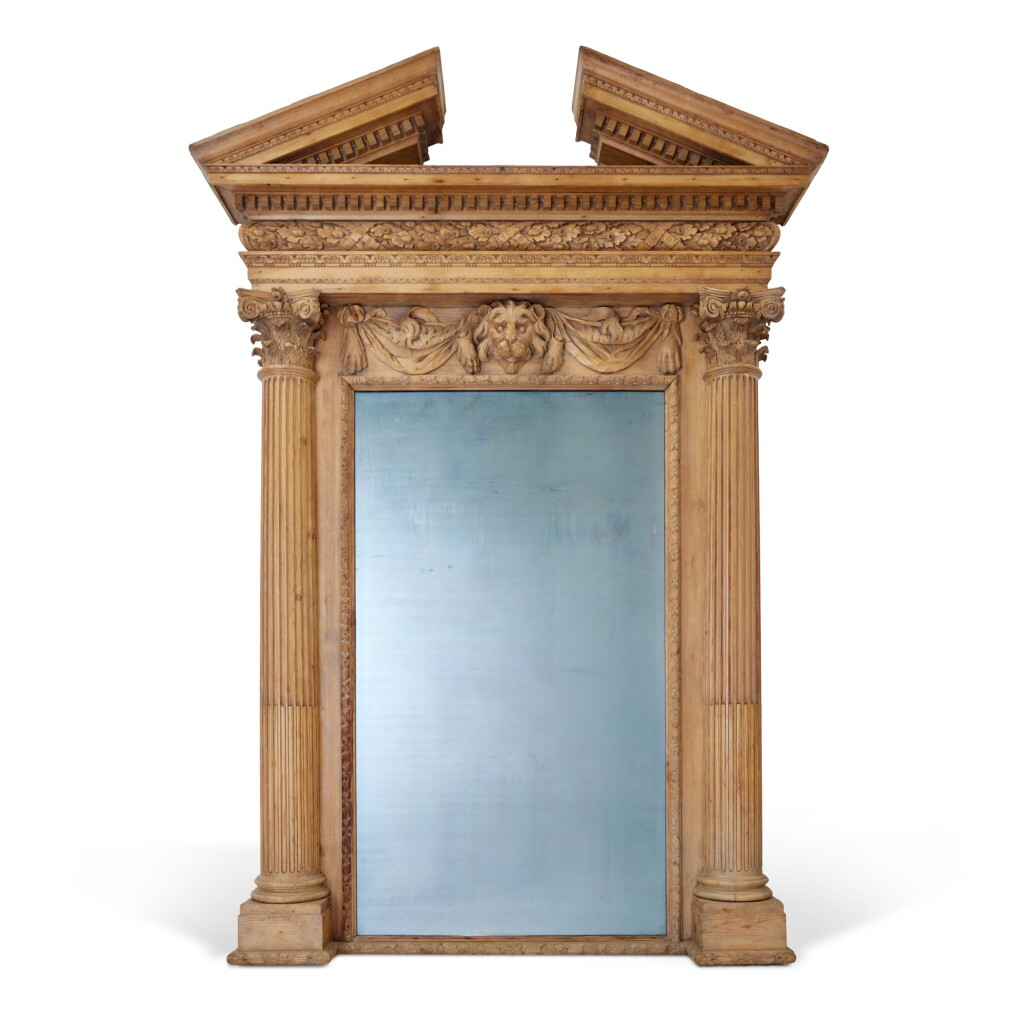
An Irish George II Pine Pier Mirror after a Design by William Jones, attributed to the Booker Family, Dublin, Circa 1740
No reserve
Auction Closed
October 15, 06:30 PM GMT
Estimate
20,000 - 30,000 USD
Lot Details
Description
the dentillated broken pediment above an oak garland and acorn frieze and lion mask pelt flanked by fluted Corinthian half columns; previously decorated and possibly previously with an additional lower section; the pediment previously with a central element
height 72 ¼ in.; width 47 in.
183.5 cm; 119.4 cm
Richard D. Bass (1929-2015), Dallas;
Christie's New York, 29-30 March 2016, lot 391.
This mirror exhibits the textbook markers of the Palladian style in early-eighteenth-century English decoration named after its most famous practitioner, William Kent. The architectural conception is typical, including a triangular pediment quoted from Greek and Roman temples but with a ‘broken’ form to allow for the display of a classical bust. The combination of classical borders like bead-and-reel motif, the substantial ribbon-tied oak wreath and the drapery incorporating a lion’s pelt are all quintessentially Kentian. However, the overall combination of these elements recalls the work of a particular family of craftsmen working in this style, the Dublin-based Booker family. This mirror stylistically relates to the mirrors produced by John Booker Sr prior to his death in 1750, and numerous similar examples of Booker mirrors from this period have been seen at auction.1 Many mirrors by the Bookers have an additional long mirrored panel beneath the columns, possibly suggesting that this mirror may originally have been taller. This possibility is strengthened by the very close resemblance between the present mirror and a design for a mirror frame in William Jones’s 1739 book The Gentlemen’s or Builder's Companion.2 This design notably incorporates a central eagle in the pediment, but otherwise the present mirror only differs in the stop-fluting of the engaged columns and treatment of the details to the lion pelt and oak wreath. Several surviving Booker mirrors of comparable model include an additional lower section with corbel brackets flanking either mirror plates or a relief-carved panel.3
1 See Christie’s London, 7 May 2009, lot 51 (with the Booker trade label); Sotheby’s London, 6 July 2010, lot 48; Christie’s London, 9 June 2011, lot 281; Christie’s London, 14 November 2013, lot 5 and Mealy’s, 14 November 2007, lot 899 (also with the trade label).
2 W. Jones, The Gentlemen’s or Builders Companion, London 1739, p.50. Available at: <https://archive.org/details/bim_eighteenth-century_the-gentlemens-or-builde_jones-william_1739/page/n114/mode/1up> [accessed 31 July 2025]; illustrated in J. Peill and the Knight of Glin, Irish Furniture, New Haven 2007, p.143.
3 See Peill and Glin 2007, fig. 190 p.140; fig. 194 p.144; figs. 224-255 p.261.
You May Also Like