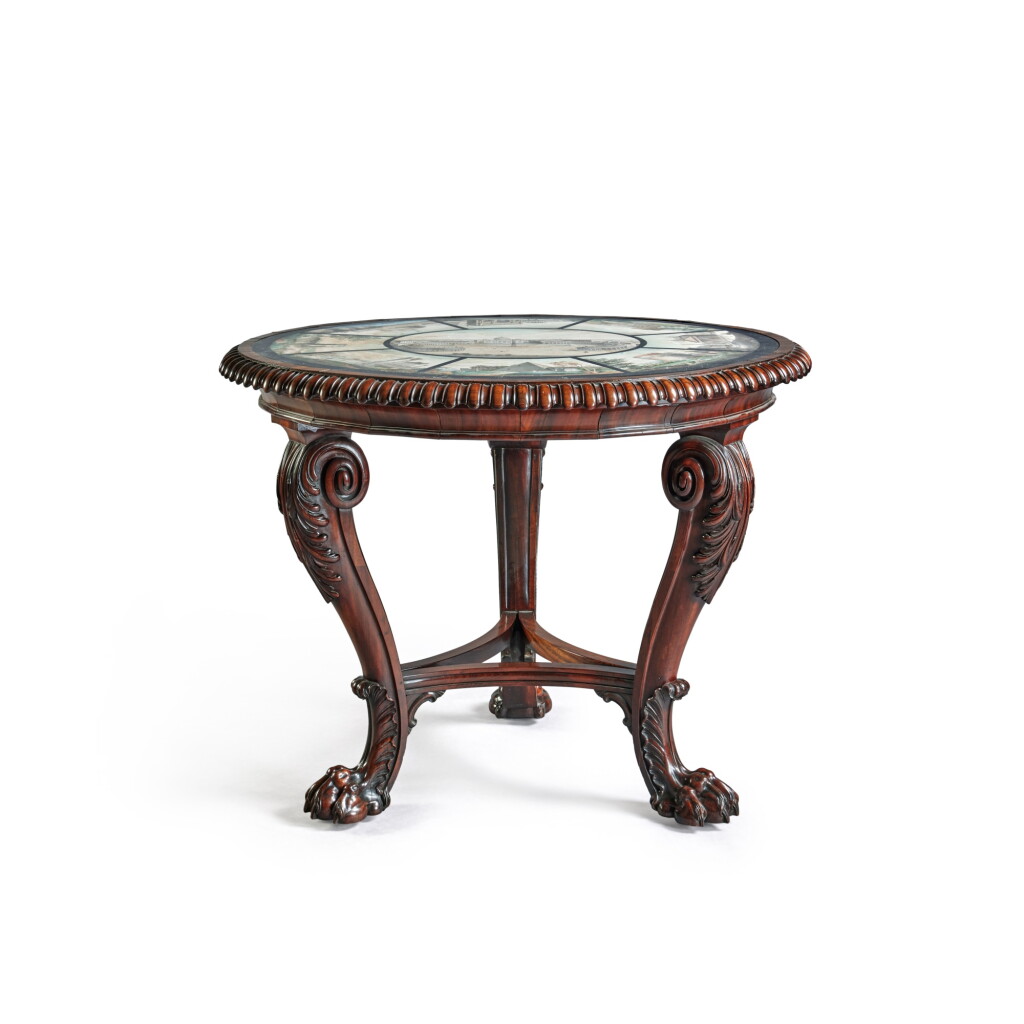
A Regency Gonçalo Alves and Scagliola Centre Table, the Top attributed to the Della Valle Brothers, Livorno, the Base in the manner of Wiliam Trotter, Edinburgh, Circa 1820
No reserve
Auction Closed
October 15, 06:30 PM GMT
Estimate
30,000 - 50,000 USD
Lot Details
Description
the top with a central vignette of St Peter's Square surrounded by vedute of ancient Roman monuments; the base with a boldly gadrooned border on three acanthus headed scrolling legs terminating in acanthus paw feet joined by a moulded concave stretcher
height 31 in.; diameter 40 1/2 in.
78.5 cm; 103 cm
Sotheby's London, 15 November 1991, lot 133;
Carlton Hobbs, London;
Christie’s New York, 11 June 2010, lot 10.
This rare tabletop takes a typical Grand Tour subject matter of Roman scenes and makes it remarkably fresh through the unusual use of scagliola. The milky pastels of the scagliola colour palette bring a more dreamy, lyrical feel to the landscapes than the more common micromosaics used for tabletops of this type, and are set off well by the sculptural and assertive base that is in the manner of William Trotter.
The scagliola top
‘Scagliola’ is the name given to a type of decorative plasterwork that combines powdered pigments with gypsum and glue to create a colourful, marbled effect. The art form was first developed in Emilia-Romagna, where marble deposits were less plentiful than in other parts of Italy but the rock used to create gypsum was abundant, prompting local craftsmen to create innovative plasterwork imitations. As a result, many scagliola tabletops follow the types of inlaid designs that were characteristic of the luxurious pietre dure tables that displayed complex formations of marbles and vibrant hardstones. However, there were also divergences from these hardstone templates, particularly as the art of scagliola was practised more widely and came to command an aesthetic respect of its own. One example of this divergence is the increasingly popular subject of detailed landscapes, cityscapes and architectural perspective scenes, rendered with a precision that would have been impossible in pietre dure, and the present tabletop is an even rarer variation on this theme. By arranging its Roman scenes radially, the designer has marked a clear departure from the norms of hardstone design and instead references a popular motif in micromosaics. The muted and harmonious colouring that is typical of scagliola brings a picturesque, poetic note to the landscapes that arguably could not have been achieved as effectively in either in hardstone or in micromosaic.
Very few other examples of scagliola tabletops in this manner have been recorded, though those that are allow us to attribute the present top to the Della Valle brothers on stylistic grounds. These include an example at Sotheby’s in 2012 that also featured eight scagliola scenes and bore the label Peter della Valle & Brothers Scagliola Manufacturers and Painters Leghorn, Leopolda Street, Palazzo Mazza.1 The Della Valle family firm are perhaps best known for representing Tuscany in the 1851 Great Exhibition, where they exhibited two scagliola tables and a scagliola vase.2 The most famous example of their work is at the Musée de Beaux-Arts in Nancy, a large rectangular example with scenes from Tuscany commissioned for a French engineer who had worked on projects in Livorno.3 On the basis of these two documented examples, and the relative paucity of tabletops that use scagliola to depict city scenes in this manner, other tabletops have also been attributed to the Della Valle brothers, including an example formerly at Chatsworth and sold at Sotheby’s in the 2010 Attic sale and another that was at Sotheby’s in 1992.4 A final example was at Christie’s in 2004, though with additional ornamental borders to the top.5 It is worth noting that the Della Valles also produced fine scagliola tops in designs other than this micromosaic-like radial arrangement of scenes, such as the view of Pisa signed P. Della Valle and offered at Koller in 2022,6 or the view of Florence’s Palazzo della Signorina in the Bianchi collection.7
The base
This is the only Della Valle top mentioned above to rest on an English stand in the grand Regency taste. This base was likely commissioned to match the top, which would have been purchased in Tuscany while on a Grand Tour. Tripod tables in this manner were a common sight in Regency interiors, but the particularly sharp carving is close to documented models by William Trotter, one of Edinburgh’s most successful furniture makers. The furniture that Trotter made for Paxton House is well-known and features numerous examples of gadrooning and foliate carving with a clear kinship to the present lot.8 Among the Paxton House furniture, we also see Trotter create custom bases for imported showpiece tops, more specifically “four commesso di pietre dure table tops, two Egyptian jasper slabs and two slabs of black marble, all acquired by Patrick Home in Naples”.9 Another Trotter piece that features the same realistically modelled paw feet was made for Penicuik House.10 William Trotter (1772-1833) was the descendant of a dynasty of furniture makers and brought the family firm to its apogee in the early nineteenth century, fulfilling highly prestigious commissions including the royal apartments in Holyrood Palace and the new Royal Museum in Edinburgh.11
2 Official Catalogue of the Great Exhibition of the Works of Industry of All Nations, London, 1851, p.312. Available at: <https://archive.org/details/officialcatalog06unkngoog/page/n318/> [accessed 2 July 2025]
3 S. Chiarugi, Botteghe di Mobilieri in Toscana, Florence 1994, vol. II, p.227.
4 Sotheby’s London, Chatsworth: The Attic Sale, 5 October 2010, lot 701; Sotheby’s London, 11 December 1992, lot 381.
5 Christie’s London, 18 March 2004, lot 21.
6 Koller Zurich, 31 March 2022, lot 1309.
7 A. M. Massinelli, Scagliola: L’arte della pietra di luna, Rome 1997, p.82.
8 This suite has been pictured in multiple publications, including F. Bamford, A Dictionary of Edinburgh Furniture Makers, Leeds 1983, pl.49-61.
9 S. Jackson, Scottish Furniture 1500–1914, Edinburgh 2024, p.138.
10 Bamford, pl.75A and 75B.
11 ‘Trotter, William (1772-1833)’, BIFMO, 28 October 2024. Available at <https://bifmo.furniturehistorysociety.org/entry/trotter-william-1772-1833> [accessed 2 July 2025]
You May Also Like