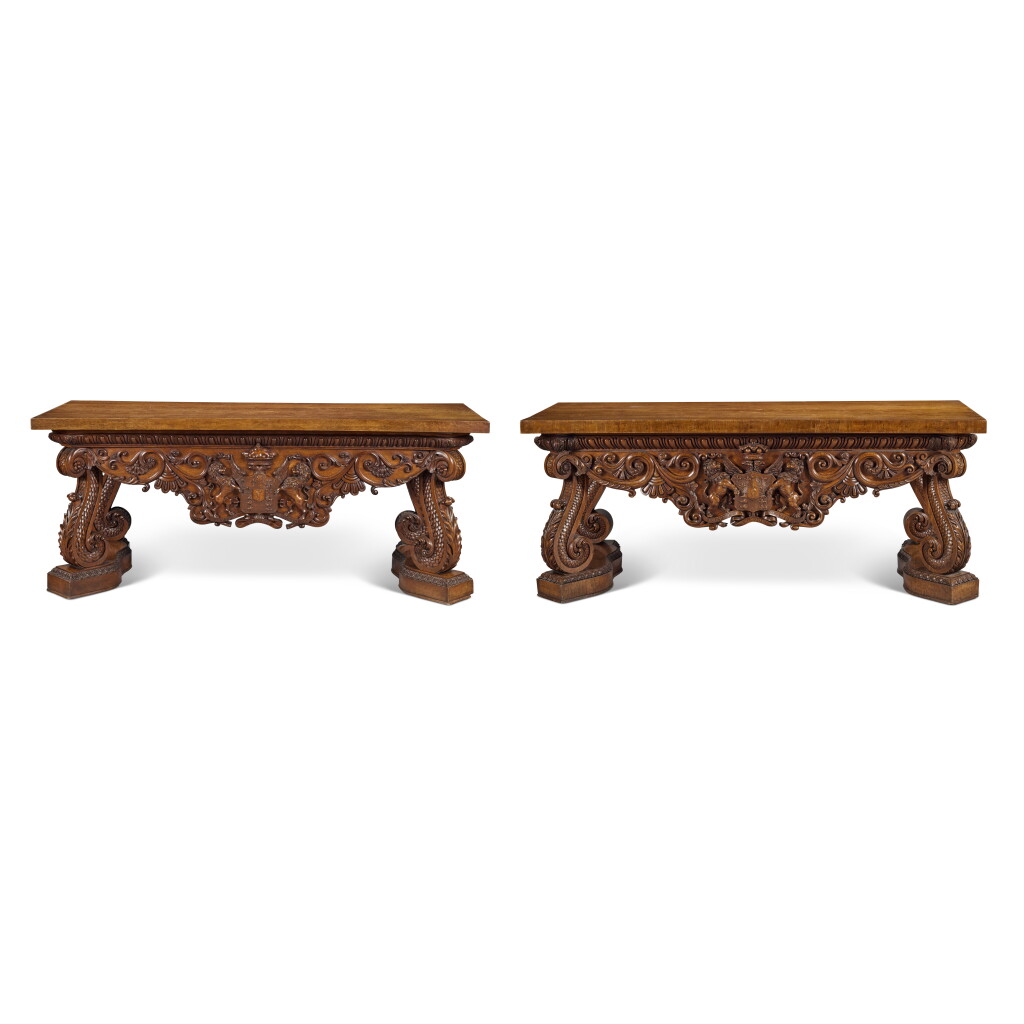
A Pair of Large Carved Oak Heraldic Console Tables, one George IV by Gillows and the other early Victorian
Auction Closed
October 15, 06:30 PM GMT
Estimate
30,000 - 50,000 USD
Lot Details
Description
each with a rectangular top above a gadrooned frieze with canted corners and scrollwork apron carved with the coat of arms of the Barons Newborough and bearing the motto SUAVITER IN MODO FORTITER IN RE [gently in manner, forcefully in deed], on imbricated S-scroll and acanthus legs raised on serpentine leaf-tip moulded plinths
height 36 1/2 in.; width 90 1/4 in.; depth 35 1/2 in.
92.5 cm; 229 cm; 90 cm
The first supplied by Gillows & Co to Thomas John Wynn, 2nd Baron Newborough for Glynllifon, Caernarfonshire, Wales in 1823;
The second supplied by Owen & King to Spencer Bulkeley Wynn, 3rd Baron Newborough in 1841, also for Glynllifon;
Sold with the house, circa 1949, to the Glynllifon Agricultural College (later renamed Coleg Meirion Dwyfor);
Christie's London, 9 March 2000, lot 100 (as 'Property of the Coleg Meirion Dwyfor, Glynllifon').
The design of these grand tables pays tribute to the long lineage of the Wynn family, for whom they were commissioned in the first half of the nineteenth century. Though the first of these two tables was created in 1823, the design is clearly reminiscent of the Kentian style that was popular almost exactly a century previously, an overt decorative statement about the lineage of wealth and power in the family. This style of furniture evokes the time period of the first member of the Wynn family to be ennobled, Sir Thomas Wynn (1677–1749). Sir Thomas, 1st Baronet held the prestigious title of equerry to George II for 35 years, beginning in 1714 when the young monarch was still the 31-year-old Prince of Wales. He also served as a Member of Parliament for Caernarvon for several decades and held the rather evocative court title of ‘Clerk of the Green Cloth’ from 1727 until his death. It was through his wife Catherine Vaughan, the heiress of the estate, that the residence Plas Glynllifon came into the Wynn family, with whom it would stay until it was sold in the 1940s.
The elder of these two tables was commissioned for Thomas John Wynn (1736–1807), the 2nd Baron Newborough, and the extant 1823 invoice from the preeminent firm Gillows & Co describes:
“An oak table richly carved with your own arms, scroll supports, centre foliage. £69”.
The second table was copied from the first in 1841, and created for his younger brother Spencer, the 3rd Baron (1803–1888). This was commissioned as part of a significant rebuilding programme for Glynllifon, with most of the building as it stands today dating from this period. There is also a surviving bill from the Berners Street, London firm Owen & King for this second table, which cost 76 pounds and 10 shillings and was described as:
“a Masive [sic] oak table 7 feet by 3 feet wide with carved frieze supported by four carved truss legs on shaped plinth with rich carved moulding on ditto - your lordship’s arms carved and carved scrolls under the frieze”
The bill also specifies that the table is for the “for the Hall”, where it would later be photographed alongside its 1823 pendant. The tables would remain with the family until they were sold with the house around 1949; it was as the property of Coleg Meirion Dwyfor, the agricultural college based in Glynllifon at the time, that the tables came to auction in March 2000.
You May Also Like