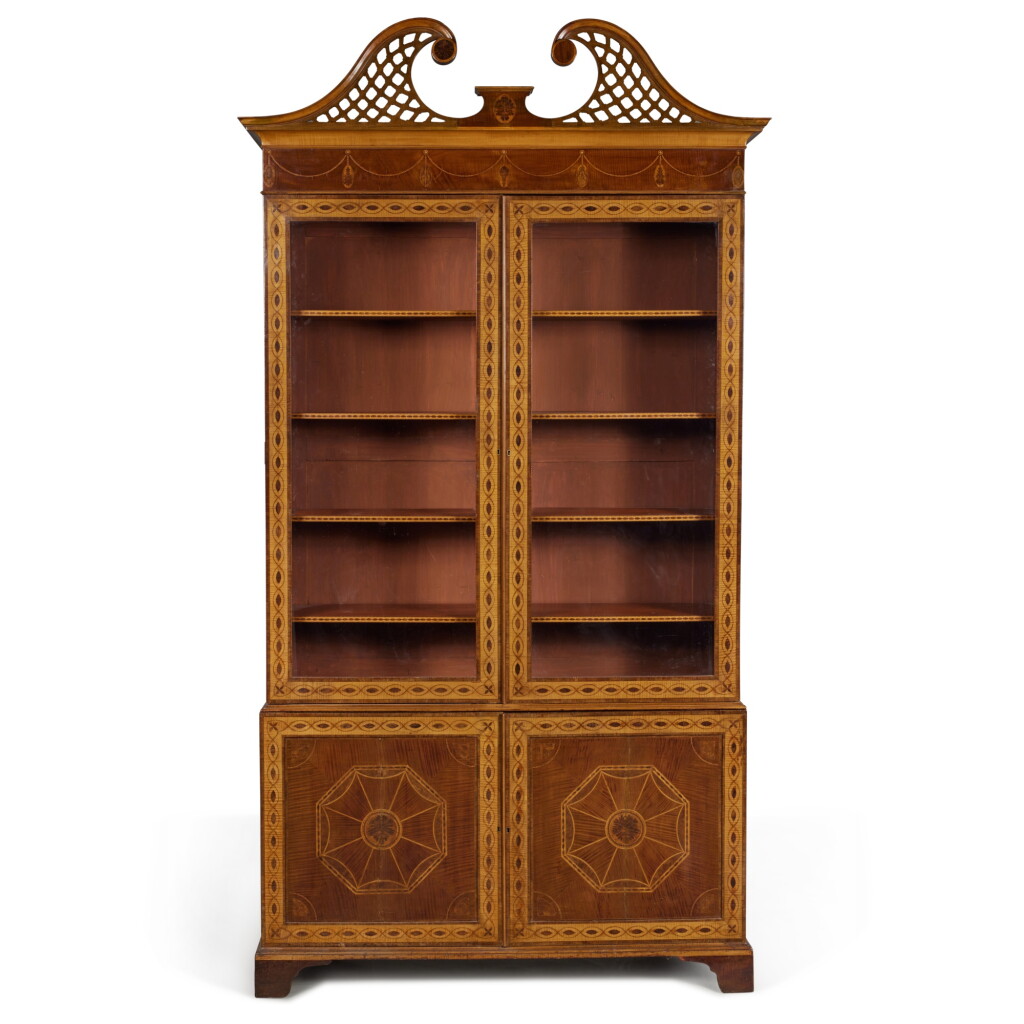
A George III Satinwood, Mahogany, Harewood, Sycamore and Burr Yew Marquetry Display Cabinet, Circa 1780
No reserve
Auction Closed
October 15, 06:30 PM GMT
Estimate
12,000 - 18,000 USD
Lot Details
Description
the upper section with swan neck and fretwork crest above two glazed doors and four shelves; the lower cupboard with two doors opening to two short and one long drawer with inlaid fronts, on bracket feet; the back bearing a typewritten label This large inlaid cabinet with glass front (one of a pair) loaned by me to the Pennsylvania Museum of Art is part of the inventoried contents of my residence Whitemarsh Hall, Chestnut Hill, Philadelphia and belongs in the Second Floor Hall and signed E. T. Stotesbury
height 107 1/4 in.; width 57 1/2 in.; depth 19 in.
272.5 cm; 146 cm; 48 cm
Edward T. Stotesbury (1849-1938), Whitemarsh Hall, Wyndmoor, Pennsylvania;
James F. Scott, Gallison Hall, Charlottesville, Virginia;
Sotheby's New York, Gallison Hall: The James F. Scott Collection, 15 October 2018, lot 114.
Philadelphia Museum of Art, Philadelphia, Pennsylvania c.1935
In 1916, the Philadelphia banker Edward Stotesbury, one of the wealthiest men in America in the early 20th century, commissioned the architect Horace Trumbauer to build Whitemarsh Hall, a palatial residence which was the third largest house in the US at the time and referred to as the 'American Versailles' because of its extensive French-style gardens laid out by Jacques Gréber. The house was furnished by Duveen and decorated by White, Allom & Co. of London and Alavoine of Paris. After Stotesbury's death in 1938, his widow sold the property, and it gradually fell into disrepair and was finally demolished in 1980.
You May Also Like