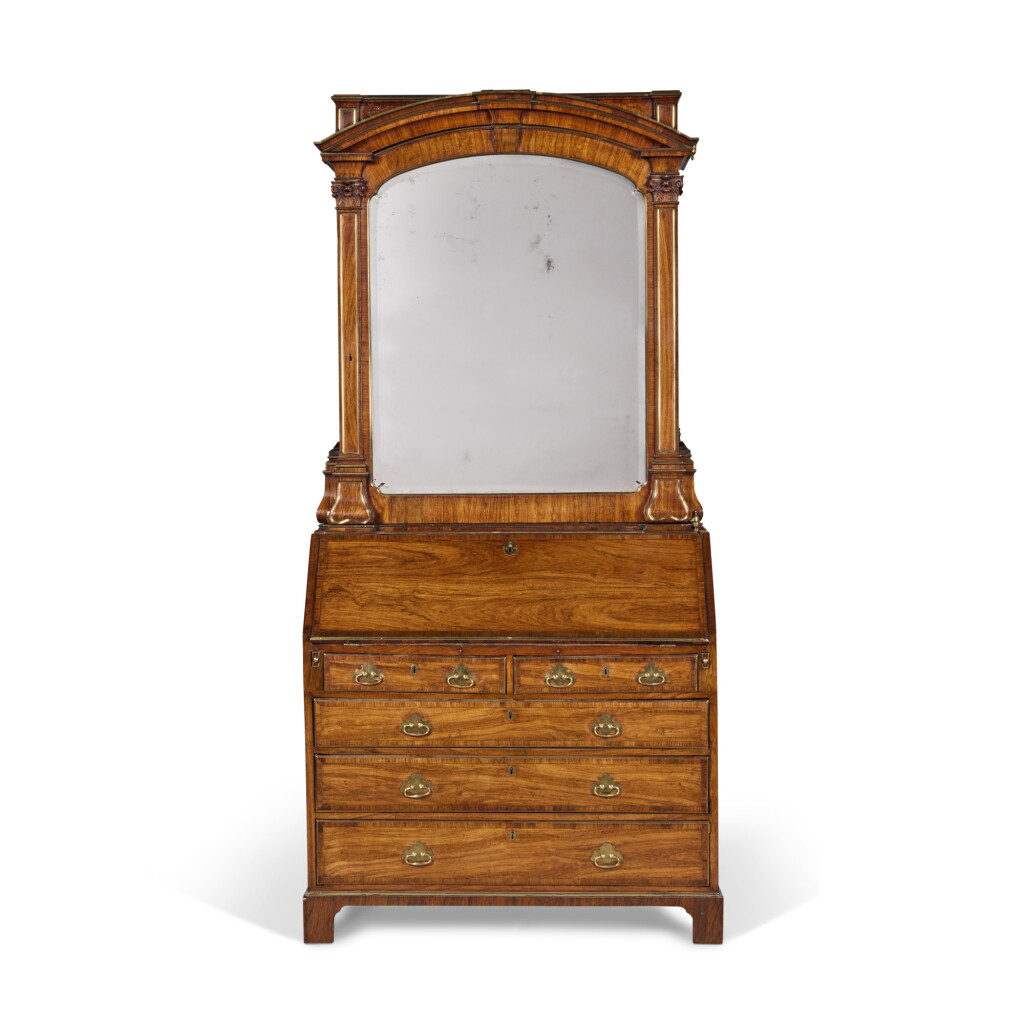
A George II Brass-Mounted and Inlaid Padouk Bureau Cabinet in the Manner of John Channon, Circa 1735
No reserve
Auction Closed
October 15, 06:30 PM GMT
Estimate
80,000 - 120,000 USD
Lot Details
Description
the arched upper section with a single door with bevelled mirror plate flanked by composite pilasters opening to a cupboard of three adjustable shelves and lower tier of three drawers; above a slant front opening to an interior arrangement of a central cupboard with a small drawer and secret compartments, flanked by detached composite columns concealing further secret compartments and an arrangement of drawers and pigeonholes and a later oxblood leather writing surface; the lower section with two short and three graduated drawers on later bracket feet
height 96 1/2 in.; width 47 in.; depth 24 in.
245 cm; 119.5 cm; 61 cm
Sotheby's New York, 26 April 1980, lot 86;
Christie's New York, 30 January 1982, lot 163 (as North German);
The Collection of Arne Schlesch;
Sotheby's New York, 15 April 2000, lot 364;
Sotheby's New York, 26 October 2012, lot 212.
The refined elegance of this bureau-cabinet rests on its distinctive combination of a cleanly minimal design, a rare exotic timber and the strong linear feel of its brass inlay. Even when employed with timbers like mahogany, such brass inlay adds a sleekly European flavour that derives from the German roots of the émigré craftsmen who worked in this technique.
The historical understanding of brass-inlaid furniture in England was boosted considerably in 1993 by the exhibition and accompanying book John Channon and Brass-Inlaid Furniture 1730–1760. Prior to this, the main reference point for this technique was the pair of bookcases made for Sir William Courtenay at Powderham Castle, which bear the label Channon Fecit.1 However, research for the 1993 exhibition and its scholarly response2 brought together a range of disparate examples and ventured names of other craftsmen working in this technique like Frederick Hintz, as well as exploring in depth the role played by Germans like Abraham Roentgen who were producing brass-inlaid furniture in London at the time. With several other pieces of case furniture like the Powderham example exhibiting more floridly Continental overall designs, and even possible constructional evidence of émigré hands,3 the most relevant comparable example to the present lot is another brass-inlaid padouk bureau-cabinet formerly in the collection of Sir George Stanley Pott and later sold at Christie’s in 2000.4 This example, like the present lot, is of inverted breakfront form with two fluted pilasters that rest on bulbous plinths unrelated to the classical architectural orders. Similar bulbous plinths can be seen on a brass-inlaid bureau-cabinet with the label Antrobus Fecit,5 though that example sports a more unusual style of pediment and cock-beaded drawers. In short, the forms of brass-inlaid furniture are often inventive and did not settle into a ‘canonical’ pattern; the present lot is a more restrained manifestation of the style, closer to English models than some of the other more elaborately Germanic examples.6
The dense, lustrous timber employed for this bureau cabinet is padouk, shown here to particular advantage with large panels of its expressive grain. While the 1730s and 1740s were the dawn of the ‘Age of Mahogany’ in English furniture, a wood which was generally imported from Central American countries like Honduras, Jamaica, the Bahamas and Cuba, there was still evident variety in the timbers that furniture makers chose. Padouk (pterocarpus) is close to rosewood and the nomenclature of the two has tended to overlap;7 the availability of padouk in South-East Asian geographies like Myanmar and the Philippines means that it is often seen in Chinese furniture made to English models for export or in campaign furniture.
1 C. Gilbert, Pictorial Dictionary of Marked London Furniture 1700–1840, Leeds 1996, p.138, figs. 193, 194. They are now in the collection of the Victoria & Albert Museum (W.1A-1987 and W.1-1987).
2 first discussed in C. Gilbert and T. Murdoch, ‘Channon Revisited’, Furniture History, 1994, pp.65-85.
3 as discussed in A. Bowett, Early Georgian Furniture 1715–1740, Woodbridge 2009, p.75.
4 Christie’s London, 6 July 2000, lot 90. Also pictured in numerous publications including C. Gilbert and T. Murdoch, John Channon and Brass-Inlaid Furniture 1730–1760, New Haven, 1993, pl. IV and VII.
5 C. Gilbert, op. cit., 1996, p.40, figs.23, 24.
6 other examples of brass-inlaid bureaux-cabinets can be seen in ibid., figs.44-70., Sotheby’s London, Precious Objects from Asprey and Garrard, 2001, lot 967, an example in the Victoria & Albert Museum that also has tortoiseshell inlay (W.37:1 to 37-1953) and an example made for export to Spain sold Sotheby’s New York, The Arthingworth Collection, 12 December 1996, lot 164.
7 see A. Bowett, Woods in British Furniture-Making 1400–1900, Wetherby 2012, p.177 and 206-7.
You May Also Like