
Albert Einstein
Autograph Quotation Signed ("A. Einstein."), to Carl Laubman, About the Virtues of Travel, 1927
Lot Closed
July 17, 06:05 PM GMT
Estimate
5,000 - 8,000 USD
We may charge or debit your saved payment method subject to the terms set out in our Conditions of Business for Buyers.
Read more.Lot Details
Description
Albert Einstein
Autograph Quotation Signed ("A. Einstein."), to Carl Laubman, About the Virtues of Travel, 1927.
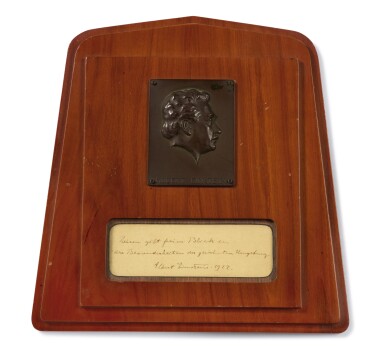
1 page in ink on a single sheet (1⅝ x 5⅛ inches), in German, in wood display frame with Albert Einstein plaque affixed to front, 10¼ x 10½ inches overall. Typed note, presumably by Carl Laubman, affixed to verso.
"TRAVELING GIVES YOU A CLEAR VIEW INTO THE UNIQUE CHARACTERISTICS OF YOUR FAMILIAR SURROUNDINGS" — ALBERT EINSTEIN, 1927
One of the consequences of Einstein's general theory of relativity is that light should appear "bent" when passing by a massive celestial body on account of its gravitational pull. British physicist Arthur Eddington (1882-1944) proved Einstein's prediction correct in 1919, when he observed and recorded the shifted positions of stars whose light passed by the Sun during a total solar eclipse.
Concerns were quickly raised, however, about the accuracy of Eddington's photographic plates. Therefore, the physics and astronomy community deemed the reconfirmation of his findings necessary. In September 1922, many national and international teams spread out across Australia to photograph a total solar eclipse that passed over the entire width of the country. The best remembered effort was that of William Wallace Campbell,
the Director of California's famed Lick Observatory, who set up camp at Warral, Western Australia. However, many other groups set up their equipment across the path of the eclipse, including at Cordillo Downs in the northeast corner of the State of South Australia.
Led by George Dodwell, the Government Astronomer for South Australia for much of the first half of the 20th century, the Cordillo Downs expedition also confirmed Einstein’s theory and Eddington’s observation. In 1927, Carl Laubman and Harold Pank, prominent South Australians and the owners of the well-known optical firm Laubman & Pank, went on a 12-month world tour as official representatives of the South Australian Government where they were to “enquire into and report upon the tests for visual acuity of drivers of public utility vehicles, ophthalmic standards, and lighting of industrial buildings in Great Britain, Europe and the United States.” During their tour – which included Palestine, Egypt, and Turkey in addition to Europe and North America – Laubman and Pank met with Einstein in Berlin where they provided him with the data from the Cordillo Downs expedition that confirmed his theory of general relativity.
In the years leading up to Laubman and Pank's visit, Einstein had taken numerous journeys around the world: to the United States in 1921, Asia and the Near East in 1922, and South America in 1925. Perhaps inspired by Laubman and Pank's more recent experiences in Palestine (where Einstein was lauded only a few years prior), Einstein gave Laubman this "inspiration," in German, as a parting gift:
"Traveling gives you a clear view into the unique characteristics of your familiar surroundings."
REFERENCES:
“A World Tour. Travel Experience of Messrs Laubman and Pank.” Kadina & Wallaroo Times. March 21, 1928.

