
Joie de Vivre: A Journey in Jewels
Schlumberger for Tiffany & Co.
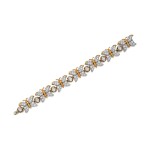
Gold and Diamond 'Seven Butterflies' Bracelet
Auction Closed
June 13, 04:37 PM GMT
Estimate
40,000 - 60,000 USD
Lot Details
Description
Composed of a line of butterfly motifs set with round diamonds, spaced by oval-shaped diamonds, length 6½ inches, signed Tiffany Schlumberger.
Joie de Vivre
A Journey in Jewels
Louisa possessed more determination and a greater wit than just about anyone in her small town in rural Colorado. Each day she would drive over a mountain, to another small town, to attend college. She had received a scholarship to the University of Pennsylvania, but circumstances required that she stay closer to home. It was 1964 and she was far too busy getting straight-As to think about men, and when she wasn’t at school, she taught dance to earn money: a dollar a day for gas, a dollar a day for food.
Jack lived on the other side of the mountain and was a man with a vision. He shared his neighbors’ curiosity over the young woman who, with her daily comings and goings, never stopped long enough to entertain an invitation. But Jack was clever and asked her to lunch, not dinner like her other suitors. The restaurant was much nicer than Louisa had expected, but she stuck to her usual, a hamburger with a glass of milk.
After lunch, Jack invited Louisa to see a handful of homes he’d been building. They headed toward the site, Jack in his brand-new white Lincoln convertible and Louisa, trailing closely behind in her 1954 Buick. It was snowing, as it often did in that part of the state, and the tires on Louisa’s car were bald to the point of being scalped. Sure enough, the Buick began to swerve and skid until it came to an abrupt stop, courtesy of Jack’s rear bumper. It was more than a “love tap,” but Jack didn’t mind; his only concern was for Louisa. After considerable back-and-forth, and much insistence on Jack’s part, she drove home in the freshly dented Lincoln and Jack took the Buick to his local garage. He told the garage owner he needed a new set of tires for his beautiful lunch date, to which the man said, “you know, if you save someone’s life, you have to marry them.” And he did, six months later.
Schedules dictated a short honeymoon at The Broadmoor, a resort that boasted headlining acts like Tony Bennett and Dean Martin. Upon their arrival, Jack and Louisa were struck by the dozens of young and attractive guests milling about the common rooms. More fresh faces appeared at dinner where the newlyweds were seated at separate tables and welcomed into conspicuously enthusiastic conversations. By the time soup had arrived, it was clear to both of them that this was not a typical evening at the Broadmoor. No, in fact, they had unwittingly booked their honeymoon for the resort’s singles weekend. With misplaced interests politely deflected, they made their way to the elevator where they were joined by three fashionable ladies wearing beautiful jewelry. “Don’t worry,” Jack whispered to Louisa, “someday you’ll have ten times as many jewels.”
Jack kept his promise and, sixty years later, they still act like newlyweds, lighting up when in each other’s presence. “I aspire to cashmere sweaters, not jewels,” laughs Louisa, “I’ve never entered a jewelry store. But Jack? He just goes for a walk and comes back with something tucked inside his coat pocket.” Many of these walks were taken in Capri where, as a family, great friendships and countless happy memories were made. Their annual summer pilgrimage to the island included stops elsewhere in Italy, most frequently in Venice and Rome. On one Venetian evening, after a cooking class where Louisa discovered risotto and Jack “learned how to boil water,” Louisa was alighting from a gondola and “plop”! One of her earrings—a recent gift from her husband—landed in the water. She put on a brave face—she didn’t want spoil the mood—but as soon as they returned to the hotel Jack sprang into action. He inquired about the bottom of the canal: “sand or mud?” he asked, knowing a sandy bottom meant the earring was well on its way to the Adriatic. Having received the desired answer, Jack hired a diver to comb the canal’s sticky bottom. In a matter of moments, the diver rose victoriously to the surface, earring in-hand. This was just one of many times Jack demonstrated his devotion to his wife and, for Louisa, provided further proof that her husband is the smartest person she knows.
The buildings Jack showed Louisa after their life-changing first date laid the foundation for a real estate portfolio that extended across the country. They made Manhattan their home for many years, and it was there that Jack discovered the ultimate mecca for spectacular jewels: Graff. He passed their flagship store at the corner of 63rd and Madison on his weekly trips to the barber. On one such trip, he was stopped mid-stride by a stunning diamond in the window. After a few more shaves-and-a-haircut, he walked through Graff’s wrought iron doors where the staff soon cottoned onto his sweet tooth. Several more visits and plenty of chocolate later he bought the 35.01-carat dazzler. “I had never seen anything so big and so perfect,” recalls Louisa. “I didn’t feel I could wear it. We were about to head to Capri, so I put it in the vault. As the days passed, the diamond grew bigger and bigger in my mind until it was the size of a table. When we returned home, I went to the vault to get the ring…and the diamond had shrunk! And so, I wore it.” The account is followed by more laughter, as are many moments shared in Louisa’s company. She’s a master raconteur with a cheeky sense of humor, often batting aside her jokes before diving into the next story. Conversations frequently touch upon fond memories, but when asked to summarize her and her husband’s philosophy on life, the answer is immediate: “The Best of Times is Now.”
The jewels in the collection, selected entirely by Jack, represent years of mutual adoration. They also reflect Louisa’s stately bearing, informed in part by years of studying dance, which allows her to wear dramatic pieces with effortless grace. “She’s the fashion icon who never wanted to be one,” explains their daughter, recalling the compliments Louisa received at a recent black-tie event. Over the years Louisa has formed close relationships with fashion houses such as Ungaro, Armani and Dolce & Gabbana, all of whom have created bespoke outfits—including hats and bags—to complement specific jewels in her collection. Her trademark look revolves around simple lines, the color black and, not infrequently, a fanciful hair comb tucked into a glamorous chignon.
Jack and Louisa are keenly aware of their good fortune and have been tireless in giving back to their community. Over the course of their long and happy marriage, their philanthropy has extended to legions of organizations. Above all, theirs is a true love story perhaps best summarized by a line from their favorite song, More, by Andy Williams: “I only live to love you more each day.”
Jean Schlumberger
Jean Schlumberger was born in Mulhouse, France in 1907. He worked briefly in textile manufacturing and banking before finding his calling as a designer. In the late 1930s he began creating brooches from found objects he collected at the Paris flea market and was hired to design fanciful buttons and accessories for Elsa Schiaparelli. He also briefly worked as a clothing designer in New York City. After serving in the Free French Forces in World War II, Schlumberger opened his jewelry business in New York City with his business partner Nicolas Bongard, who had experience working for jewelers René Boivin and Lacloche Frères. In 1950 they opened a Paris store and workshop, and in 1956 the pair was invited to join Tiffany & Co. Schlumberger was to maintain his own studio within the company while continuing to operate his Paris business. He remained at Tiffany & Co. until his death in 1987, inhabiting a role akin to artist in residence and creating some of the firm’s most enduring and recognizable designs. He earned many accolades throughout his career, including the first Coty Award given to a jewelry designer and being made a Chevalier de l’ordre national du Mérite by the government of France. Tiffany & Co. continues to produce jewelry under the Schlumberger Studios name, using the designer’s original drawings, models and manufacturing techniques.
Jean Schlumberger’s designs are characterized by a certain boldness and sense of confidence. He never received any formal training but was guided by an instinct for style and proportion, using his talent for drawing to communicate his ideas to the accomplished jewelers he employed. The resulting jewels are highly sculptural, often imbued with a sense of restless motion. Lot 3, a gold and diamond fringe necklace and pair of matching earclips, features curling ribbon motifs whose varied shapes lend the pieces a dynamic quality. Schlumberger enjoyed using bright and arresting colors and often incorporated colored gemstones and enamel into his work. He became particularly well known for his use of paillonné enamel, a technique that entails layering translucent enamel over gold foil, allowing the texture and glow of the foil to shine through. His colorful enamel bracelets have graced the wrists of countless style icons and celebrities over the years. Lot 2 is a particularly sumptuous example in an unusual shade of turquoise blue with ample bands of diamonds.
Nature provided the subject for some of Schlumberger’s most recognizable designs. His plant forms are exuberant, with curling, often stylized leaves and petals. Lot 1, a pair of “Seven Leaves” earclips set with large aquamarines, is a striking example of his botanical motifs. His portrayals of traditionally thin and delicate subjects are often notably solid and imposing. Lots 4 and 5, “Butterfly” bracelets rendered in diamonds and multicolored sapphire, feature highly volumetric butterfly-shaped links. Schlumberger was particularly fond of depicting sea life, perhaps inspired by time spent in coastal areas throughout the world. Lot 6, a “La Méduse” brooch in moonstones, sapphires and diamonds, is one of his masterpieces, the otherworldly glow of moonstones forming the mantle of a jellyfish with curling arms set with emerald-cut sapphires and articulated tentacles that move with the wearer. An example of this design belonging to Bunny Mellon is currently in the collection of the Virginia Museum of Fine Arts.
That Jean Schlumberger’s jewelry is still being successfully produced in its original forms is evidence of its continuing relevance and appeal, reflecting the timelessness and distinctiveness of his unique creative vision.