
Exceptional Discoveries: The Olmsted Complications Collection
Ulysse Nardin
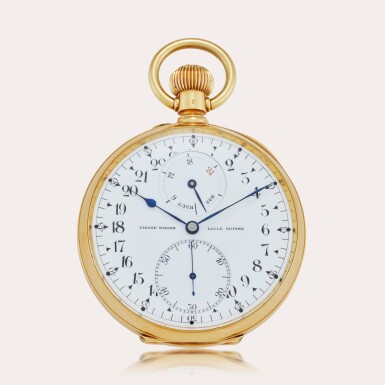
An important, rare and heavy yellow gold open-faced keyless pocket chronometer, awarded 1st prize in the Neuchâtel timing contest with 24-hour dial, up-and-down indication, No. 12284, Circa 1906
Lot Closed
December 10, 05:47 PM GMT
Estimate
8,000 - 12,000 USD
We may charge or debit your saved payment method subject to the terms set out in our Conditions of Business for Buyers.
Read more.Lot Details
Description
Movement: frosted gilded movement jewelled to the center, spring detent escapement, Guillaume balance, blued steel hairspring with overcoil, the backplate signed Ulysse Nardin, Locle & Genève, No. 12284
Dial: white enamel dial calibrated for 24-hours, Arabic numerals with arrow motifs, subsidiary dials for constant seconds and 36- hour up-and-down indication below 12 o’clock
Case: 18k yellow gold engine-turned centered by a blank rondel, olivette for hand setting with protective shoulders, case stamped with Swiss Helvetia head assay, Ulysse Nardin maker’s mark and numbered 12284, cuvette engraved Chronometre No. 12284, Primé 1er Prix en 1ère Classe au Concours de l'Observatoire Astronomique de Neuchâtel, Ulysse Nardin, Locle & Genève, Grands Prix Paris 1889 & 1900
Signed: case, cuvette, dial and movement
Diameter: 57 mm
i Eugnène Jaquet & Alfred Chapuis, Technique and History of the Swiss Watch, London: Hamlyn, 1970, p.179.
Developments in transit instrumentation and the success of Neuchâtel watchmakers at international exhibitions underscored the growing need for a dedicated observatory to support the pursuit of higher standards in chronometry. This vision became reality in 1858 with the founding of the Neuchâtel Observatory. One of its primary missions was to support the advancement of the watchmaking industry and foster the development of precision horology in the region.
The present chronometer, submitted for testing to the Neuchâtel Observatory by Ulysse Nardin in 1906, exemplifies the enduring legacy of one of the most influential names in 20th-century precision watchmaking. Awarded a First Prize in the First-Class Pocket Chronometer category, it achieved 9th place out of 90 contestants, with an impressive final rating of N = 16.9. The watch was expertly adjusted by Henri Rosat and Henri Gerber.
The use of a 24-hour dial in astronomical chronometry was of practical and scientific use, allowing time to be read directly in a full 24-hour cycle corresponding to the Earth’s rotation. This format eliminated ambiguity between day and night hours and aligned with the time conventions used in observatories. Such dials enabled observers to record events without conversion or risk of error and were particularly valuable when comparing mean solar and sidereal time. On the present watch, in addition to the Arabic numerals marking each of the 24 hours, every even-numbered hour is further highlighted by a small dot above the numeral. This additional marking may have been intended to aid quick visual reference in low light, particularly when making astronomical observations.
Ulysse Nardin (1823–1876) played a crucial role in advancing precision watchmaking in the Canton of Neuchâtel. Born in Le Locle, Nardin studied under Frédéric-William Dubois (1811–1869), a skilled watchmaker who pioneered marine chronometer production in the region. Nardin’s expertise earned him widespread recognition, and he received his first gold medal for chronometry at the 1862 Universal Exhibition in London. In 1868, Ulysse Nardin won the top two prizes for pocket chronometers at the Neuchâtel Observatory. Dr Hirsch, Director of the Observatory, highlighted these exceptional timepieces in his report to the State Council, praising their remarkable precision and craftsmanship, saying: “They are true timekeepers, which would be of service even to astronomers and navigators.” i Following the death of its founder, the firm of Ulysse Nardin continued in its pursuit of fine precision watchmaking and the present watch stands as a testament to the enduring importance of scientific horology and the Neuchâtel region’s critical role in its evolution.
Sotheby’s gratefully acknowledges Mr. Andreas Vierhuf and Dr. Christian Müller for providing the submission reports that informed and enhanced the description of the present lot.