
Important Gold Boxes from a Private European Family Collection
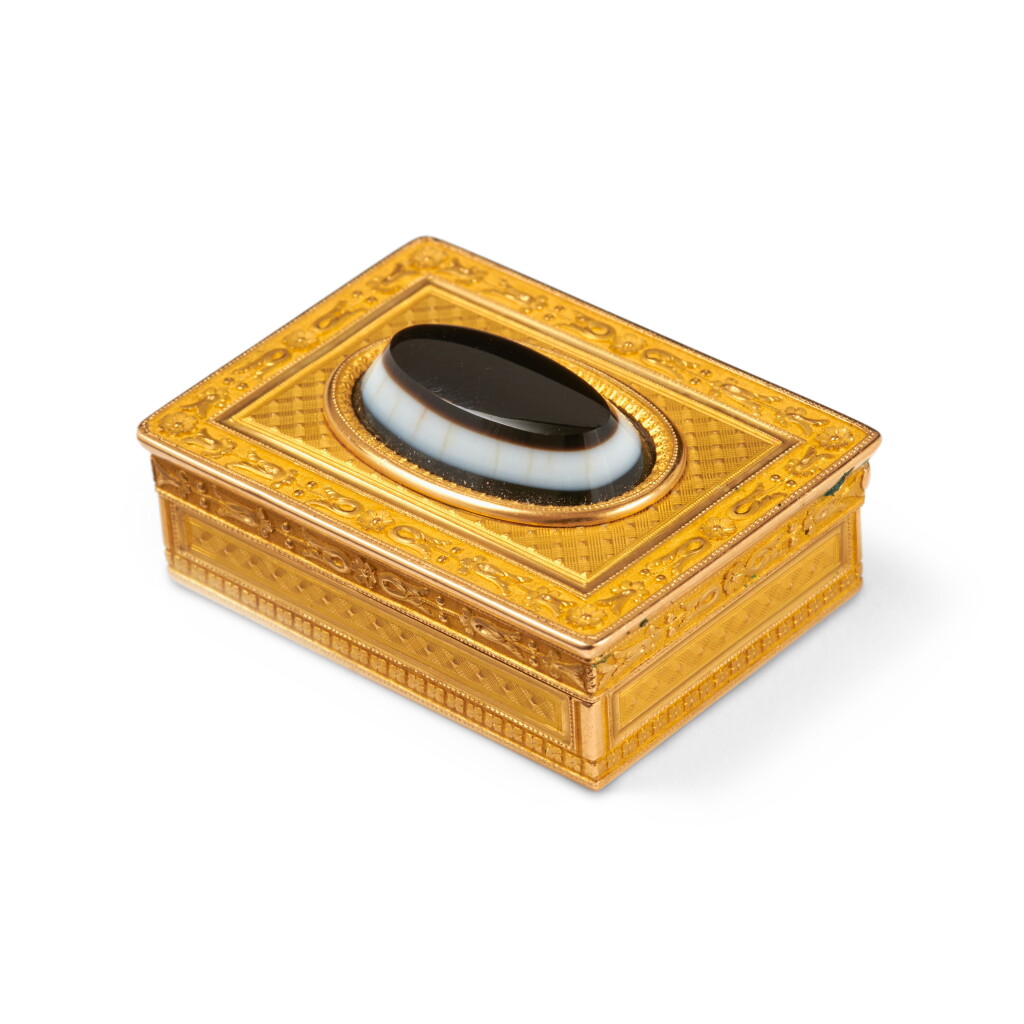
A gold and hardstone vinaigrette, Adrien-Jean-Maximilien Vachette, Paris, 1809-1819, and a jewelled gold and enamel pocket watch, late 18th century
Lot Closed
May 16, 01:56 PM GMT
Estimate
4,000 - 6,000 CHF
We may charge or debit your saved payment method subject to the terms set out in our Conditions of Business for Buyers.
Read more.Lot Details
Description
rectangular, the lid applied with a layered agate oval on an engine-turned trellis ground, within chased folaite borders, the interior fitted with an openwork quatrefoil grille, the sides and base decorated en suite, maker's mark, Paris petite garantie 1809-1819, unofficial baby's head 2e titre for 20.5 ct gold, the rim engraved with retailer's inscription reading: Etienne Nitot et Fils, Joailliers Bijoutiers de S.M. L'Impce et Reine à Paris, the left rim engraved: 267, 3. 9cm wide; together with a jewelled gold and enamel pocket watch, the white enamel dial with diamond-set fleur-de-lys hands, within jewelled border and suspension loops, the reverse set with the jewelled cipher on a dark blue enamel ground, within diamond-set frame and twirling ribbons, with associated winding key by Bovet & Fleurier, 4.6 cm diameter
Marie-Étienne Nitot was, in his heyday, one of the most sought-after jewellers in Paris. He was initially an apprentice to Ange-Joseph Aubert, the official jeweller to Marie Antionette. In 1780 he founded his own firm which went on to become the House of Chaumet. The firm was regarded as one of the most well-respected orfèvres-joailliers-bijoutiers in Paris and still exists to this day. After the 1789 French Revolution he became the official jeweller to Napoleon Bonaparte. His early commissions included Napoleon’s coronation sword and Pope Pius VII’s tiara, presented to the Pope during Napoleon’s coronation in 1804. Following Nitot’s death, the firm was taken over by his son, François-Regnault – likely the ’fils’ in the present inscription. It was he that moved the House of Chaumet to the luxurious Place-Vendôme. Like the other famous jewellers and retailers at the time, commissions sometimes included objects requiring the art of the enameller or the lapidary for which the firm of Nitot was often obliged to rely upon outworkers. Thus for snuff boxes, Nitot & fils used goldsmiths such as Adrien-Jean-Maximilien Vachette or Pierre-André Montauban to fulfill their client’s wishes (see also Haydn Williams, Enamels of the World 1700-2000, The Khalili Collections, London, 2009, p. 34). This explains why the present lot is signed by Nitot & fils as well as stamped with the hallmark of the eminent Parisian goldsmith Adrien-Jean-Maximilien Vachette (1753 - 1839).