Exquisite Corpus: Surrealist Treasures from a Private Collection
The Point of Intersection
Auction Closed
November 21, 12:43 AM GMT
Estimate
1,000,000 - 1,500,000 USD
Lot Details
Description
Kay Sage
(1898 - 1963)
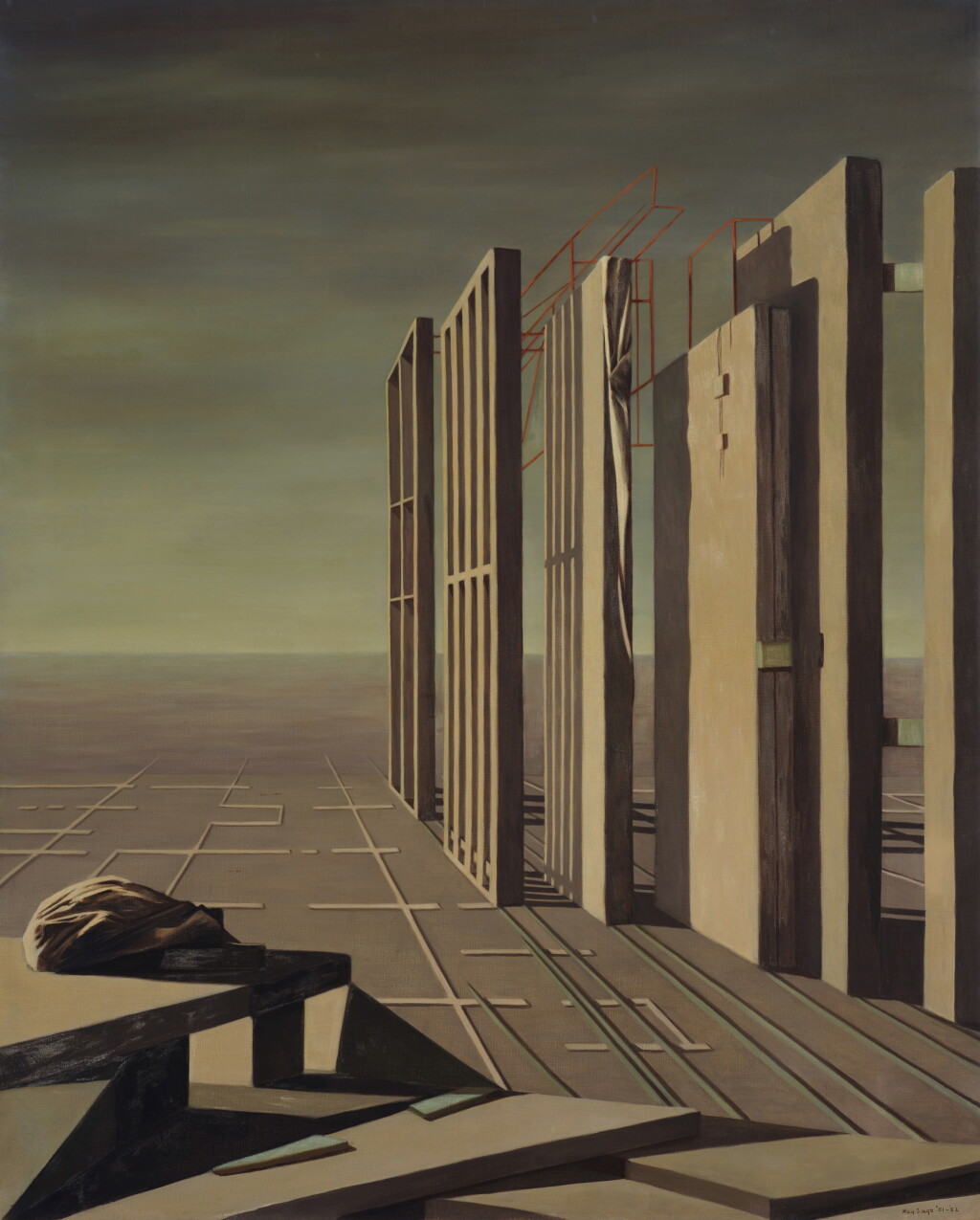
The Point of Intersection
signed Kay Sage and dated ‘51-‘52 (lower right)
oil on canvas
39 by 31 ⅞ in. 99 by 81 cm.
Executed in 1951-52.
Catherine Viviano Gallery, New York (acquired directly from the artist in 1952)
Josephine Sprague Taylor, Spain (acquired from the above in 1956)
Sotheby Parke-Bernet, New York, 1 November 1978, lot 66 (consigned by the above)
Acquired at the above sale by the present owner
New York, Catherine Viviano Gallery, Kay Sage, 1952, no. 10
New York, Whitney Museum of American Art, 1952 Annual Exhibition of Contemporary American Painting, 1952-53, no. 115
Bloomfield Hills, Museum of Cranbrook Academy of Art, First Biennial Exhibition: American Painting, Sculpture, 1953, no. 41
Rome, Galleria dell’Obelisco, Kay Sage, 1953, no. 16 (dated 1952)
Paris, Galerie Nina Dausset, Kay Sage, 1953
Ann Arbor, University of Michigan Museum of Art, Woman in the World of Man: Three Women Painters—Irene Rice Pereira, Kay Sage, Dorothea Tanning, 1954
Hartford, Wadsworth Atheneum, Yves Tanguy, Kay Sage, 1954, no. 26
Lincoln, University Galleries, University of Nebraska and Omaha, Joslyn Art Museum, Nebraska Art Association Sixty-Fifth Annual Exhibition, 1955
New York, Solomon R. Guggenheim Museum, Surrealism: Two Private Eyes, 1999, vol. I, no. 215, p. 284; p. 285, illustrated in color
Fairfield Porter, “Reviews and Previews: Kay Sage,” ARTnews, vol. 51, no. 4, Summer 1952, p. 82
James Thrall Soby, “The Fine Arts: Whitney Annual,” Saturday Review, vol. 35, no. 49, 6 December 1952, pp. 60 and 62; p. 61, illustrated
James Thrall Soby, “The Fine Arts: Double Solitaire,” Saturday Review, vol. 37, no. 36, 4 September 1954, pp. 29-30, illustrated
Helen Mary Hayes, “Life and Motion Permeate Annual Art Association Show,” Lincoln Evening Journal, vol. 88, no. 59, 28 February 1955, p. 7
Stephen Robeson Miller, “The Surrealist Imagery of Kay Sage,” Art International, vol. XXVI, no. 4, September-October 1983, fig. 25, p. 44, illustrated
Judith D. Suther, A House of Her Own: Kay Sage, Solitary Surrealist, Lincoln, 1997, p. 142
Williams College Museum of Art, ed., American Dreams: American Art in the Williams College Museum of Art, New York, 2001, p. 186
Stephen Robeson Miller; Jessie Sentivan, ed., Kay Sage: Catalogue raisonné, Munich, London and New York, 2018, no. P.1952.2, p. 268; p. 269, illustrated in color
On the occasion of Kay Sage’s first exhibition in Italy, held in 1953, seminal art historian James Thrall Soby declared of her oneiric, enigmatic landscapes: “Her structures rise in a setting…somewhere, deep in memory, their like. These are pavilions of dreaming. They stand in boundless space…We believe in them at once: they will withstand wind and logic’s thunder. Around this enchanted architecture an arid landscape follows a curious geometry, toward infinity and harmonious skies” (Exh. Cat., Rome, Galleria dell’Obelisco, Kay Sage, n.p.). Among the works on view in that landmark exhibition in Rome was The Point of Intersection, a painting that at once invokes solitude and limitless expanse, mystery and possibility. It emblematizes these pavilions of dreaming for which Sage is hailed a master of Surrealism.
Born into privilege in Albany in 1898, Kay Sage trained at traditional Beaux-Arts academies across Europe and the United States, far removed from avant-garde circles. Her early painting practice was curtailed by her 1927 marriage to Prince Ranieri di San Faustino. A turning point came in 1933, when a visit from Ezra Pound reignited her interest in modern art. Inspired by Pound’s connections and a 1936 visit to the International Surrealist Exhibition in London—where she was especially drawn to works by Dalí, Magritte, and Yves Tanguy (whose painting titled Je vous attends (I Await You) would prove prophetic)—Sage left her marriage and relocated to Paris to pursue painting in earnest.
By 1938, she had established a distinct artistic voice, exhibiting six works at the Salon des Surindépendants. Her work captured the attention of both Yves Tanguy and André Breton, the latter notably surprised to learn that the stark, architectural landscapes were painted by a woman. Sage quickly moved from the margins of Surrealism to its core. She and Tanguy began a relationship in 1939; as the artist later recalled, “‘I do not believe there has ever been such a total and devastating love and understanding as there was between us. It was simply an amalgamation of two beings into one blinding totality” (quoted in Exh. Cat., Katonah Museum of Art, Double Solitaire. The Surreal Worlds of Kay Sage and Yves Tanguy, 2011, p. 29). She and Tanguy relocated to the United States and married in 1940. With Sage’s help, many European Surrealists secured visas to escape the war, contributing to the rise of the New York School.
Settling at Town Farm in Woodbury, Connecticut, Sage and Tanguy developed their practices in parallel, working in separate parts of a shared studio and only viewing each other’s finished works. Despite their closeness, both maintained strong individual identities as artists. “The traces of each other’s presence discernible in their works are no more than modest borrowings or acknowledgements that can scarcely be construed as invasive or appropriative. Only the interplay of deep shadows, the absence of identifiable beings, and the resultant mystery of silence can be regarded as a binding link between Sage’s and Tanguy’s art” (Renée Riese Hubert, Magnifying Mirrors: Women, Surrealism and Partnership, Lincoln, 1994, p. 198). They declined joint exhibitions until 1954, when The Point of Intersection was included in their two-person show at the Wadsworth Atheneum where works were shown in separate but adjoining rooms.
From 1944 onward, Sage developed her signature vocabulary of scaffolding, lattices, and stark architectural forms, replacing earlier biomorphic motifs. This shift was partly inspired by her interest in metaphysical imagery and a hallucinatory episode in Rome, during which she believed the scaffolding of a façade neighboring her palazzo was aflame, an experience she later found mirrored the divine visions of a sixteenth-century French abbot. In The Point of Intersection, the monumental scaffold structures recede into an expansive, near-infinite terrain, while fractured geometry in the foreground disrupts spatial stability, recalling the vertiginous perspective and unvarying architectural programs of Giorgio de Chirico’s seminal metaphysical paintings.
The painting is replete with the tensions of paradox: structure and collapse, presence and absence, distance and immediacy. Shrouded forms suggestive of abandoned figures add to the pervasive solitude that defines Sage’s most accomplished work. As her friend Régine Tessier Krieger later memorialized, “Kay Sage never talked about (1951her paintings. ‘Let them speak for themselves,’ she used to say. The messages come loud and clear. They talk about infinity, space and obstacles…the landscapes may be from another planet, but in Kay’s paintings, the scaffolding, the rigging, and the towers are familiar to our modern world in a dreamlike fashion. They are carefully structured and harmonious, but some of them have collapsed, as if pushed by an adverse force that has disappeared after destroying their delicate balance. The colors in her paintings are subtle and glowing at the same time, reminiscent of the sulphurous light before a thunderstorm…The figures in the landscapes are human, but veiled, walking blindly to their destiny. The paths they follow look mysterious, tantalizing, and sometimes treacherous” (Exh. Cat., Ithaca, Herbert F. Johnson Museum of Art, Cornell University, Kay Sage: 1898-1963, 1977, n.p.).
The Point of Intersection dates to the apex of Kay Sage’s output, just before the death of Yves Tanguy in 1955, and stands as a powerful emblem of Sage’s singular contribution to Surrealism. It was featured in several of the exhibitions instrumental to her lifetime international recognition, including the 1952 Annual Exhibition of Contemporary American Painting at the Whitney Museum of American Art, later known as the Whitney Biennial. Last offered at auction over a half-century ago, The Point of Intersection has resided in the same preeminent collection since.
You May Also Like