Exquisite Corpus: Surrealist Treasures from a Private Collection
Sans titre
Auction Closed
November 21, 12:43 AM GMT
Estimate
500,000 - 700,000 USD
Lot Details
Description
Exquisite Corpus: Surrealist Treasures from a Private Collection
Remedios Varo
(1908 - 1963)
Sans titre
signed Remedios and dedicated Remedios a Michette et Pierre (lower right); signed R (on the verso)
gouache and pencil on paper
11 by 9 ⅝ in. 28 by 24 cm.
Executed circa 1943.
We wish to thank Dr. Salomon Grimberg for his kind assistance in the cataloguing of this work.
Michette and Pierre Mabille, Paris (acquired as a gift from the artist circa 1943)
Consultat, Paris (acquired from the above)
Acquired from the above in October 1982 by the present owner
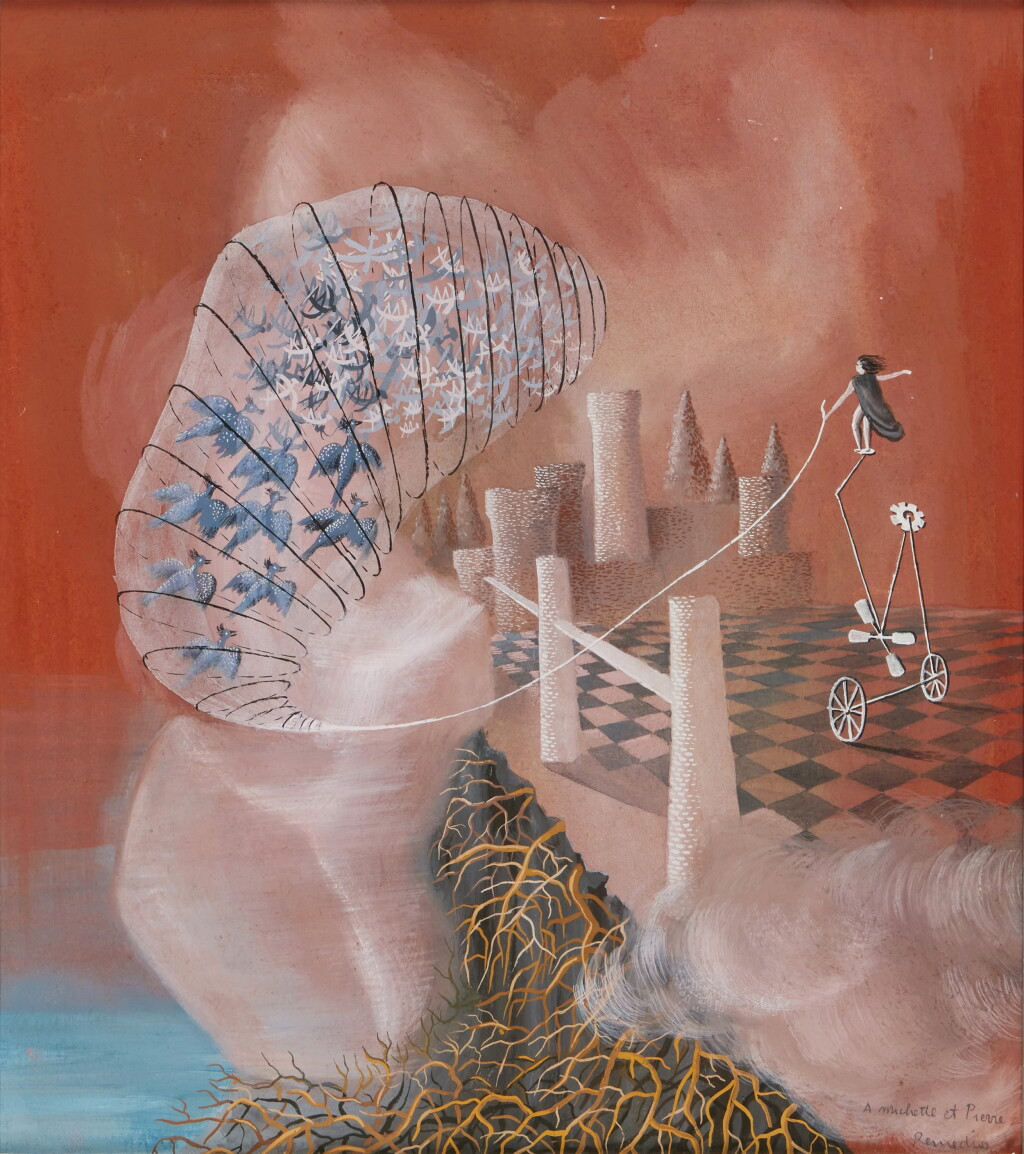
Sans titre marks a pivotal moment in Remedios Varo’s life and practice. Executed in late 1943, near her fleeing of war-torn Europe, this dynamic work on paper captures the early stirrings of what would become her singular visual language: bird-headed figures, trapped winds, motionless wheels, tangled roots, ethereal skies. Dedicated to her close friends and fellow exiled Surrealists, Michette and Pierre Mabille, the work is a visual dedication to the enduring power of the symbolic image. In its layered visual allegories, this work offers a rare window into a transitional period defined by upheaval and hard-won artistic agency.
Born in 1908 in Anglès, Catalonia, Varo’s early life was shaped by tension between Catholic orthodoxy and occult rebellion. While studying at a convent school in Madrid, Varo became increasingly drawn to esoteric systems of thought. Her father, an engineer, encouraged her technical drawing skills, and early visits to the Museo Nacional del Prado introduced her to the fantastical universes of Hieronymus Bosch and the jewel-toned intricacies of Duccio and Fra Angelico. From Bosch, in particular, she learned that a painting could be a self-contained cosmology—plausible in its strangeness, convincing in its absurdity. Such approaches, ever present in works like The Garden of Earthly Delights, would later serve as spiritual ancestors to her own imagined worlds.
After studying at the prestigious Real Academia de San Fernando in Madrid, she fled the Spanish Civil War for Paris, eventually meeting her partner, the Surrealist poet Benjamin Péret, and immersing herself in the Surrealist milieu. During the German occupation, she and Péret were forced into hiding before fleeing to Mexico in 1941. Varo and Péret not only found refuge in Mexico, but creative clarity, joining a vibrant Surrealist movement in exile that included artists Gunther Gerszo, Kati and José Horna, and Leonora Carrington, among others.
Executed circa 1943, Sans titre emerged from a moment of profound emotional and geographic upheaval. Having fled Spain around the outbreak of the Civil War and taken refuge in Paris, she was again uprooted when the German occupation made her Surrealist affiliations and leftist sympathies perilous. Forced into hiding and eventually exile, alongside Benjamin Péret, Varo’s world of constant transition echoes in the present work. Her protagonist’s voyage becomes a metaphor for the Varo’s own navigation through constraint and freedom, order and disarray.
In this work, we see a journey of paradoxes. Along the perimeters, striking reds and calming blues, seemingly opposed, meld into one another. Under a cliff, a complex web of roots is suspended, grounded in nothing. Billowing gusts of wind are frozen, seemingly trapped in open air. Monochromatic birds, captured in a spiraling net, are poised between capture and flight. A feminine protagonist, atop a bicycle-like vehicle, is untethered, seemingly floating across a checkered grid towards a castle without a clear entrance. Here, a fleeting passage underway is not halted, but suspended. As Octavio Paz notes, “[Varo] did not paint time but the instants in which time rests” ("Apariciones y desapariciones de Remedios Varo." Corriente alterna, Siglo XXI Editores, 1967, p. 51).
The present work calls upon Leonora Carrington’s The Pomps of the Subsoil, where floating figures engage in quiet rituals, disconnected from linear time and the laws of physics. The present work aligns with these efforts to visualize alternate psychic realities. Indeed, Varo’s vision stands in strong contrast to her fellow male Surrealists—less explosive than Breton’s automatism or Ernst’s collage, and more methodically wrought. Here, we see a surrealism not of rupture, but finely-tuned suspension.
The work is prominently dedicated to Michette and Pierre Mabille—figures deeply invested in Surrealist philosophy. Pierre Mabille, a physician and anthropologist, had long advocated for a fusion of science, myth, and spiritual awareness. A series of metaphors from his 1940 seminal text, Mirror of the Marvelous: The Classic Surrealist Work on Myth, find a remarkable resonance in the present work. Speaking of the journey to the “marvelous,” Mabille writes, “These admittedly enigmatic plans lie like a grid over the routes used…They permit the discovery of a mysterial castle, not far from the well-traveled paths, hidden by undergrowth and thickets…It is the domain of insects and birds” (p. 2). The Mabilles likely received the work during their visit to Mexico in August 1943, when they reunited with Varo, Benjamin Péret, and other Surrealists. Their gatherings that summer, during which Leonora Carrington also presented them with a gouache, underscore the painting’s origins within an intimate network of creatives. Varo’s composition affirms her and the Mabilles’ shared pursuit of capturing the marvelous—not as fantasy, but as a vital framework for navigating the underpinnings of life.
While often associated with Carrington and other female Surrealists, Varo’s work distinguishes itself through its ability to transcend Surrealist doctrine. Unlike the Surrealist automism favored by André Breton or even Pierre Mabille, Varo's work rarely surrendered to chance. Indeed, Varo had overcome too much in life to do so. Her practice was shaped by her meticulous control over her worlds, in which tableaux of intricate symbols wove together the mystical, the scientific, and the autobiographical. Sans titre is not simply a fantasy, but the encapsulation of a broader ethos. Her imagination was not a retreat from the world, but a means to reconfigure it.
You May Also Like