Exquisite Corpus: Surrealist Treasures from a Private Collection
Ce Matin
Auction Closed
November 21, 12:43 AM GMT
Estimate
1,000,000 - 1,500,000 USD
Lot Details
Description
Yves Tanguy
(1900 - 1955)
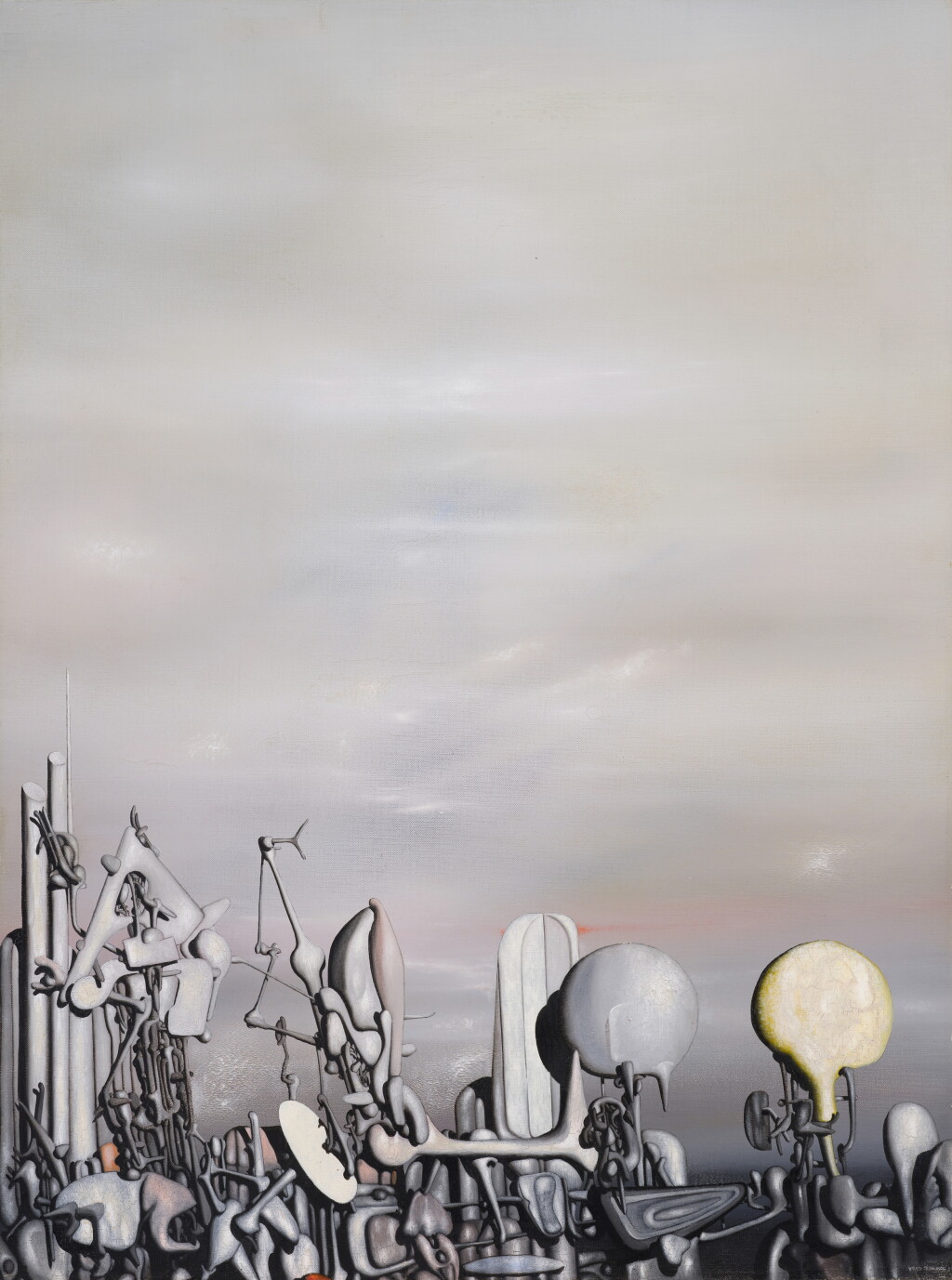
Ce Matin
signed Yves Tanguy and dated 51 (lower right)
oil on canvas
28 by 20 ⅞ in. 71 by 53 cm.
Executed in 1951.
Pierre Matisse Gallery, New York (on consignment from the artist)
Marcel Duhamel, Mouans-Sarteux (acquired by 1963)
Daniel Filipacchi, Paris
Acquired from the above by 1972 by the present owner
Paris, Renou & Poyet, Exposition Yves Tanguy, 1953, no. 4
New York, Acquavella Galleries, Yves Tanguy, 1974, no. 50, illustrated
New York, Knoedler & Co., Inc., Surrealism in Art, 1975, no. 128, p. 55, illustrated; p. 63
London, Hayward Gallery, Arts Council of Great Britain, Dada and Surrealism Reviewed, 1978, no. 17.40, p. 446; illustrated in color
Paris, Centre Pompidou; Baden-Baden, Staatliche Kunsthalle and New York, Solomon R. Guggenheim Museum; Yves Tanguy: rétrospective 1925-1955, 1982-83, no. 111, p. 150, illustrated (Paris); p. 15, illustrated; p. 20 (New York) (with incorrect dimensions)
New York, Solomon R. Guggenheim Museum, Surrealism: Two Private Eyes, 1999, vol. I, no. 238, p. 312, illustrated in color
Pierre Matisse, Yves Tanguy, Un Recueil de ses oeuvres, New York, 1963, no. 429, p. 183, illustrated
Sarane Alexandrian, Dictionnaire de la peinture surréaliste, Paris, 1973, p. 58, illustrated in color
Patrick Waldberg, Yves Tanguy, Brussels, 1977, p. 211, illustrated in color; p. 347 (with incorrect dimensions)
George Melly, “Dada and Surrealism: George Melly Reviews ‘Dada and Surrealism Reviewed,’” Architectural Design, vol. 48, issues 2-3, 1978, p. 131, illustrated in color
Jacques Baron, Anthologie plastique du surréalisme, Paris, 1980, p. 247, illustrated in color
Robert Short, Dada & Surrealism, London, 1980, no. 86, p. 91; p. 92, illustrated in color; p. 173
Iwaya Kunio, “The History of Yves Tanguy,” Mizue, no. 927, Summer 1983, p. 40, illustrated in color
René Le Bihan, Renée Mabin and Martica Sawin, Yves Tanguy, Paris, 2001, no. 114, p. 198; p. 199, illustrated in color (with incorrect dimensions)
Painted in 1951, Ce Matin exemplifies the remarkable clarity and compositional authority of Yves Tanguy’s late American period. By this date, the artist had refined his Surrealist language, creating images that hover between dream and reality, figuration and abstraction, with an otherworldly lucidity.
Though his meticulous method of painting—building form upon form through an intuitive chain of associations—remained constant from his earliest Surrealist experiments, Tanguy’s American years produced a decisive expansion of scope and ambition. After settling in Woodbury, Connecticut, with his wife and fellow Surrealist painter Kay Sage, Tanguy exchanged the restlessness of Paris for a rigorous daily practice. Supported by his contract with Pierre Matisse’s gallery, he painted with steady discipline, producing some of the most complex and commanding canvases of his career. Sage’s own precise, architecturally-inflected Surrealist style may have subtly influenced Tanguy during this period, encouraging the even greater clarity and spatial rigor that characterize his late work. The wild bohemian of the 1920s gave way in these later years to a consummate craftsman, one who built, in the relative quiet of rural New England, a world of extraordinary invention and grandeur.
In Ce Matin, Tanguy challenges perception through the juxtaposition of a seemingly quotidian title with a profoundly uncanny landscape. A dense congregation of elongated, almost mechanical forms rises along the lower edge of the canvas as two luminous, spherical shapes hover above the fragile architecture, glowing against a pale, hazy sky. The ordinary title—“This Morning”—contrasts sharply with this surreal scene, drawing attention to the tension between the familiar and the unfamiliar, and inviting the viewer to confront a landscape that seems suspended outside conventional space and time.
“Here in the United States the only change I can distinguish in my work is possibly in my palette,” Tanguy explained in 1945 for André Breton’s Le Surréalisme et la peinture. “What the cause of this intensification of color is I can’t say. But I do recognize a considerable change. Perhaps it is due to the light. I also have a feeling of greater space here, more ‘room’” (quoted in Exh. Cat., New York, Acquavella Galleries, Yves Tanguy, 1974, n.p.).
In Ce Matin, subtle gradations of grey and pale ochre are enlivened by delicate chromatic inflections of red, orange and yellow which hint at warmth beneath the surface, enriching the atmosphere with a quiet, alchemical glow. Compared to his denser canvases of the late 1940s, this work breathes, its sense of clarity and space heightening the impression of permanence.
At the same time, the work reflects the broader tenor of Tanguy’s late oeuvre: its crystalline precision, its unnerving stillness, and its subtle dialogue with the technological anxieties of the postwar world. Where earlier canvases conjured dolmen-like monoliths echoing the prehistoric landscapes of his Breton childhood, his late works often resemble fragments of some advanced but inscrutable machinery, relics of a civilization suspended between the archaic and the futuristic. Here, Tanguy further develops his lifelong engagement with biomorphic forms, pushing their organic, otherworldly logic increasingly toward the mechanical—a convergence of living shapes and abstracted technology also explored by Kay Sage and Jean Arp in the 1950s. In Ce Matin, the fragile balance of forms, silhouetted against infinite space, suggests both emergence and ruin—an ambiguous vision that mirrors the unease of an atomic age.
“There are no landscapes. There is not even a horizon,” André Breton once wrote of Tanguy’s work. “There is only, physically speaking, our immense suspicion which surrounds everything. These figures of our suspicion, lovely and miserable shadows that prowl around our cave, are really shadows. The strong subjective light that floods Tanguy’s canvases makes us feel less abandoned. Every creature he depicts participates metaphysically in the life we have chosen, corresponds to our mental expectancy, belongs to some transcendent order (superior? inferior?) whose attractiveness is felt by us all. For a man who acts only on the purest motives, the fact of living among us gives him a vista on the mystery. It also implies his refusal to make a concession. Where most observers would see only a favourite setting for obscure and magnificent metamorphoses, there is actually presented the first survey—achieved without the aid of legends—of a considerable extent of the mental world which is not in its Genesis” (André Breton quoted in Exh. Cat., Tanguy/Calder: Between Surrealism and Abstraction, New York, 2010, p. 31).
Ce Matin embodies that late vision with rare clarity: an immersive dreamscape that resists all categories, neither abstraction nor figuration, neither still life nor landscape. Its monumentality lies not only in its scale but in its ability to conjure an entire cosmos within the frame, a world precise but unknowable. Executed only four years before the artist’s untimely death in 1955, Ce Matin belongs to the final chapter of Tanguy’s oeuvre—paintings marked by a striking sense of confidence, in which the boundaries of dream and reality dissolve into an eternal dawn.
Consigned by the artist to his primary dealer Pierre Matisse shortly after its creation, Ce Matin was subsequently acquired by French actor and screenwriter Marcel Duhamel by 1963. Since then, it has remained in the same private collection for more than fifty years.
You May Also Like