Property from a Private Florida Collection
Tiffany Studios
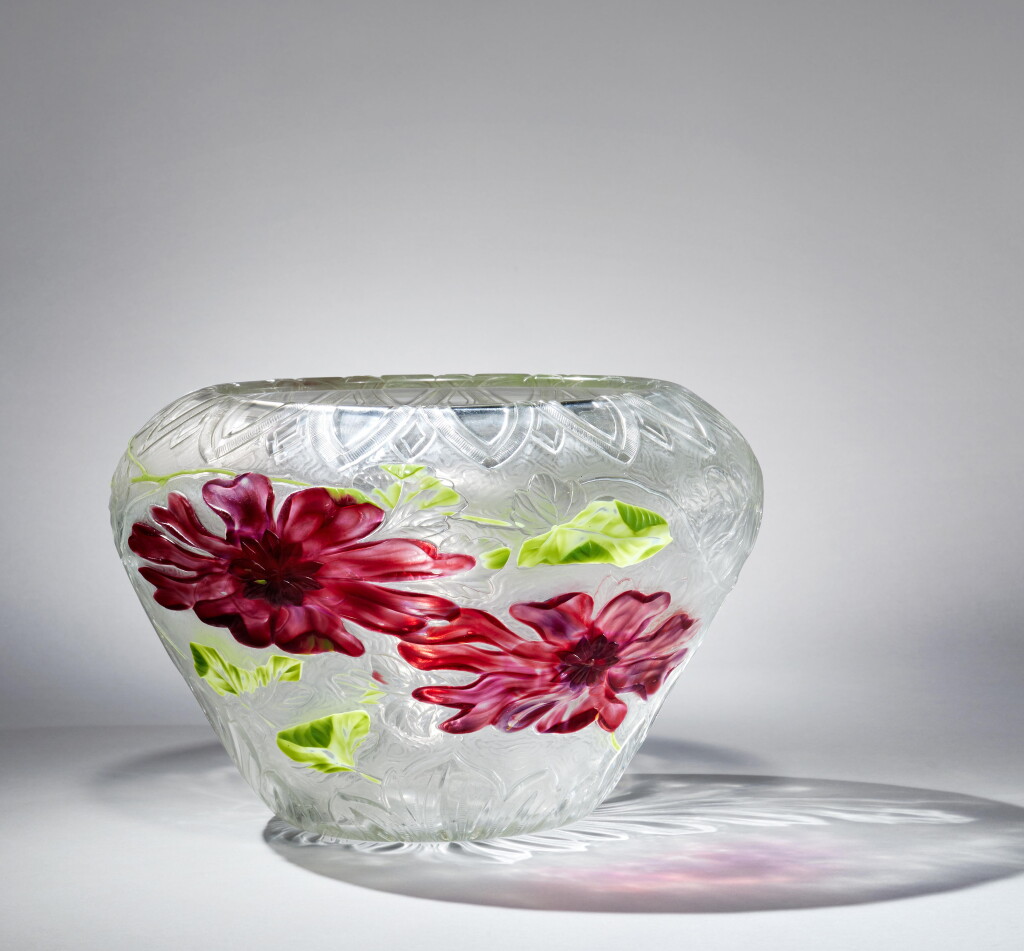
Cameo "Rose" Bowl
Auction Closed
December 11, 04:33 PM GMT
Estimate
40,000 - 60,000 USD
Lot Details
Description
Property from a Private Florida Collection
Tiffany Glass and Decorating Company
Cameo "Rose" Bowl
circa 1897-1898
design attributed to Fredolin Kretschmann
Favrile glass
engraved L.C.T. o3444
7 ¼ in. (18.4 cm) high
11 ¼ in. (28.6 cm) maximum diameter
Private Collection, New York
Sotheby's New York, December 4, 1999, lot 439
The Garden Museum Collection, Matsue, Japan, acquired from the above
Private Collection, California
Acquired from the above by the present owner
Hugh McKean, The “Lost” Treasures of Louis Comfort Tiffany, New York, 1980, p. 172, fig. 173 (for a related example numbered o3440)
Alastair Duncan, Louis C. Tiffany: The Garden Museum Collection, Woodbridge, Suffolk, 2004, p. 243 (for the present lot illustrated)
Paul Doros, The Art Glass of Louis Comfort Tiffany, New York, 2013, pp. 2 and 86 (for a related example)
Timeless Beauty, The Art of Louis Comfort Tiffany, The Charles Hosmer Morse Museum of American Art, Atglen, PA, 2016, p. 71 (for the above mentioned related example)
Cameo glass, in which the exterior is formed into a design in relief, was exceptionally popular in late-19th century Europe. The commercial success of Émile Gallé in France and Thomas Webb & Sons in England was the catalyst for numerous imitators throughout the Continent. Tiffany, through his many trips to Europe, and Arthur Nash, his British-born and trained glasshouse superintendent, were very aware of these European products. It therefore was to be expected that Tiffany’s glass factory would incorporate cameo work into its oeuvre shortly after it opened in 1893.
One of company’s most valued employees during the early period of production of blown Favrile glass was Fredolin Kretschmann (1853-1898). Born in Austria, Kretschmann moved to England when he was 19-years-old, received training at a glasshouse near Birmingham, and was soon recognized as one of the world’s leading glass cutters and engravers. Tiffany supposedly met and hired Kretschmann while the latter was preparing an exhibition of his work at the 1893 Columbian Exposition. Kretschmann’s finest pieces, some of which was sold at the then-incredible price of $1,500, were offered to some of the glasshouse’s most important clients, including the Goulds, Havemeyers and Vanderbilts.
Kretschmann tragically died at the age of 45. This cameo “Rose” Bowl, likely made by him shortly prior to his death, truly epitomizes Kretschmann’s supreme skill and artistic acumen. The front of the transparent bowl features two glorious, large crimson and plum dahlias with superbly carved petals in high relief. Bordering the blossoms are brown-streaked chartreuse leaves and stems, also finely engraved. These flowers and leafage are on an ornate background finely carved with additional leaves and petals as well as a moiré-like pattern in various stages of relief. The piece is clearly an absolute tour de force created by the hands of a master craftsman.
– PAUL DOROS
You May Also Like