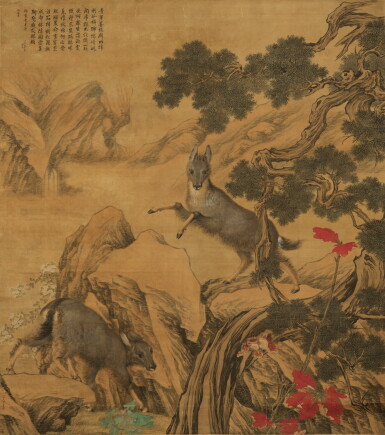
The Blue Goats by Lang Shining (Giuseppe Castiglione, 1688-1766) and Jin Tingbiao (d. 1767), Qing dynasty, Qianlong period, recorded to have been commissioned and completed between 1759-1760 | 清乾隆二十四至二十五年(1759-1760年) 郎世寧、金廷標合繪《青羊圖》 設色絹本 立軸
Premium Lot
Auction Closed
May 7, 04:09 AM GMT
Estimate
60,000,000 - 150,000,000 HKD
Lot Details
Description
ink and colour on silk, hanging scroll
217.6 by 191.8 cm
Signed: Jing Tingbiao, with one seal of the artist, Tingbiao
By imperial command, inscribed by Yu Mingzhong with the poem The Blue Goats by the Qianlong Emperor
設色絹本 立軸
217.6 x 191.8 厘米
題識:臣金廷標恭畫
鈐印:廷標
題跋:青羊善緣壁,四蹄利如鑷,躑躅㠝岏間,虎狼不能躡,一朝失所據,生捕被虞獵,神蕊豈跳踉,喙息惟伏帖,何必貪肥腯,爰命育蹇苶,誰辨梓樹化,謾擬成都接,隨圍霍集斯,驚觀笑囅頰。御製青羊詩,臣于敏中奉勅敬書。
Collection of Guo Baochang (1867-1942), Beijing, c. late 1920s.
Collection of Douglas Bergeron, an American antique dealer.
The Chinese Porcelain Company, New York, 1990s.
A private collection, South America, 1990s to the present.
Hu She yuekan [Lake artists association monthly bulletin], Beijing, 1st June 1930, vol. 31, p. 8, illustrated on the cover.
The Chinese Porcelain Company, A Dealer’s Record 1985-2000, New York, 2000, pp. 39-41.
Nie Chongzheng, 'Lang Shining, Jin Tingbiao hehua de "Huoji tu" [The Turkey jointly painted by Lang Shining and Jin Tingbiao]', Zijincheng / Forbidden City, Beijing, 2017, vol. 265, p. 79.
Nie Chongzheng, Lang Shining de huihua yishu [The Art of Lang Shining], Beijing, 2017, pp. 96-97, fig. 45.
來源
郭葆昌(1867-1942年)收藏,約1920年代末
美國古董商 Douglas Burgeron 收藏
中國陶瓷公司,紐約,1990年代
南美私人珍藏,1990年代至今
出版
《湖社月刊》,北京,1930年6月1日,第31冊,頁8﹐圖載於封面
中國陶瓷公司,《A Dealer’s Record 1985-2000》,紐約,2000年,頁39-41
聶崇正,〈郎世寧、金廷標合畫的《火雞圖》〉,《紫禁城》,北京,2017年,第265期,頁79
聶崇正,《郎世寧的繪畫藝術》,北京,2017年,頁96-97,圖45
The Blue Goats in Qianlong’s Frontier
Niamh Cullinane
When the Qianlong Emperor commissioned the painting of The Blue Goats at the closing of the 1750s, he would be marking in ink the culmination of a centuries long story which spans several dynasties and epochs. In the delicately rendered figures of these two Chinese gorals, rare creatures which dwell in the forests and mountains of the Central Asian landscape, a meditation on the nature of harmony, fragility, and power is written. The Poem of the Blue Goats, one of the Qianlong Emperor’s vast literary corpus, tells of the conquest of Xinjiang and the consolidation of the Qing Dynasty’s rule over the vast, fragmented, landscape of western China.
In venerating the beauty, agility, and resilience of these creatures, Qianlong finds in their fragile dignity a profound allegory for imperial power, and for the eloquent, untamed forces of nature. The blue goats, masters of the mountainous western plateau, tread where others fear to follow—noble in their wildness, they yield not from weakness, but from the dignity that the civilizing authority of imperial power demands. The untamed wilderness, ungoverned and untrodden, must be subdued within the harmonising influence of imperial power, with the goats representing not only the frontier itself, but also the people of Xinjiang. These subjects, if they stray from the civilising influence of the Emperor, seal their fate of captivity.
The spirit and vitality of the goats, in their submission to the hunt, mirrors the taming of the region under imperial rule. It is in their capture that Qianlong enacts his stewardship of the now extended and resigned Qing Empire, his taming of natural imagery in verse a proclamation of his sovereignty over a now harmonious kingdom. The excessive vitality of the western pastures, unwavering in their rank brutality, must be cultivated by the civilising force of imperial rule, an expression of the Confucian ideals of governance embodied in the figure of the Emperor. The profusion of vitality embodied by the figures of the goats threatens the forces of civility, an allusion to the rebellious Mongol and Muslim chieftains of the region who were brought to submission by the Emperor. It is here that Qianlong makes a historical allusion to the Catalpa tree; native to western China and rich with cultural meaning in classical poetry, the tree is transformed through the imagery of the hunt. Referring to Khojis, or Huojisi, the Central Asian noble and Uyghur leader who surrendered to Qing forces during the conquest of Xinjiang, as witnessing the transformational power of the hunt, Qianlong further historicises the imperial conquest. It is through this surrender, and in the hunt of the blue goats, that the history of imperial expansion is written - one of triumph, of harmony and of the melding of nature with imperial destiny. Through the nobility of the blue goats and their eventual submission, Qianlong casts the civilising forces of imperial expansion as both a natural and righteous conviction. In this delicate balance of strength and submission, conquest is no longer a tale of mere domination, but one of guardianship—an act of bringing order, peace, and enlightenment to a frontier untamed.
神蕊天威
Niamh Cullinane
十八世紀五十年代末,乾隆皇帝作《青羊詩》,並下旨創作《青羊圖》,以丹青筆墨借物隱喻,宣示治國之道。畫中所繪二隻青羊,是中國西北山林中罕見的斑羚,他們姿態亭勻秀逸,寓意深厚。乾隆藉物抒懷,展現大清帝國的和諧興盛以及他剛柔並濟的邊疆政策。
乾隆帝通過讚美青羊之秀美、靈動、堅韌,喻示皇權定鼎,受命於天。青羊盤踞於西域崇山峻嶺,足跡所至,虎狼難追。青羊野性難馴,性非軟弱,卻對帝國之文明開化必然折服。乾隆以青羊象徵邊疆,也隱喻新疆回部各派首領,爾等皆須歸順浩蕩皇威,如若背離皇帝「懷柔遠人」的善意,便註定成為囚籠中的困獸。青羊在狩獵中展現的精神與生命力,恰恰映射了大清帝國馴服西域的過程。乾隆帝藉此詩畫,寓意皇威之下,邊疆鞏固,彰顯他的十全武功。他藉馴服自然的意象,宣示天子對這個「和諧帝國」的主權。西陲之地,這個以其野蠻強悍、桀驁不馴而著稱的地區,必須由尊儒皇權來教化。
這種澎湃生命力,同時暗喻邊疆准部及回部的反抗力量。臥榻之側,豈容他人安睡,乾隆帝以《青羊詩》和《青羊圖》,將青羊的圍獵隱喻成對大小和卓首領叛亂的圍剿。他在詩中借梓樹——這種生於隴西,然而在《詩經》中又象徵故土的嘉木,隱喻自己將文明開化向西退進的篤念。當乾隆提及霍集斯——這位歸順清廷並幫助乾隆平定准格爾及大小和卓之亂中發揮重要作用的烏什貴族時,歷史的褶皺進一步展開。霍集斯目睹狩獵的場景,見證皇權如何重塑自然與文明的邊界。青羊的屈服與這位中亞領袖的歸降,共同書寫了帝國擴張的歷史:一場勝利、和諧與天命交融的史詩。乾隆將青羊的高貴與其最終臣服,詮釋為皇權天威的彰顯,乃師出正義,承順天命——征服不再是粗暴的支配,而是守護邊疆的使命,是將秩序、和平與啟蒙賦予蠻荒之地的神聖職責。
You May Also Like


