
Mia Forrest
Blue Waterlily
拍品已结束竞投
July 15, 07:26 PM GMT
估价
5,000 - 7,000 USD
我们会按买家业务规则所列条款,透过您选择的付款方式收取或扣除款项。
展开文字拍品信息
描述
Mia Forrest
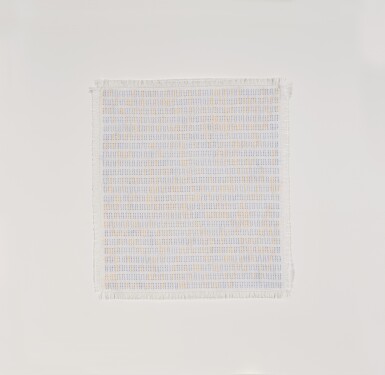
Blue Waterlily
Hand embroidery, silk thread, cotton cloth, artwork attached to cotton rag matboard, encased in a Tasmanian Oak Frame, Ultra vue glass
artwork: 19 by 17.5 in. 48.26 by 44.45 cm.
framed: 36.22 by 35 in. 92 by 88.9 cm.
Executed in 2025, this work is unique from the Stitching as Storage series. This work also includes an ordinal inscription.
Digital:
Inscription 97,599,023
JPEG inscribed on Bitcoin
Executed in 2025, this work is unique
Satoshi 1,977,341,250,000,000
SAT Creation Year: 2024
Inscription Date: June 19th, 2025
Blockchain: Bitcoin
Satributes: uncommon
https://gamma.io/inscription/5b55b2bcec14f4197dbba1968078bb42f98626c5e0a0978421a68a5e7fab07e5i0
The artist.
Mia Forrest’s work hones in on the premise that art can be generative by nature - adopting ecological systems and rule-based processes as a collaborative framework. These ideas have become foundational to her practice, leading her to build a practice methodology around natural algorithms within ecological systems.
Blue Waterlily is the third artwork from Mia’s tight quadriptych textiles series Stitching as Storage. The series explores how textiles can store, index, and arrange ecological data, with a particular focus on primordial blooms - modern descendants of some of the earliest flowering angiosperms that first emerged during the Cretaceous period.
The artwork is created through a rule-based system, where stochastic plant biodata is notated as rhythmic embroidery. Each of the 7360 hand-embroidered stitched lines, is a registration of the on/off electrical conductivity pulsations from the Blue Waterlily, capturing the intrinsic algorithmic essence of the plant.
To capture this, sensors are attached to the plant to record activity within the stomata (the tiny pores on a leaf’s surface that respond to environmental conditions). This biodata is then sonified and notated as a rhythmic composition, where each embroidered line signifies the duration of an 1/8th note, encoding the blue waterlily’s internal autonomous rhythms into geometric harmony.
This data-driven mark-making introduces variability within constraint - a hallmark of systems-based practice. This approach aligns with conceptual art's evolution into systems thinking in the 1960s and '70s; artists like Sol LeWitt, Hans Haacke, and Vera Molnár who used generative processes, logical constraints, and environmental input to define the aesthetics of a piece. In this lineage, Stitching as Storage echoes the same intent: to visualize processes and translate invisible systems into material form. It’s generative, by nature.
“I view the work as an intimate collaboration between nature’s deep time, its hidden intrinsic energetic code, and myself”.