Man Ray
Landscape (A Tree Grows in Brooklyn)
Auction Closed
October 6, 05:06 PM GMT
Estimate
80,000 - 120,000 EUR
Lot Details
Description
Man Ray (1890 - 1976)
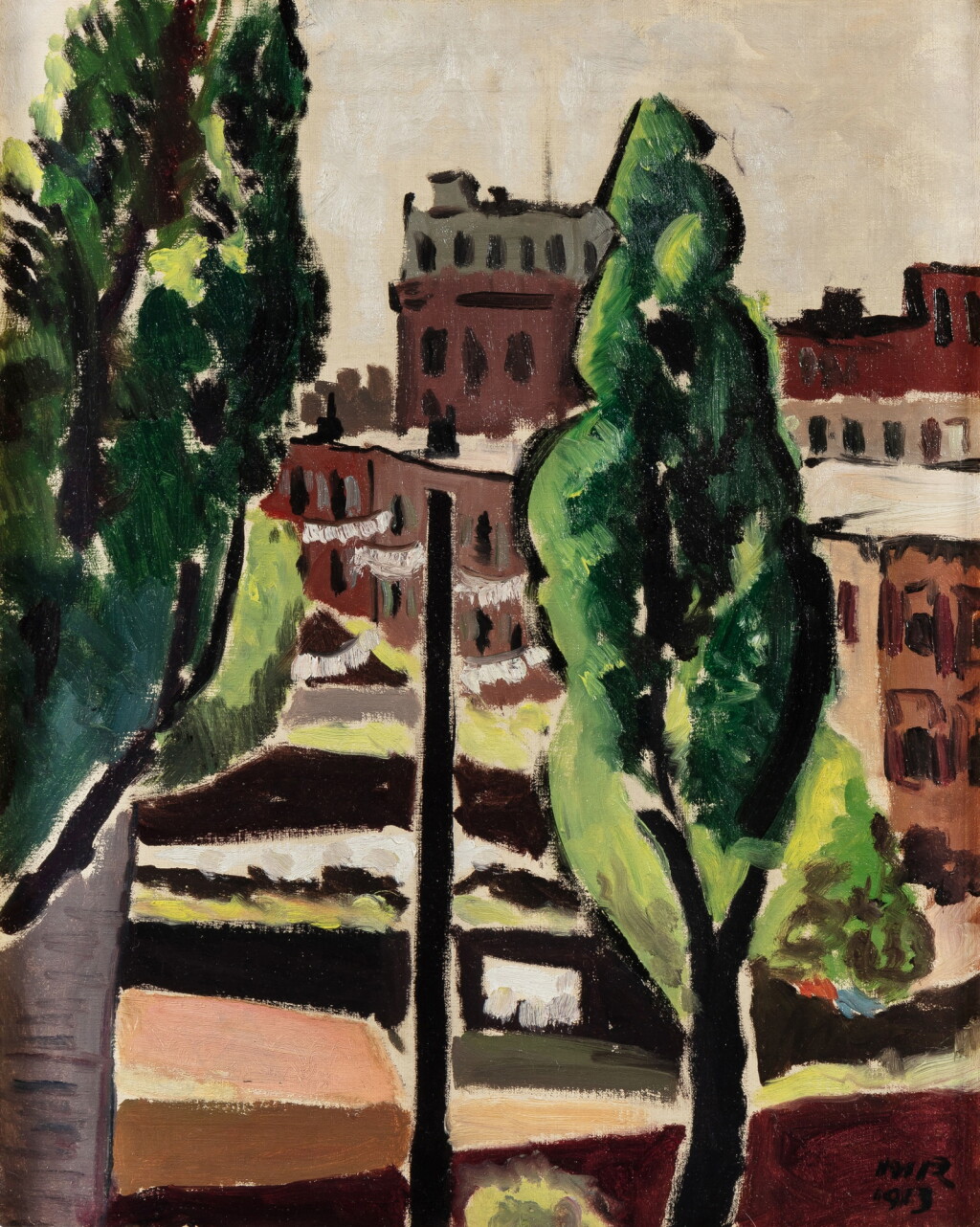
Landscape (A Tree Grows in Brooklyn)
signed with the initials MR and dated 1913 (lower right)
oil on canvas
50,9 x 41 cm; 20 x 16⅛ in.
Executed in 1913.
Andrew Strauss and Timothy Baum of the Man Ray Expertise Committee have confirmed the authenticity of this work under reference 00593-P-2025 and that it will be included in the Catalogue of Paintings of Man Ray, currently in preparation.
Elsie Ray Siegler, New Jersey (the artist's sister)
Naomi Savage, Princeton (by descent from the above)
Hollis Taggart Galleries, New York (acquired from the above)
Sotheby's New York, 5 November 2004, lot 241 (consigned by the above)
Private collection, USA (acquired at the above sale)
Private collection, Europe
Sotheby's New York, 17 May 2017, lot 150 (consigned by the above)
Acquired from the above by the present owner
New York, The Daniel Gallery, Exhibition of Drawings and Paintings by Man Ray, 1915 (probably)
New York, Francis M. Naumann Fine Art, Man Ray in America, Paintings, Drawings, Sculpture, and Photographs from the New York/Ridgefield (1912-21) and Hollywood (1940-50) years, 2001-02, pl. 9, p. 28, illustrated in colour
New Jersey, Montclair Art Museum; Athens, Georgia Museum of Art and Chicago, Terra Museum of American Art, Conversion to Modernism: The Early Work of Man Ray, 2003-04, no. 68, p. 56, illustrated in colour (titled Ridgefield Landscape (A Tree Grows in Brooklyn)
Carl Belz, The Role of Man Ray in Dada and Surrealist Movements, Princeton, 1963, fig. 10, illustrated and p. 57, discussed
Painted when the artist was only twenty-three, Landscape (A Tree Grows in Brooklyn), was executed during a year which saw significant developments in Man Ray's artistic output. On February 17, 1913, The International Exhibition of Modern Art - known to posterity as the Armory Show- opened in New York. Exhibiting the work of the European avant-garde in New York for the first time, including pieces by Duchamp, Brancusi and Matisse among others, the show exerted a profound influence on the young Man Ray. The artist later told Arturo Schwarz that the show acted on him as "an encouragement. All the contacts I made were to encourage me to pursue the way I had already chosen, to confirm my own intentions, as it were. I had a clear, firm will at the time. I knew what I wanted to do" (quoted in Arturo Schwarz, Man Ray, The Rigour of Imagination, London, 1977, pp. 25-26).
Likely painted in Brooklyn where he was brought up, this canvas displays the influence of German Expressionism. The year 1913 also marked a turning-point for Man Ray in that he moved into his first studio in Ridgefield just outside New York. It was not long before Ridgefield became a magnet for artists and writers, including the poets William Carlos Williams and Alanson Hartpence. Of greater personal significance for Man Ray was his meeting with Adon Lacroix, who was to become his wife in 1914. The move acted as a creative spur for the artist, and as a result the works he created during this time are imbued with a newly assured confidence of handling and line. With its flattened planed and bold daubs of paint, Landscape (A Tree Grows in Brooklyn) showcases these newfound stylistic tendencies to powerful effect.
The painting's alternate title, A Tree Grows in Brooklyn, was coined by the artist himself upon revisiting the work at the Princeton Art Museum in 1963; the title refers to the eponymous novel by Betty Smith published in 1943 which was subsequently made into a popular movie.
You May Also Like