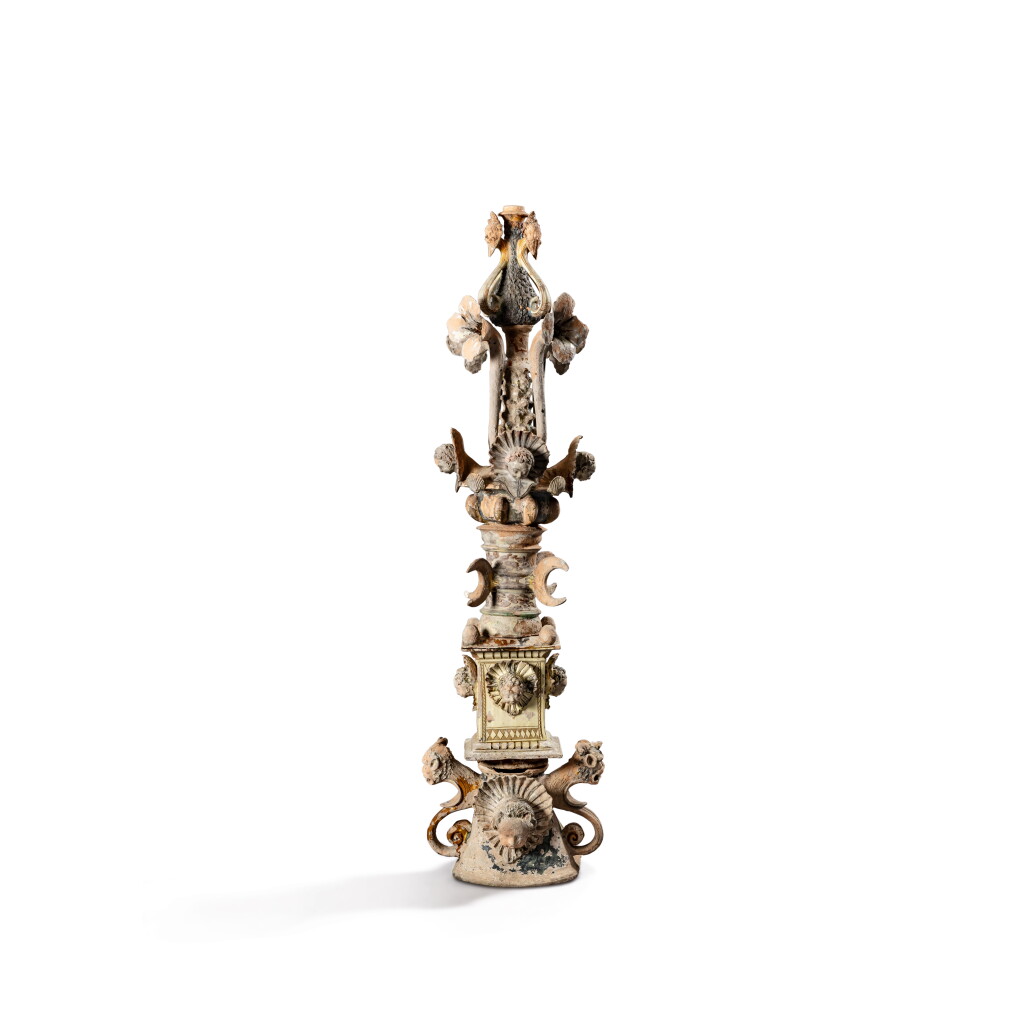
A Pré d'Auge or Manerbe glazed earthenware roof finial, early 17th century
Lot Closed
September 23, 01:16 PM GMT
Estimate
6,000 - 8,000 EUR
We may charge or debit your saved payment method subject to the terms set out in our Conditions of Business for Buyers.
Read more.Lot Details
Description
decorated with cherubs' heads before shells, faun masks, crescent moons and flowers
Haut. 169 cm ; Height 66 1/2 in
These elaborate roof finials or épis-de-faîtages are thought to have been made in the Pré d’Auge or possibly at Manerbe near Lisieux in the Calvados region of Normandy. They are an amalgamation of Italian and French inspiration and Medieval and Renaissance techniques, with some local accents, which together bring a distinctive element to the Normandy skyline.
The overall composition owes something to the Italian Renaissance as seen in the elongated decorative panels of grotteschi engraved by Giovanni Pietro da Birago and Giovanni Antonio da Brescia and later the designs of Etienne Delaune. Their fabrication demonstrates an evolution of the encaustic work of local tile makers and the more refined faience of Saint-Prochaire and undoubtedly the influence of the “grottier et architecte des rustiques figulines du roy et de la royne”, Bernard Palissy and his followers. A similar épis-de-faîtage, with masks, is in the Petit Palais museum in Paris (ODUT1164).
Early roof finials were often formed as models of birds or figures covered in simple glazes but became more ambitious, being composed of several elements designed to fit together on a metal pole with increasingly complex ornament. The present example features crescent moons, flowers, cherub heads, shells and faun masks, supported above and below a square section architectural pediment.
Pré d’Auge and Manerbe were the centres for the production of ceramics in Normandy. Along with paving tiles, the manufacture of roof finials was a particularly important characteristic of the region from the late 15th to the 17th century. Ornate and brightly coloured, these were used to adorn the grand buildings and manors of the region and they were also prized at the courts of Henri IV and Louis XIII. Whilst they had fallen out of favour by the end of the 17th century, production continued into the 18th century before finally ceasing by the end of the century.
A number of articles in the 19th century saw an increase in interest from collectors in these early architectural gems and their popularity led to a revival in production. In the early 20th century, the definitive work was produced by Étienne Deville who lists numerous examples in French museums, private collections as well as those intact at the time of publication; see E. Deville, La céramique du pays d’Auge: l’art de terre à Manerbe et au Pré-d’Auge, Paris, 1927. A finial in the form of a mermaid with comb and mirror is in the collection of the Victoria & Albert Museum, London (accession no. 655:1-1906). A roof finial of this type was sold from the collection of Danny Katz, Sotheby's London, 27 May 2020, lot 83.
You May Also Like